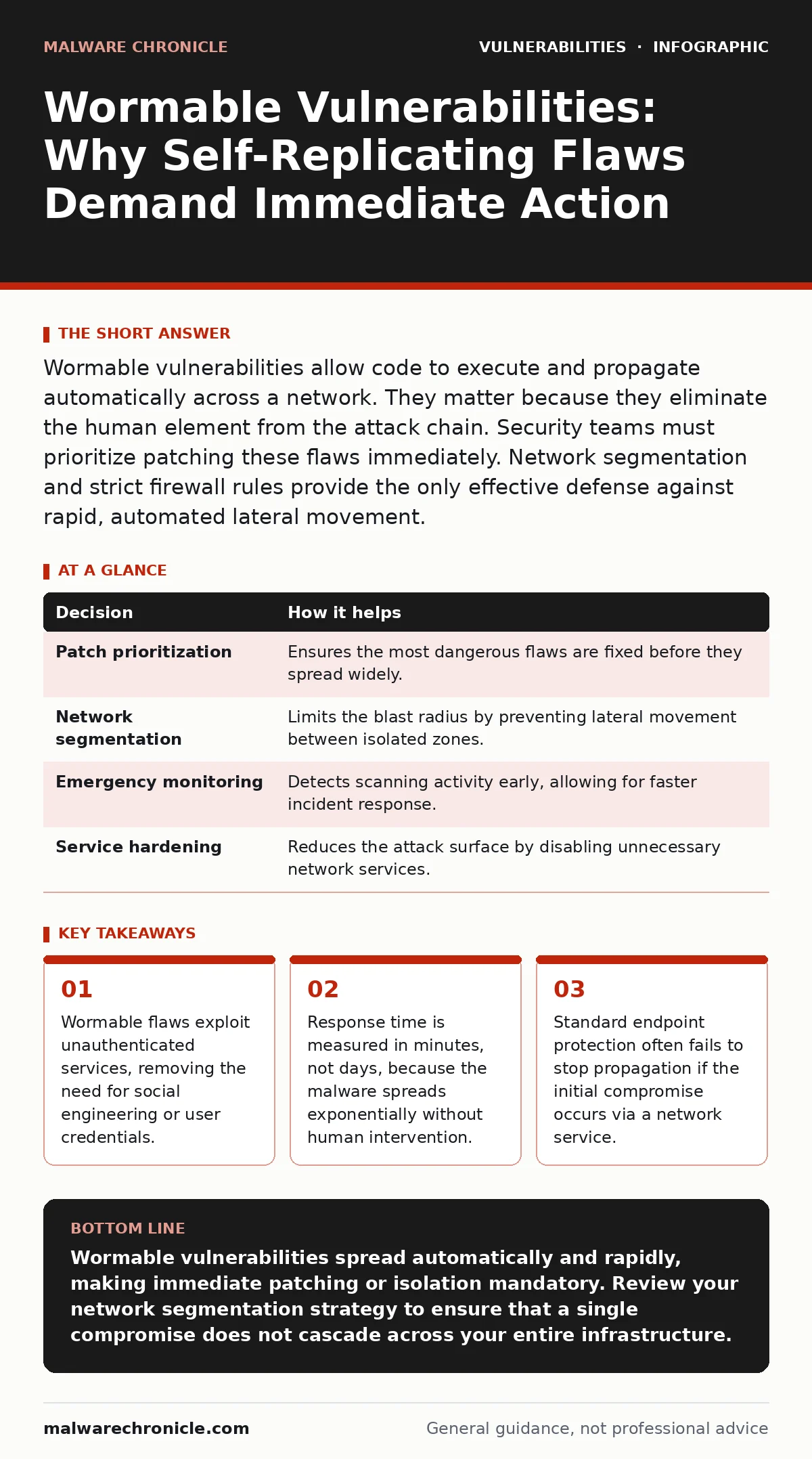
Wormable vulnerabilities allow code to execute and propagate automatically across a network. They matter because they eliminate the human element from the attack chain. Security teams must prioritize patching these flaws immediately. Network segmentation and strict firewall rules provide the only effective defense against rapid, automated lateral movement.
Defining the Wormable Threat Model
A wormable vulnerability is a software flaw that allows an attacker to execute code remotely without requiring user interaction. Unlike typical exploits, these flaws do not depend on a victim opening an email attachment or visiting a malicious website. The attack happens automatically when two systems communicate. This characteristic changes the risk profile entirely. You are no longer protecting against a targeted attempt. You are defending against a broadcast signal that any connected device can receive. The mechanism relies on unauthenticated access to network services. If a service listens for incoming connections and processes data incorrectly, it becomes a potential entry point.
The Speed of Automated Propagation
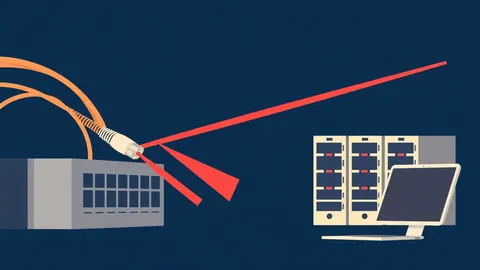
Imagine a flaw in a file-sharing protocol. An attacker sends a crafted packet to one machine. That machine executes the malicious code. The code then scans the local network for other machines running the same vulnerable protocol. It sends the same packet to them. This cycle repeats. The number of infected systems doubles with each cycle.
This exponential growth means that a single entry point can compromise an entire organization in minutes. Human defenders cannot react fast enough to stop this spread manually. You cannot call every user to disconnect their machines. The speed of propagation exceeds the speed of human decision-making. This is why wormable vulnerabilities are treated with higher urgency than other flaws.
Decisions Informed by Wormability Classification
Identifying a vulnerability as wormable changes how you allocate resources. It shifts the priority from risk assessment to immediate containment. You must decide whether to patch now or isolate the affected systems. If the patch is not ready, isolation is the only safe option. You also decide how to monitor network traffic for signs of scanning activity. These decisions require a clear understanding of the attack vector. The classification helps you determine which systems are exposed. It tells you whether the flaw affects internal services or public-facing endpoints. This clarity prevents wasted effort on low-risk systems.
| Decision | How it helps |
|---|---|
| Patch prioritization | Ensures the most dangerous flaws are fixed before they spread widely. |
| Network segmentation | Limits the blast radius by preventing lateral movement between isolated zones. |
| Emergency monitoring | Detects scanning activity early, allowing for faster incident response. |
| Service hardening | Reduces the attack surface by disabling unnecessary network services. |
What Goes Wrong Without Classification
Teams that treat all vulnerabilities equally face severe consequences. They may spend weeks testing a patch for a wormable flaw while the malware spreads unchecked. By the time the patch is deployed, the damage is done. The attacker has already moved laterally across the network. They have accessed sensitive data and established persistence.
The lack of classification leads to a false sense of security. Teams assume that standard vulnerability management processes are sufficient. They are not. Wormable flaws require a different playbook. Without recognizing the unique threat, teams fail to implement the necessary containment measures. This delay allows the attacker to operate freely within the environment.
How Teams Use Wormability Data
Security operations centers use wormability data to trigger specific alerts. They configure intrusion detection systems to look for known exploit signatures. These signatures are tied to specific network ports and protocols. When traffic matches the signature, the system blocks it. Teams also use this data to guide their infrastructure as code scanning efforts.
They ensure that new deployments do not include vulnerable services. This proactive approach prevents the introduction of new entry points. Teams also review their firewall rules to ensure that unnecessary ports are closed. This reduces the likelihood of an attacker finding an open door. The data informs both defensive and preventive strategies.
See also: Difference Between Network Scanning and Port Scanning: How to Detect and Respond · SYN Flood Attack Response: Containment, Recovery, and Prevention Steps
The Hidden Cost of Delay
The cost of delaying action on wormable vulnerabilities is not just financial. It is reputational and operational. A widespread infection can take down critical services. This leads to downtime that affects customers and partners. Restoring systems from backups takes time. During this time, the organization cannot operate. The hidden cost is the loss of trust. Customers and partners lose confidence in the organization’s ability to protect their data. This loss of trust is hard to recover. It affects future business opportunities. The cost is also in the resources required to investigate and remediate the breach. This diverts attention from other important security initiatives.
Integrating with Broader Security Practices
Addressing wormable vulnerabilities requires a holistic approach. You must combine patch management with network security. Configuration hardening plays a key role here. By disabling unnecessary services, you reduce the number of potential entry points. You must also consider silent security patches. These patches fix flaws without requiring a restart.
They are useful for maintaining availability while fixing critical issues. Teams should also review their browser updates process. While browsers are not the primary target for wormable flaws, they can be part of the attack chain. Keeping all software up to date is a fundamental defense. This includes firmware updates for network devices. These devices often run unpatched services that can be exploited.
The Role of Specific Vulnerability Types
Some vulnerability types are more likely to be wormable than others. Memory corruption flaws, such as buffer overflows, are common targets. These flaws allow an attacker to execute arbitrary code. PHP application vulnerabilities can also be wormable if they allow remote code execution. PHP object injection is another example.
It allows an attacker to serialize and deserialize objects in a way that executes code. Understanding these specific types helps you prioritize your testing efforts. You should focus on services that handle untrusted input. These services are the most likely to contain wormable flaws. Regular code reviews and penetration testing can help identify these issues early.
Key takeaways
- Wormable flaws exploit unauthenticated services, removing the need for social engineering or user credentials.
- Response time is measured in minutes, not days, because the malware spreads exponentially without human intervention.
- Standard endpoint protection often fails to stop propagation if the initial compromise occurs via a network service.
Wormable vulnerabilities spread automatically and rapidly, making immediate patching or isolation mandatory. Review your network segmentation strategy to ensure that a single compromise does not cascade across your entire infrastructure.
Frequently asked questions
How do I know if a vulnerability is wormable?
Check the vulnerability description for remote code execution without authentication. If the flaw allows an attacker to send a packet that executes code, it is likely wormable.
Can firewalls stop wormable malware?
Firewalls can block the initial attack if configured to deny traffic to vulnerable ports. They cannot stop malware that has already entered the network.
What is the difference between a worm and a virus?
A worm replicates itself automatically across networks. A virus requires a host file and user action to spread. Worms are faster and more dangerous.
Should I disable all network services?
No, disable only the services that are not necessary for your operations. Every open port is a potential entry point. Minimize the attack surface.
How this guide was produced: written by the Malware Chronicle editorial team with AI assistance, checked against the public references listed below, and reviewed when the facts change. See our editorial policy or report an error.