
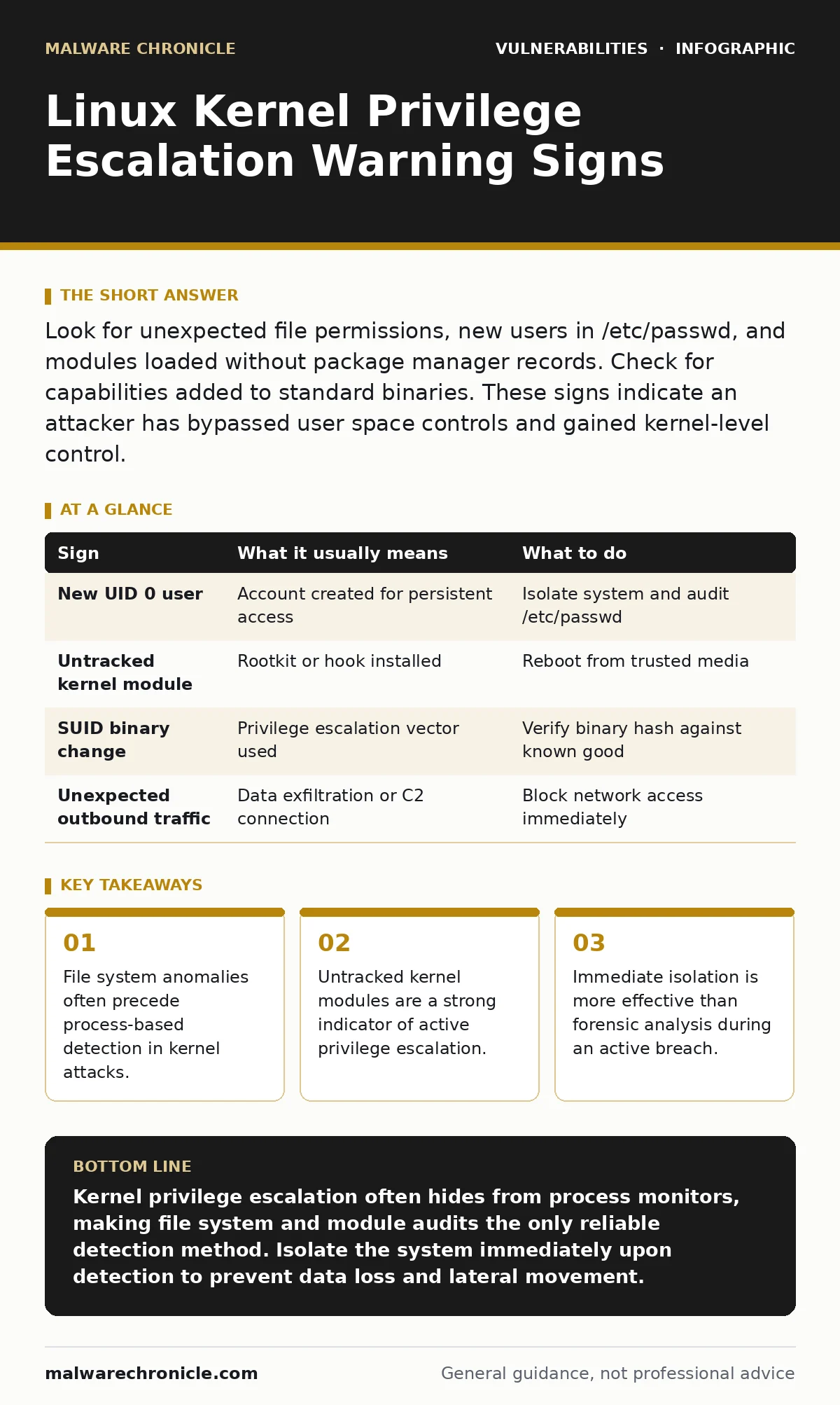
Look for unexpected file permissions, new users in /etc/passwd, and modules loaded without package manager records. Check for capabilities added to standard binaries. These signs indicate an attacker has bypassed user space controls and gained kernel-level control.
Early Warning Signs of Kernel Compromise
Kernel privilege escalation attacks often bypass traditional monitoring because they operate below the user space layer. You will notice these signs first when system behavior deviates from expected baselines. The most common early indicator is the appearance of new files in system directories like /tmp or /dev/shm. These files often have executable permissions and unusual names. Another sign is the sudden presence of new user accounts with UID 0. Check the /etc/passwd file for entries that were not created through your standard provisioning tools.
Process lists may show commands running with unexpected capabilities. Standard utilities like ping or find might possess elevated permissions they do not normally hold. This happens when an attacker uses the setuid bit or Linux capabilities to grant a binary root access. You should also watch for network connections originating from non-daemon processes. A text editor or a shell script initiating outbound traffic is a clear anomaly.
Subtle Indicators That Are Easy to Miss
Many kernel exploits leave no persistent process footprint. The attack code executes in memory and then self-deletes. You will miss these if you only monitor running processes. Instead, look for changes in file metadata. Modification times that do not align with package updates suggest manual tampering. Check for files that have changed ownership to root without a corresponding system update. This is a silent sign that a script has executed with elevated privileges.
Kernel module loading is another hidden vector. Attackers often load custom modules to hook system calls. These modules do not appear in standard package lists. You must verify that every loaded module corresponds to a known driver or feature. Discrepancies here indicate that the kernel itself has been modified at runtime. This bypasses application-level security controls entirely.
The Role of Security Misconfigurations
Privilege escalation is rarely a pure code flaw. It usually exploits a configuration error that allows an unprivileged user to interact with privileged resources. Security misconfigurations often leave debug interfaces open or allow unauthenticated access to system management tools. These errors create the initial foothold. An attacker then uses this access to trigger a kernel vulnerability. Fixing the misconfiguration removes the attack surface, even if the underlying kernel bug remains.
Immediate Response Steps
When you detect a sign of kernel compromise, stop all investigation and isolate the system. Do not attempt to kill processes or delete files. The attacker may have hooks in the kernel that trigger on such actions. This can cause data corruption or evidence destruction. Disconnect the machine from the network immediately. This prevents lateral movement and data exfiltration. Preserve the memory state for later analysis.
After isolation, verify the integrity of the boot process. Check for unauthorized changes to the bootloader or kernel image. If the kernel is compromised, you must rebuild the system from trusted media. Do not trust binaries on the compromised drive. Use a known-good installation source. This ensures that no backdoors remain in the system libraries or kernel modules.
Detection Table for Common Signs
| Sign | What it usually means | What to do |
|---|---|---|
| New UID 0 user | Account created for persistent access | Isolate system and audit /etc/passwd |
| Untracked kernel module | Rootkit or hook installed | Reboot from trusted media |
| SUID binary change | Privilege escalation vector used | Verify binary hash against known good |
| Unexpected outbound traffic | Data exfiltration or C2 connection | Block network access immediately |
Preventing Future Escalation
Prevention requires a strict approach to system updates and access control. Apply kernel patches as soon as they are released. Delaying updates leaves known vulnerabilities open to exploitation. Implement least privilege access for all users and services. This limits the damage if an attacker gains initial access. Regular penetration testing helps identify configuration errors before attackers do.
The Hidden Cost of Delayed Detection
Kernel compromises are dangerous because they persist across reboots if the kernel image is modified. Standard antivirus tools often miss these changes. They scan user-space files, not the kernel memory space. This creates a false sense of security. You might think the system is clean because no malware is found in /home or /opt. However, the kernel itself is compromised. This allows the attacker to hide their activities from standard monitoring tools.
Understanding Zero-Click Exploits
Some attacks require no user interaction. Zero-click exploits trigger automatically when the system processes network data. These are rare in Linux kernels but possible in network stack handlers. They bypass all user-space defenses. The only protection is network segmentation and strict firewall rules. Limit the exposure of kernel services to untrusted networks. This reduces the chance of a zero-click trigger.
Key takeaways
- File system anomalies often precede process-based detection in kernel attacks.
- Untracked kernel modules are a strong indicator of active privilege escalation.
- Immediate isolation is more effective than forensic analysis during an active breach.
Kernel privilege escalation often hides from process monitors, making file system and module audits the only reliable detection method. Isolate the system immediately upon detection to prevent data loss and lateral movement.
Frequently asked questions
How do I check for unauthorized kernel modules?
Use the lsmod command to list loaded modules. Compare this list against your known hardware and drivers. Any module not associated with a physical device or standard service is suspicious.
Can a kernel exploit survive a reboot?
Yes, if the attacker modifies the kernel image or bootloader. If the exploit is only in memory, a reboot clears it. Always verify the integrity of the boot process after a suspected compromise.
What is the difference between user space and kernel space?
User space runs applications. Kernel space runs the operating system core. Kernel space has full access to hardware and memory. A compromise in kernel space is far more severe than in user space.
How do I verify binary integrity?
Use cryptographic hashes like SHA-256. Compare the hash of the binary on your system with the hash from the official package repository. Any mismatch indicates tampering or corruption.
How this guide was produced: written by the Malware Chronicle editorial team with AI assistance, checked against the public references listed below, and reviewed when the facts change. See our editorial policy or report an error.