
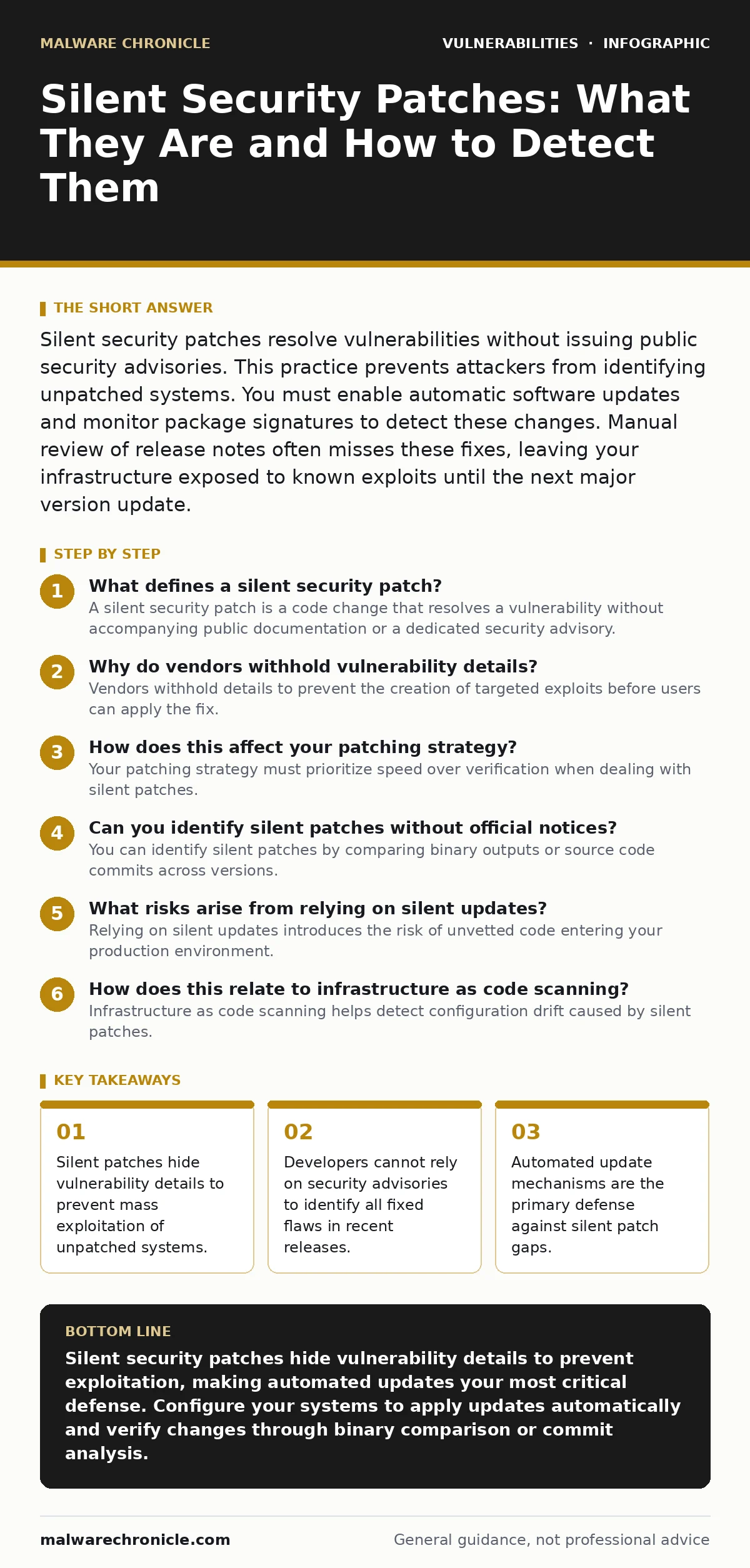
Silent security patches resolve vulnerabilities without issuing public security advisories. This practice prevents attackers from identifying unpatched systems. You must enable automatic software updates and monitor package signatures to detect these changes. Manual review of release notes often misses these fixes, leaving your infrastructure exposed to known exploits until the next major version update.
What defines a silent security patch?
A silent security patch is a code change that resolves a vulnerability without accompanying public documentation or a dedicated security advisory. Developers apply these fixes directly within standard maintenance releases. The goal is to limit the window of opportunity for attackers who scan for newly disclosed flaws. This approach reduces the time between patch availability and widespread adoption. You receive the fix alongside feature updates or minor bug corrections. The absence of a public warning means you cannot manually verify the fix without inspecting the source code or binary differences.
Why do vendors withhold vulnerability details?
Vendors withhold details to prevent the creation of targeted exploits before users can apply the fix. Public disclosure creates a race condition between patching and exploitation. Attackers monitor security advisories to identify systems that have not yet updated. By keeping the flaw quiet, vendors reduce the incentive for immediate weaponization. This strategy assumes that most users rely on automatic software updates rather than manual checks. It shifts the burden from user awareness to system automation. The trade-off is reduced transparency for security researchers and auditors who need visibility into the threat model.
How does this affect your patching strategy?
Your patching strategy must prioritize speed over verification when dealing with silent patches. You cannot wait for a detailed impact assessment before applying updates. Delaying installation leaves your systems vulnerable to unknown threats. You must trust the vendor’s integrity and the security of the update pipeline. Implementing strict version control helps you track which components require immediate attention. You should treat every minor release as a potential security fix. This mindset reduces the mean time to remediation. It also requires a robust testing environment to catch regressions introduced by the patch.
Can you identify silent patches without official notices?
You can identify silent patches by comparing binary outputs or source code commits across versions. Tools that perform differential analysis highlight changes in logic flow and memory handling. Look for modifications in input validation routines or error handling paths. These areas often contain fixes for injection flaws or buffer overflows. If the changelog mentions "stability improvements" or "internal optimizations," assume a security fix is present. This method requires significant technical effort and access to the source. It is not feasible for all teams but provides necessary insight for critical infrastructure.
| Detection Method | Effort Level | Reliability | Best Use Case |
|---|---|---|---|
| Changelog Review | Low | Low | Quick triage of minor updates |
| Binary Diffing | High | High | Critical infrastructure components |
| Commit History Analysis | Medium | Medium | Open-source dependencies |
| Automated Update Logs | Low | High | Large-scale fleet management |
What risks arise from relying on silent updates?
Relying on silent updates introduces the risk of unvetted code entering your production environment. You lose the ability to assess the severity and scope of the fix. This lack of transparency can lead to compliance violations in regulated industries. Auditors require evidence of vulnerability management and risk assessment. Silent patches make it difficult to demonstrate due diligence. You may also introduce new bugs that are not flagged as security issues. The absence of a public bug bounty or community review means errors may persist longer. You must balance speed with rigorous automated testing.
See also: VEX Documents: How Small Teams Manage Vulnerability Exceptions · Out-of-Band Patches: How Emergency Fixes Protect Your Systems
How does this relate to infrastructure as code scanning?
Infrastructure as code scanning helps detect configuration drift caused by silent patches. When underlying libraries change, your deployment scripts may become invalid or insecure. Scanning tools verify that your infrastructure definitions align with the current software state. This ensures that security controls remain effective after updates. You must integrate scanning into your continuous integration pipeline. This catches issues before they reach production. It also helps identify dependencies that may have been updated silently. Regular scanning reduces the attack surface by ensuring consistency across environments.
Do silent patches address wormable vulnerabilities?
Silent patches often address wormable vulnerabilities to prevent rapid, automated spread. These flaws allow attackers to propagate malware without user interaction. Public disclosure would trigger immediate exploitation by botnets. Vendors prioritize silent fixes for these high-risk issues. You must assume that any network-facing component could be targeted. Enable network segmentation to limit lateral movement. Monitor for unusual traffic patterns that indicate exploitation. Silent patching buys time for widespread adoption. It does not eliminate the need for defensive network architecture.
What is the impact on security advisories?
Security advisories become less comprehensive when vendors use silent patching. You cannot rely on them for a complete picture of your risk posture. Advisories may only highlight critical flaws while ignoring moderate risks. This creates a false sense of security for systems not mentioned in reports. You must supplement advisories with internal monitoring and threat intelligence. Subscribe to vendor mailing lists for early notifications. Engage with community forums to gather anecdotal evidence. This multi-source approach ensures you do not miss critical updates.
How do developers verify silent fixes?
Developers verify silent fixes by analyzing code commits and running regression tests. You must examine the specific functions modified in the release. Check for changes in input sanitization, authentication logic, and memory management. Automated testing frameworks can detect behavioral changes. You should also review dependency trees for transitive updates. Silent patches in third-party libraries often propagate to your application. Verify that the fix does not introduce new vulnerabilities. Document the verification process for audit purposes. This ensures accountability and transparency in your development lifecycle.
What should you do if you cannot apply updates immediately?
If you cannot apply updates immediately, you must implement compensating controls. Restrict network access to the vulnerable component. Use web application firewalls to filter malicious traffic. Monitor logs for signs of exploitation. Isolate the affected system from critical assets. These measures reduce the risk of compromise. You must plan for a rapid update cycle as soon as possible. Silent patches do not provide long-term protection. Delaying updates increases the likelihood of a successful attack.
How does this compare to out-of-band security patches?
Out-of-band security patches are released separately from the regular schedule to address critical flaws. They are often accompanied by public advisories. Silent patches are integrated into regular releases to maintain stealth. Out-of-band patches require immediate attention and manual installation. Silent patches rely on automated update mechanisms. Both approaches aim to reduce exposure time. Out-of-band patches provide transparency and allow for detailed risk assessment. Silent patches prioritize speed and prevent targeted exploitation. You must support both processes in your infrastructure.
What is the role of automatic software updates?
Automatic software updates are the primary defense against silent security patches. They ensure that fixes are applied without manual intervention. This reduces the window of exposure to unknown threats. You must configure update policies to prioritize security over feature stability. Test updates in a staging environment before deployment. This catches compatibility issues early. Automatic updates also simplify compliance reporting. They provide a clear audit trail of patch adoption. You must monitor update failures to ensure continuous protection.
Key takeaways
- Silent patches hide vulnerability details to prevent mass exploitation of unpatched systems.
- Developers cannot rely on security advisories to identify all fixed flaws in recent releases.
- Automated update mechanisms are the primary defense against silent patch gaps.
- Binary comparison tools help detect changes when changelogs are vague or missing.
Silent security patches hide vulnerability details to prevent exploitation, making automated updates your most critical defense. Configure your systems to apply updates automatically and verify changes through binary comparison or commit analysis.
Frequently asked questions
Are silent patches illegal or unethical?
No, silent patches are a standard industry practice aimed at reducing exploitation windows. They are not illegal, but they may conflict with specific compliance requirements that mandate full disclosure.
Do open-source projects use silent patches?
Yes, open-source projects may use silent patches, especially for critical flaws. Contributors often merge fixes directly into the main branch without prior announcement.
How this guide was produced: written by the Malware Chronicle editorial team with AI assistance, checked against the public references listed below, and reviewed when the facts change. See our editorial policy or report an error.