
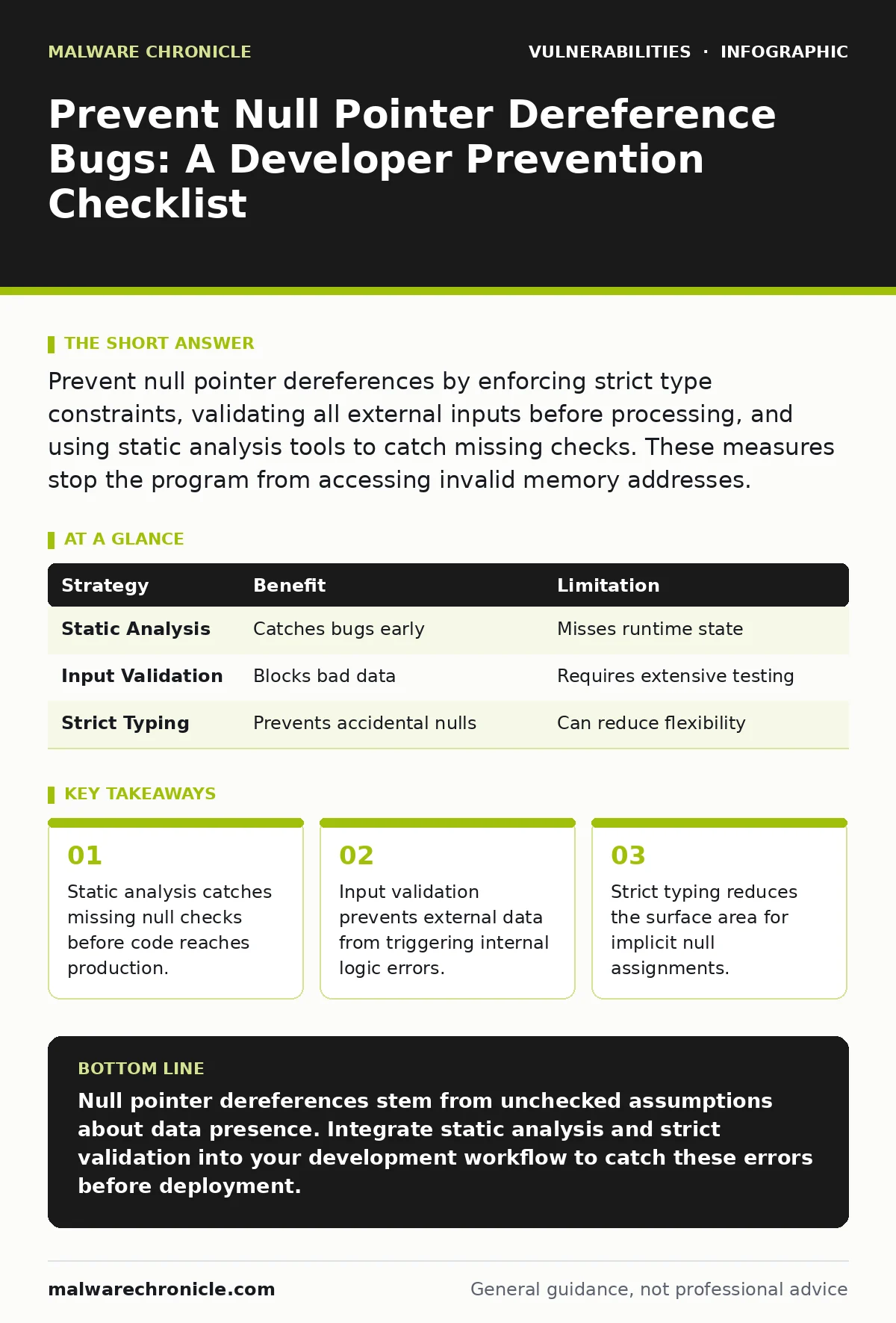
Prevent null pointer dereferences by enforcing strict type constraints, validating all external inputs before processing, and using static analysis tools to catch missing checks. These measures stop the program from accessing invalid memory addresses.
Define the Threat Model
Null pointer dereference bugs occur when software attempts to read or write to a memory address that does not exist. This happens when a variable holds a null value, which represents the absence of an object or data. The operating system detects this invalid access and terminates the process to protect system integrity. This termination is a denial of service. In some cases, an attacker can manipulate the memory layout to execute arbitrary code instead of crashing the program. You must treat null values as hostile inputs that bypass intended logic paths.
Enforce Strict Type Safety
Static type checking prevents variables from holding unexpected null values. Strongly typed languages restrict what values a variable can contain at compile time. This stops many null pointer issues before the program runs. Dynamic languages allow variables to change types freely, which increases the risk of accidental null assignments. You should enable strict mode in your development environment. This configuration forces explicit handling of null values rather than implicit conversions.
- Enable strict null checks in compiler settings: The compiler rejects code that might pass null to functions expecting valid objects.
- Use non-nullable types by default: Variables must hold actual data unless explicitly declared as optional.
- Avoid optional chaining without bounds checking: Chaining methods on potentially null objects can hide missing validation steps.
Validate External Inputs Thoroughly
External inputs include data from users, network requests, and files. This data often arrives in unexpected formats or missing entirely. Your code must validate every piece of external data before using it. Assuming data exists because it is in a required field is a common mistake. Malformed packets or truncated responses can result in null values during parsing. You must check for null after every parsing operation.
- Check for null after deserialization: Converting data formats often results in missing fields that become null values.
- Validate database query results: Queries may return no rows, resulting in a null object instead of an expected record.
- Inspect API response payloads: Third-party services may change their output format, sending null instead of expected data.
Apply Static Analysis Tools
Static application security testing (SAST) tools analyze source code without executing it. These tools identify paths where null values might propagate unchecked. They catch issues that human review often misses due to complexity or fatigue. Integrate SAST into your continuous integration pipeline. This ensures every code change is scanned for potential null pointer dereferences. The tool flags lines where a variable might be null at runtime. You must resolve these flags before merging code.
- Configure SAST rules for null pointer dereferences: Custom rules ensure the tool checks your specific framework patterns.
- Review false positives carefully: Some warnings are safe because context guarantees a value exists.
- Track suppression reasons: Documenting why a warning is ignored prevents future regressions.
Implement Defensive Coding Practices
Defensive coding assumes that errors will occur. You should design your code to handle missing data gracefully. This means providing default values or failing safely when null is encountered. Never assume a function returns a valid object. Check the return value immediately. If the value is null, handle it explicitly. This prevents the null from propagating to other parts of the system.
- Use factory methods that return valid objects: Constructors that might fail should return a safe default instead of null.
- Implement null object pattern: Replace null checks with objects that do nothing, simplifying logic flow.
- Fail fast on unexpected nulls: Throw an exception immediately rather than letting the error propagate silently.
See also: VEX Documents: How Small Teams Manage Vulnerability Exceptions · Silent Security Patches: What They Are and How to Detect Them
Review Memory Management Strategies
Manual memory management introduces high risk. When you allocate and free memory yourself, you can accidentally free an object while another thread holds a reference. This results in a dangling pointer, which is similar to a null pointer in its danger. Use garbage collected languages where possible. If you use manual memory management, ensure reference counting is correct. Every allocation must have a corresponding deallocation.
- Audit reference counting logic: Ensure every increment has a matching decrement to prevent use-after-free errors.
- Use smart pointers or equivalent: These wrappers automatically manage memory lifecycle, reducing manual errors.
- Isolate critical sections: Prevent concurrent access to shared resources that might become null during updates.
Monitor and Respond to Incidents
Even with prevention, bugs may slip through. You must monitor your applications for unexpected crashes. Log all null pointer exceptions with full stack traces. Analyze these logs to identify patterns. If a specific endpoint triggers crashes frequently, investigate the input handling. Update your validation rules based on these findings. This feedback loop strengthens your defenses over time.
- Centralize exception logging: Aggregate logs from all servers to spot systemic issues.
- Alert on frequency spikes: Sudden increases in null pointer errors indicate a new attack vector or bug.
- Update security advisories: Document known issues and fixes to help other teams avoid similar mistakes.
Understand Related Vulnerability Classes
Null pointer dereferences often overlap with other issues. Wormable vulnerabilities can exploit memory corruption to spread automatically. Least privilege access limits the damage if an exploit succeeds. Understanding speculative execution vulnerabilities helps explain why some crashes lead to data leaks. You should review guides on PHP application vulnerabilities and vulnerability scanning to build a broader defense. Responsible disclosure practices ensure you report findings safely.
| Strategy | Benefit | Limitation |
|---|---|---|
| Static Analysis | Catches bugs early | Misses runtime state |
| Input Validation | Blocks bad data | Requires extensive testing |
| Strict Typing | Prevents accidental nulls | Can reduce flexibility |
Key takeaways
- Static analysis catches missing null checks before code reaches production.
- Input validation prevents external data from triggering internal logic errors.
- Strict typing reduces the surface area for implicit null assignments.
Null pointer dereferences stem from unchecked assumptions about data presence. Integrate static analysis and strict validation into your development workflow to catch these errors before deployment.
Frequently asked questions
Does strict typing eliminate all null pointer bugs?
No, strict typing reduces the risk by enforcing rules at compile time, but runtime logic errors and external inputs can still introduce null values.
How do I handle null values in legacy code?
Wrap legacy components with adapter layers that validate inputs and provide default values, isolating the risky code from new features.
Can null pointer dereferences be exploited remotely?
Yes, if an attacker can control the input that triggers the dereference, they may manipulate memory to execute arbitrary code or crash the service.
Why do static analysis tools miss some null bugs?
Static tools analyze code structure without executing it, so they cannot detect null values that depend on complex runtime conditions or external data.
How this guide was produced: written by the Malware Chronicle editorial team with AI assistance, checked against the public references listed below, and reviewed when the facts change. See our editorial policy or report an error.