A Vulnerability Exploitability eXchange document allows your team to declare that a known security flaw in a software component does not affect your application. You create these records to stop scanning tools from flagging harmless issues. This reduces noise and lets you focus on real threats.
The Reality of Vulnerability Noise
This scenario wastes engineering time and causes unnecessary panic. You face a constant stream of alerts from dependency scanners. Most of these alerts are theoretical. The component exists in your project, but your code does not trigger the vulnerable path. VEX documents solve this mismatch. They allow you to document why a vulnerability is not actionable. This shifts your focus from noise to risk. You stop treating every library update as an emergency. You start treating security as a manageable engineering process. The noise reduction is immediate and significant for small teams with limited staff.
Understanding the VEX Mechanism
A VEX document is a structured file. It links a specific software component to a known vulnerability. It then states whether that vulnerability is exploitable in your specific context. The standard format is usually CycloneDX or SPDX. These are open standards for software bill of materials. You do not need a new tool to create them. You can integrate VEX generation into your existing build pipeline.
The document contains 4 main pieces of information. It lists the product. It lists the component. It references the vulnerability ID. It states the exploitability status. This status is usually "not_affected" or "affected". You must provide a justification for the status. This justification can be a code path analysis or a configuration check.
Why This Matters for Small Teams
Small teams cannot afford to ignore every alert. They also cannot fix every alert. VEX documents provide a middle ground. They allow you to accept risk where it does not matter. This is not about ignoring security. It is about prioritizing correctly. When you declare a vulnerability as not affecting your system, you are making a technical claim. This claim must be defensible. If you are wrong, you have a problem.
If you are right, you save hours of work. This efficiency is vital for teams with 1 to 10 developers. You free up time for actual feature development. You also improve your security posture by focusing on real threats. The process forces you to understand your dependencies better. This knowledge pays off in other areas, such as identifying hardcoded secrets in source code before they cause incidents.
Practical Steps for Implementation
Start by integrating a VEX generator into your CI/CD pipeline. Many modern build tools support this natively. You do not need to write documents manually. The tool analyzes your build artifacts. It maps components to vulnerabilities. It generates a draft VEX document. You review the draft. You confirm the justifications. This review step is critical. Automated tools can make mistakes. They might miss a subtle code path. You must verify the logic.
Once verified, you store the VEX document. You attach it to your release artifacts. This allows downstream users to trust your risk assessment. You can also use these documents to suppress alerts in your scanning tools. This creates a feedback loop. You scan, you verify, you document, you suppress. The cycle repeats with every build. This approach aligns well with infrastructure as code scanning practices, where consistency and automation are key to maintaining security standards.
Managing the Hidden Costs
VEX documents are not free. They require maintenance. When you update a library, the VEX document may change. You must regenerate it. If you change your code, the exploitability status may change. You must re-evaluate it. This adds complexity to your release process. You need a workflow to handle this. You need people who understand the code. This is a hidden cost. Small teams often underestimate this burden. They assume automation handles everything. It does not. You still need human judgment.
You need to decide which vulnerabilities to investigate. You need to document your decisions. This discipline prevents drift. It ensures your security data stays accurate. Without this discipline, your VEX documents become stale. Stale documents are worse than no documents. They give a false sense of security. You might think you are safe when you are not. This risk applies to any complex system, including those prone to Linux kernel privilege escalation if you manage low-level services.
See also: Responsible Disclosure: Weighing Benefits Against Real-World Limitations · Wormable Vulnerabilities: Why Self-Replicating Flaws Demand Immediate Action
What to Ask Your IT Provider
If you outsource your security operations, you must ensure they support VEX. Many providers do not. They treat every vulnerability as a high priority. They charge you to fix things that do not need fixing. You need a partner who understands context. Ask them specific questions. Do not accept vague promises. You need to know how they handle false positives.
You need to know if they support standard formats. You need to know who owns the justification. This clarity prevents billing surprises. It also ensures your security strategy is aligned with your engineering reality. You should also check if they can help you identify security misconfigurations that might make otherwise safe components vulnerable.
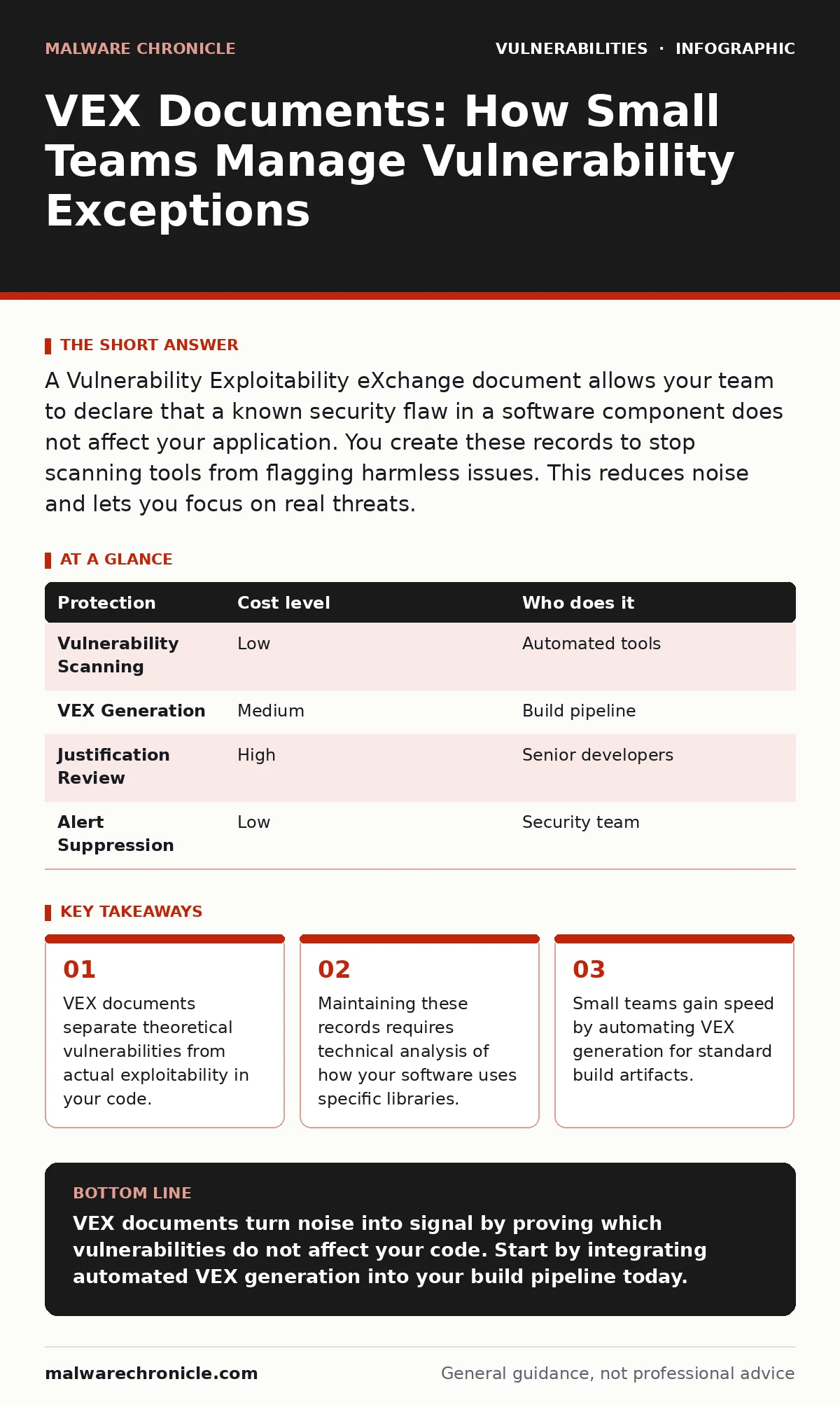
| Protection | Cost level | Who does it |
|---|---|---|
| Vulnerability Scanning | Low | Automated tools |
| VEX Generation | Medium | Build pipeline |
| Justification Review | High | Senior developers |
| Alert Suppression | Low | Security team |
Questions for Your Provider
- Do you support CycloneDX or SPDX VEX formats?
- How do you handle justification reviews for critical vulnerabilities?
- Can you integrate VEX documents into our existing scan reports?
- Who is responsible for updating VEX documents when libraries change?
- Do you charge per vulnerability fixed or per hour of analysis?
These questions reveal their maturity. A good provider will have clear answers. They will explain their process. They will not promise to eliminate all risk. They will promise to manage it effectively. This distinction matters. It separates vendors who sell fear from vendors who sell solutions. You want the latter. You want a partner who helps you sleep at night. You do not want a vendor who keeps you awake with alerts. Choose wisely. The right partner makes VEX a tool for efficiency. The wrong partner makes it a source of friction. This is similar to handling PHP application vulnerabilities, where understanding the specific framework context is often more valuable than generic patching.
Building a Sustainable Process
Sustainability requires consistency. You must treat VEX as part of your code. It is not an afterthought. It is a first-class citizen. You version control it. You review it in pull requests. You test it in staging. This rigor ensures quality. It also builds muscle memory. Your team learns to think about exploitability. They learn to question assumptions. This mindset shift is valuable. It improves your overall security culture. You become more resilient.
You handle incidents better. You recover faster. You trust your tools more. You trust your data more. This trust is the foundation of good security. It allows you to move fast without breaking things. It allows you to innovate safely. You are not just fixing bugs. You are building a system that understands itself. This self-awareness is your greatest asset. It protects you against null pointer dereference bugs and other subtle issues that scanners miss.
Key takeaways
- VEX documents separate theoretical vulnerabilities from actual exploitability in your code.
- Maintaining these records requires technical analysis of how your software uses specific libraries.
- Small teams gain speed by automating VEX generation for standard build artifacts.
VEX documents turn noise into signal by proving which vulnerabilities do not affect your code. Start by integrating automated VEX generation into your build pipeline today.
Frequently asked questions
Do VEX documents replace patching?
No, VEX documents only declare that a specific vulnerability is not exploitable in your context. You must still patch vulnerabilities that are exploitable or where you cannot prove safety.
Can I automate VEX justification?
You can automate the generation of the document structure and basic code path analysis. However, complex justifications often require human review to ensure accuracy and defensability.
What if my provider ignores VEX?
If your provider ignores VEX, you will pay for unnecessary remediation work. Consider switching providers or negotiating a contract that recognizes VEX-based risk reduction.
How long should I keep VEX documents?
Keep VEX documents as long as you keep the software version they describe. Once you upgrade the component, the old VEX document is obsolete. Archive it for audit purposes.
How this guide was produced: written by the Malware Chronicle editorial team with AI assistance, checked against the public references listed below, and reviewed when the facts change. See our editorial policy or report an error.