
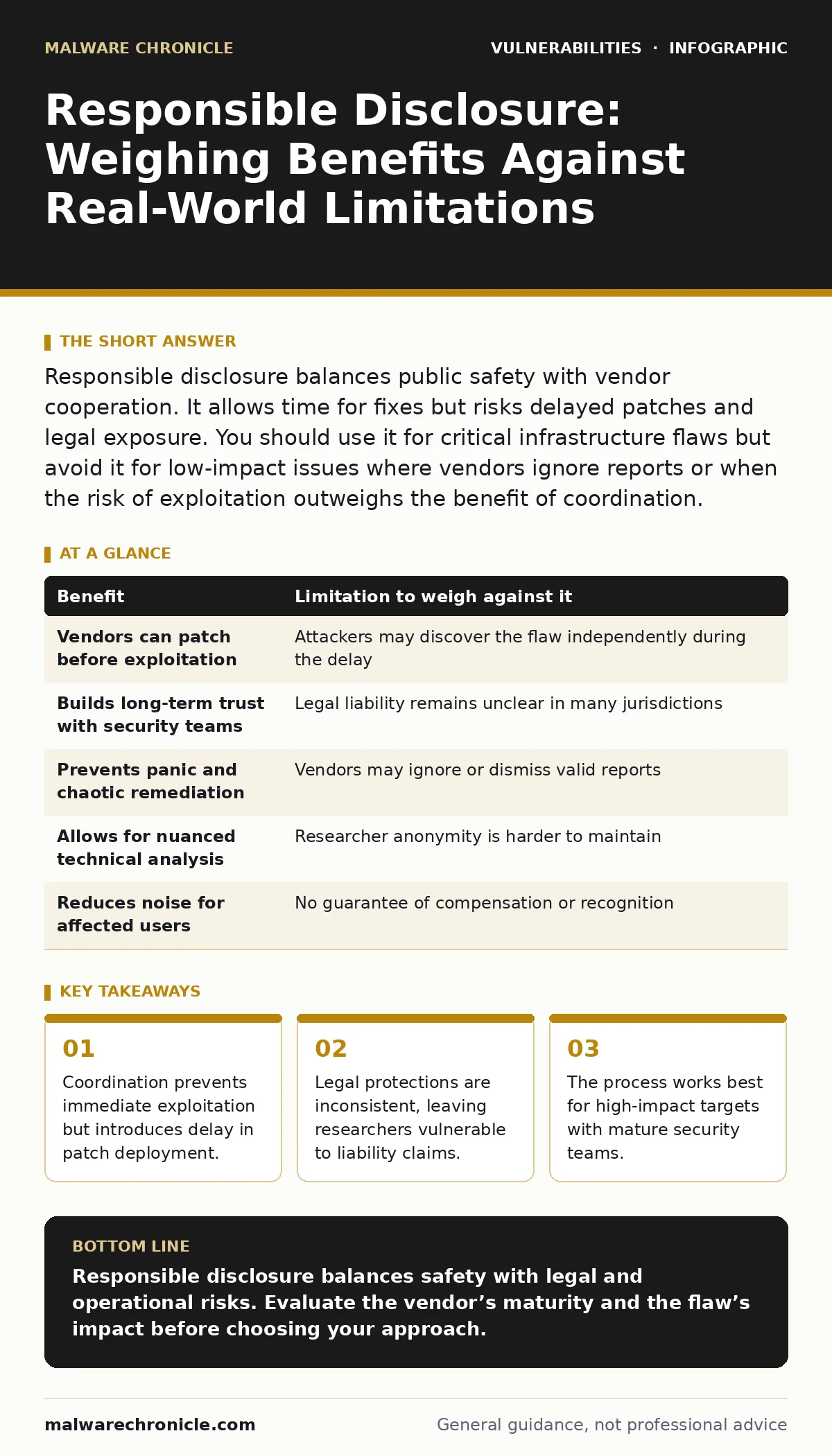
Responsible disclosure balances public safety with vendor cooperation. It allows time for fixes but risks delayed patches and legal exposure. You should use it for critical infrastructure flaws but avoid it for low-impact issues where vendors ignore reports or when the risk of exploitation outweighs the benefit of coordination.
The Mechanics of Coordinated Action
Responsible disclosure is the practice of reporting a security flaw to the vendor before making it public. You find a vulnerability, document the steps to reproduce it, and send this information to the organization that owns the affected system. The vendor then has a window to develop and deploy a fix. Only after that window closes do you release the details to the wider community.
This mechanism relies on trust. You trust the vendor to act quickly. The vendor trusts you not to exploit the flaw or sell it to adversaries. This cooperation aims to reduce the time systems remain exposed to attackers. However, the process introduces friction that does not exist in immediate public disclosure.
Imagine you discover a flaw in a widely used library. You report it privately. The vendor takes three months to patch it. During those three months, no one knows the flaw exists except you and the vendor. If an attacker discovers it independently, they have a head start. This delay is the primary hidden cost of responsible disclosure.
Weighing Benefits Against Limitations
Every disclosure strategy involves trade-offs. You must balance the safety of coordinated fixes against the risks of delay and legal exposure. The table below outlines the primary benefits and the specific limitations you must weigh against them.
| Benefit | Limitation to weigh against it |
|---|---|
| Vendors can patch before exploitation | Attackers may discover the flaw independently during the delay |
| Builds long-term trust with security teams | Legal liability remains unclear in many jurisdictions |
| Prevents panic and chaotic remediation | Vendors may ignore or dismiss valid reports |
| Allows for nuanced technical analysis | Researcher anonymity is harder to maintain |
| Reduces noise for affected users | No guarantee of compensation or recognition |
The benefit of trust is significant for long-term careers. A good relationship with a vendor can lead to future invitations for penetration testing or advisory roles. However, this trust is fragile. One perceived breach of confidentiality can end that relationship permanently.
The Hidden Cost of Delay
The most significant limitation of responsible disclosure is time. While you wait for a patch, the vulnerability remains a silent threat. This period is known as the "fix window." If the window is too long, the value of responsible disclosure diminishes.
Consider a flaw in a home router. If the vendor takes six months to patch it, millions of devices remain vulnerable. Attackers do not wait for your public report. They scan for the flaw continuously. In this scenario, the delay caused by responsible disclosure may actually increase the total number of compromised systems.
This is why context matters. A flaw in a bank’s core ledger requires careful coordination. A flaw in a personal blog theme may not. You must assess the potential for mass exploitation against the vendor’s historical response time. If the vendor has a poor track record, the delay becomes a liability rather than a safety measure.
Legal Exposure and Liability
Many researchers assume that responsible disclosure provides legal immunity. It does not. While some jurisdictions have laws protecting good-faith researchers, these laws are often vague or difficult to enforce. You may still face civil lawsuits or criminal charges if your testing causes disruption.
Vendors often include terms of service that prohibit unauthorized testing. Even if you report the issue, you have already violated their terms. This creates a legal gray area. You are breaking the rules to help them fix the rules.
To mitigate this risk, you should seek explicit permission before testing. Some organizations publish security policies that define acceptable testing scopes. If no such policy exists, you are operating without legal cover. This uncertainty is a major reason why many developers hesitate to report issues.
When It Is Worth It
Responsible disclosure is worth the effort when the potential impact is severe and the vendor is capable of responding. High-value targets like banking systems, healthcare platforms, and critical infrastructure benefit from coordination. These organizations have the resources to develop patches quickly.
It is also worth it when the flaw is complex and requires detailed explanation. If the vendor needs your help to understand the issue, private communication is more effective. You can provide proof-of-concept code and detailed logs without fear of public scrutiny.
Consider a flaw that affects IT asset inventory management. If the flaw allows an attacker to hide their presence in the system, public disclosure might alert them to cover their tracks. Private disclosure allows the vendor to patch the hole before the attacker realizes it has been found.
When It Is Not
Responsible disclosure is often a waste of time when the vendor is unresponsive or lacks the technical capacity to fix the issue. If a vendor ignores your reports for months, you are holding valuable information hostage. In these cases, public disclosure may be the only way to force action.
It is also not worth it for low-impact issues. A minor clickjacking flaw in a rarely visited page does not justify the legal risk and time investment. The effort required to coordinate with the vendor outweighs the benefit of a coordinated fix.
Furthermore, if the flaw is already known to attackers, responsible disclosure adds little value. If you find evidence that the flaw is being actively exploited, immediate public warning may be necessary. Waiting for a patch in this scenario leaves users exposed to a known threat.
The Role of Vendor Maturity
The success of responsible disclosure depends heavily on the vendor’s security maturity. Mature organizations have dedicated security teams and clear processes for handling reports. They acknowledge receipt, provide timelines, and communicate progress.
Immature organizations may lack these processes. Your report may go into a black hole. You may receive no acknowledgment or a generic response that ignores the severity of the issue. In these cases, you must decide whether to follow up, escalate, or go public.
This variability makes it difficult to apply a one-size-fits-all approach. You must evaluate each vendor individually. Look for signs of maturity, such as a published security policy or a history of timely patches. If these signs are absent, proceed with caution.
Integrating With Other Practices
Responsible disclosure works best when integrated with other security practices. For example, if you are performing patch testing, you may discover flaws that require responsible disclosure. The testing process itself should be designed to minimize disruption and respect the vendor’s systems.
Similarly, understanding configuration hardening can help you distinguish between a true vulnerability and a misconfiguration. Many reported "flaws" are actually security misconfigurations that the user can fix themselves. Reporting these as vulnerabilities wastes vendor resources and dilutes the priority of genuine flaws.
Finally, keeping your own tools updated is vital. Regular browser updates and system patches ensure that you are not inadvertently introducing vulnerabilities into your own environment while testing others. A secure testing environment is the foundation of credible disclosure.
Key takeaways
- Coordination prevents immediate exploitation but introduces delay in patch deployment.
- Legal protections are inconsistent, leaving researchers vulnerable to liability claims.
- The process works best for high-impact targets with mature security teams.
Responsible disclosure balances safety with legal and operational risks. Evaluate the vendor’s maturity and the flaw’s impact before choosing your approach.
Frequently asked questions
What is the difference between responsible and full disclosure?
Responsible disclosure involves notifying the vendor before making the details public. Full disclosure releases all details immediately, regardless of whether a patch exists.
How long should I wait before going public?
There is no standard timeframe. It depends on the severity of the flaw and the vendor’s response time. Generally, 90 days is a common benchmark, but this varies by context.
Can I be sued for responsible disclosure?
Yes, legal protections are not universal. Even with good intentions, you may face liability if your testing causes disruption or violates terms of service.
What if the vendor asks me to keep quiet indefinitely?
You should not agree to indefinite silence. Set a reasonable deadline for public disclosure. If the vendor cannot meet it, you must consider the risk of keeping the flaw secret.
How this guide was produced: written by the Malware Chronicle editorial team with AI assistance, checked against the public references listed below, and reviewed when the facts change. See our editorial policy or report an error.