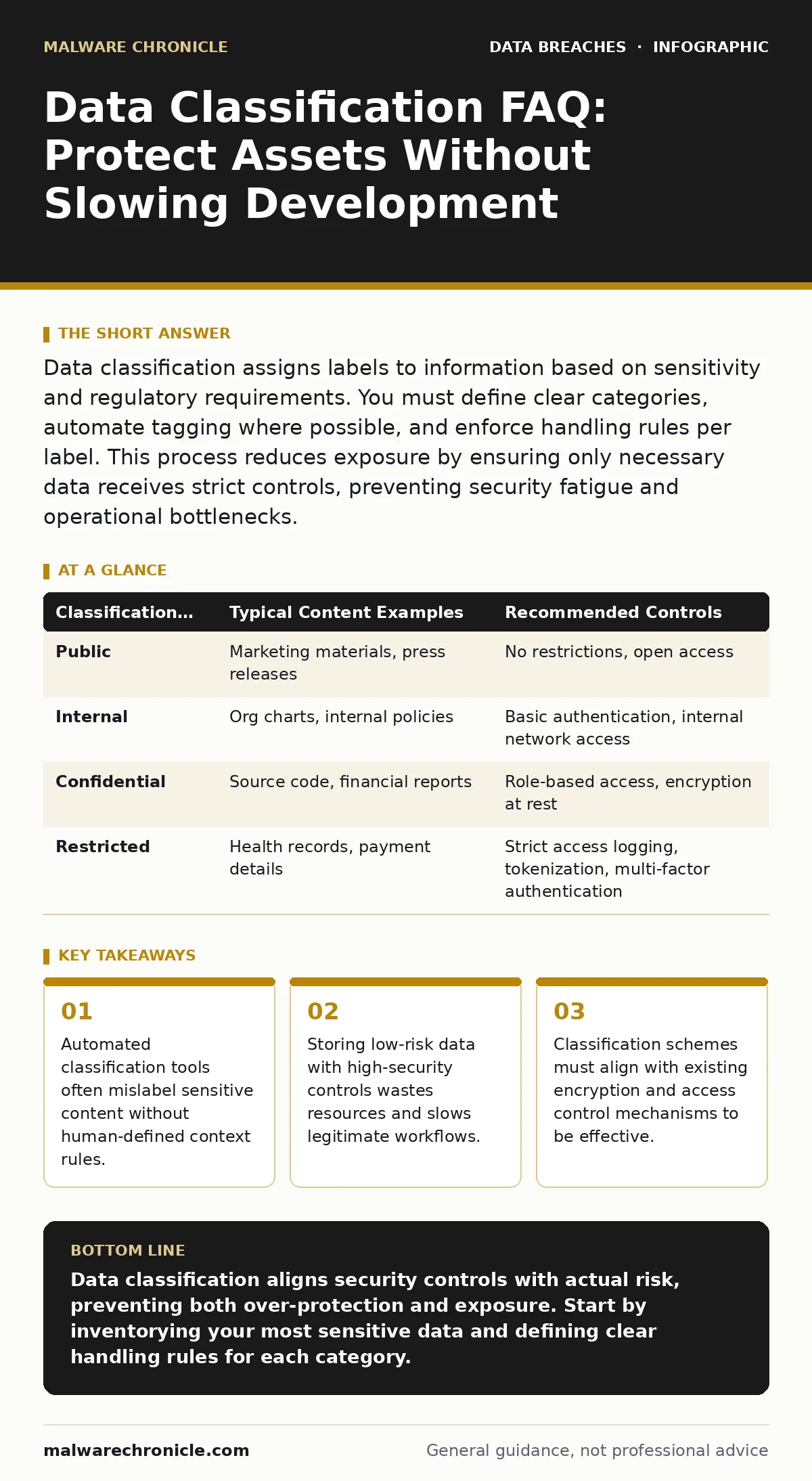
Data classification assigns labels to information based on sensitivity and regulatory requirements. You must define clear categories, automate tagging where possible, and enforce handling rules per label. This process reduces exposure by ensuring only necessary data receives strict controls, preventing security fatigue and operational bottlenecks.
What is data classification in cybersecurity?
Data classification is the process of categorizing information based on its sensitivity, criticality, and regulatory requirements. You group data into tiers such as public, internal, confidential, and restricted. Each tier dictates specific handling, storage, and access rules. This structure ensures that security controls match the actual risk of the data. Without classification, you apply uniform security to all assets, which creates unnecessary friction for low-risk items and leaves high-risk items potentially under-protected.
Why does classification matter for developers?
Developers handle data constantly, often moving it between environments without realizing the security implications. Classification provides a clear map of what data requires protection. When you know a database field contains sensitive personal data, you apply appropriate masking or encryption. This prevents accidental exposure in logs, debug outputs, or test environments. It also simplifies compliance audits by proving that you treat regulated information with the required level of care.
How do I choose a classification scheme?
You select a scheme that matches your organization’s risk appetite and legal obligations. A common approach uses 3 to 4 levels. Public data faces no restriction. Internal data supports business operations but lacks public release value. Confidential data requires access controls and encryption. Restricted data demands strict isolation, often with legal or financial penalties for exposure. The scheme must be simple enough for staff to understand but granular enough to drive specific technical controls.
| Classification Level | Typical Content Examples | Recommended Controls |
|---|---|---|
| Public | Marketing materials, press releases | No restrictions, open access |
| Internal | Org charts, internal policies | Basic authentication, internal network access |
| Confidential | Source code, financial reports | Role-based access, encryption at rest |
| Restricted | Health records, payment details | Strict access logging, tokenization, multi-factor authentication |
Can automation replace manual tagging?
Automation tools scan files and databases to suggest labels based on keywords or patterns. These tools reduce the burden on staff but introduce accuracy challenges. They may flag false positives, such as identifying a sample credit card number in a test script as real data. You must validate automated tags with spot checks and refine detection rules. Relying solely on automation without human oversight leads to misclassification, which undermines the entire security posture.
How does classification affect encryption choices?
Classification determines the strength and type of encryption you apply. Public data rarely needs encryption. Internal data may use standard transport layer security. Confidential and restricted data require strong encryption at rest and in transit. You must also manage keys separately from the data. If you encrypt everything uniformly, you complicate key management and degrade performance. Aligning encryption with classification ensures you protect high-value assets without crippling system speed.
See also: Tokenization Mistakes That Expose Data and How to Fix Them · Cloud Encryption Checklist: Protect Data in Transit and at Rest
What are the risks of misclassification?
Misclassification occurs when data receives the wrong label. Over-classification treats low-risk data as sensitive, wasting storage and processing power on unnecessary controls. Under-classification leaves sensitive data exposed to standard threats. Both errors create security debt. Under-classification is the greater risk because it leads to data breaches when attackers exploit unprotected assets. Regular audits help identify and correct these discrepancies before they cause harm.
How do I enforce classification policies?
Enforcement requires integrating labels into your security infrastructure. Access control systems must read classification tags to grant or deny permissions. Data loss prevention tools monitor outbound traffic for mislabeled sensitive data. Technical controls alone fail if users bypass them. Combine automated enforcement with clear documentation and regular training to maintain compliance.
How does this relate to other security measures?
Classification works alongside other controls to create a layered defense. For example, understanding your digital footprint helps you identify where external data resides. Full disk encryption protects lost devices, but classification tells you which devices hold critical data. Dark web monitoring alerts you if misclassified data appears in illicit markets. These measures complement classification by addressing different stages of the data lifecycle.
What is the first step to start classifying?
Begin by identifying the data that matters most. Conduct a data inventory to locate where sensitive information lives. Define clear labels and handling rules for each category. Pilot the classification process with one team or system before scaling. This approach allows you to refine rules and address technical issues early. Start small, measure results, and expand gradually to avoid overwhelming staff and systems.
Key takeaways
- Automated classification tools often mislabel sensitive content without human-defined context rules.
- Storing low-risk data with high-security controls wastes resources and slows legitimate workflows.
- Classification schemes must align with existing encryption and access control mechanisms to be effective.
Data classification aligns security controls with actual risk, preventing both over-protection and exposure. Start by inventorying your most sensitive data and defining clear handling rules for each category.
Frequently asked questions
How often should I review my classification scheme?
Review your scheme annually or whenever regulations change. Update it immediately after significant business changes or new data types are introduced.
Can I use cloud-based classification tools?
Yes, many cloud providers offer built-in classification features. Ensure the tool supports your specific labels and integrates with your access controls.
What if data spans multiple classification levels?
Apply the highest classification level to the entire dataset. You cannot protect sensitive parts of a file while leaving other parts exposed.
How does classification help with incident response?
It speeds up response by identifying affected assets quickly. You know exactly which systems hold critical data and can prioritize containment efforts accordingly.
How this guide was produced: written by the Malware Chronicle editorial team with AI assistance, checked against the public references listed below, and reviewed when the facts change. See our editorial policy or report an error.