Data breaches occur when unauthorized actors access sensitive information through technical vulnerabilities, human error, or insider threats. Causes include weak authentication, misconfigured cloud storage, and unpatched software. Understanding these mechanisms allows you to close specific gaps before attackers exploit them.
The Mechanics of Unauthorized Access
Imagine a library where the doors are locked, but the windows are wide open. A data breach is the act of reading the books inside. It happens when unauthorized individuals gain access to sensitive information that was meant to remain private. This definition covers any instance where data integrity, confidentiality, or availability is compromised by an actor without permission.
The process rarely involves a single dramatic event. Attackers typically move laterally through systems, escalating privileges step by step. They exploit trust relationships between servers or use stolen credentials to mimic legitimate users. The goal is often to remain undetected while copying as much data as possible.
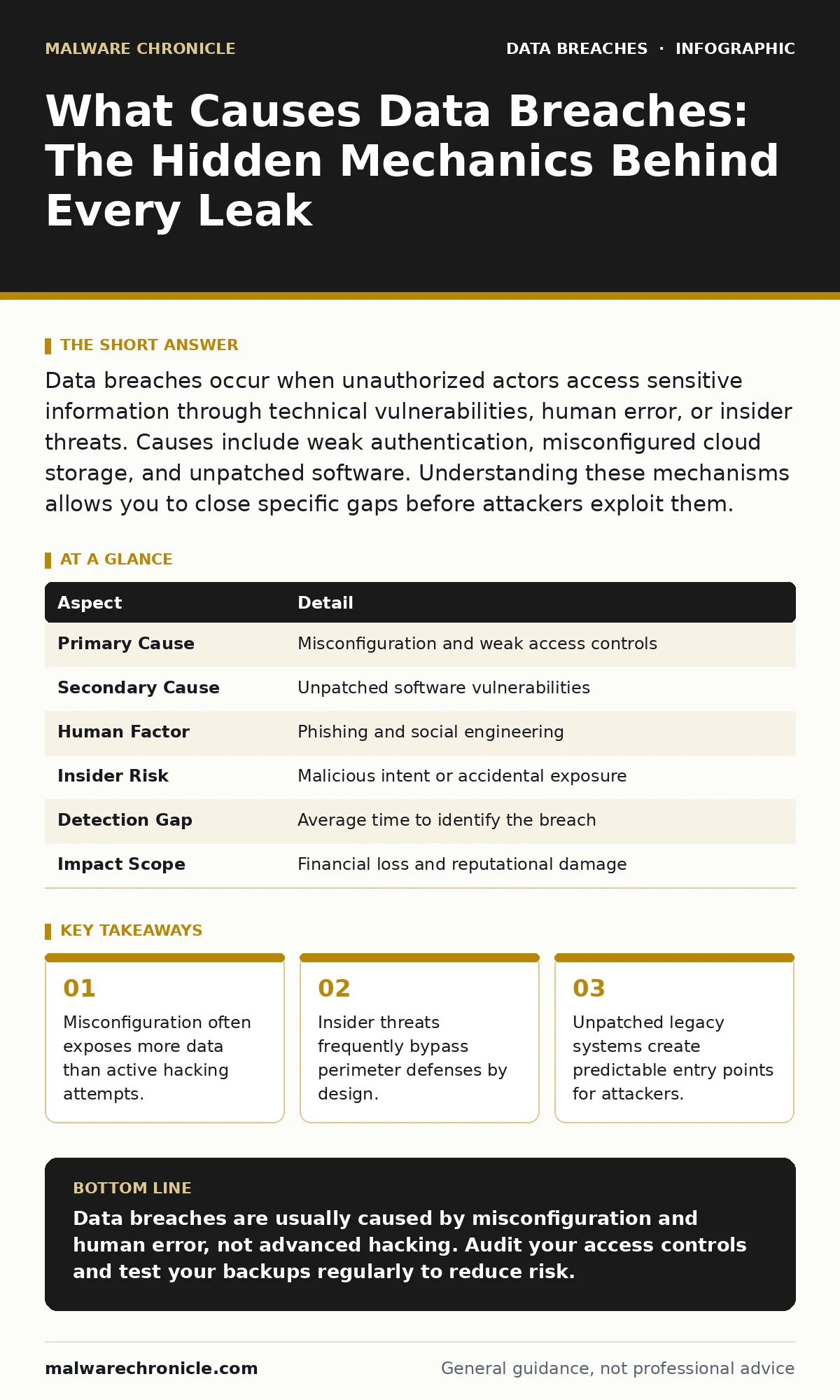
| Aspect | Detail |
|---|---|
| Primary Cause | Misconfiguration and weak access controls |
| Secondary Cause | Unpatched software vulnerabilities |
| Human Factor | Phishing and social engineering |
| Insider Risk | Malicious intent or accidental exposure |
| Detection Gap | Average time to identify the breach |
| Impact Scope | Financial loss and reputational damage |
What Causes Data Breaches in Modern Systems
You might expect complex code injection to be the main culprit. In reality, what causes data breaches is often simple negligence. Developers leave default passwords on test servers. Administrators grant excessive permissions to service accounts. These mistakes create open doors that require no special skills to enter.
Supply chain attacks introduce another layer of risk. When you install software from a trusted vendor, you also install their potential vulnerabilities. If the vendor’s build process is compromised, your system inherits that risk. This means your security is only as strong as the weakest link in your software supply chain.
The Role of Human Error and Insider Threats
Technology fails less often than people do. You might follow every protocol, but a colleague might click a malicious link. Phishing emails evolve to mimic internal communications perfectly. They exploit urgency and fear to bypass rational judgment. Once a single credential is stolen, the attacker gains a foothold inside your network.
Insider threats are particularly dangerous because they already have access. A disgruntled employee might copy files before leaving. A well-meaning staff member might misconfigure a cloud bucket, exposing terabytes of data to the public internet. These actions are difficult to distinguish from normal behavior, making detection challenging.
How Attackers Exploit Technical Vulnerabilities
Unpatched software provides a map for attackers. Security researchers publish details about vulnerabilities, including how to exploit them. If you do not update your systems, you leave known doors unlocked. Legacy systems that no longer receive updates are especially vulnerable because they cannot be patched.
Attackers also exploit misconfigured databases. Many organizations deploy databases with default settings that allow remote access or lack encryption. This makes it easy to dump entire tables of sensitive personal data. The attacker does not need to break in; the data is simply available to anyone who knows the query.
The Hidden Cost of Legacy Infrastructure
Old systems often run on outdated protocols that lack modern security features. They cannot support strong encryption or multi-factor authentication. You might think these systems are isolated, but network maps evolve. New devices connect to old networks, creating bridges for attackers to cross.
Maintaining legacy systems requires specialized knowledge that is becoming scarce. When staff leave, institutional knowledge disappears with them. This leads to poor documentation and ad-hoc fixes that introduce new vulnerabilities. The cost of keeping these systems running often exceeds the cost of replacing them, yet organizations delay the upgrade due to budget constraints.
See also: Tokenization Mistakes That Expose Data and How to Fix Them · Cloud Encryption Checklist: Protect Data in Transit and at Rest
What People Usually Get Wrong About Security
Many believe that perimeter defenses are sufficient. Firewalls and intrusion detection systems are useful, but they do not stop threats that originate from inside. Once an attacker is inside, the perimeter is irrelevant. You must assume that attackers will eventually bypass external defenses.
Another common mistake is relying solely on antivirus software. Modern malware often uses fileless techniques that do not write to the disk. They execute directly in memory, evading traditional signature-based detection. This requires behavioral monitoring rather than just scanning for known bad files.
Implementing Effective Defenses and Monitoring
Defense requires depth. You need multiple layers of security that work together. Full disk encryption protects data if a device is stolen. Encryption at rest ensures that stored data remains unreadable without the proper keys. These measures do not prevent breaches, but they limit the damage if one occurs.
Monitoring is critical for early detection. Database activity monitoring tracks queries and access patterns in real time. It alerts you to unusual behavior, such as a user downloading large volumes of data at odd hours. This helps you identify credential dumps before the attacker can use them extensively.
Managing Data Lifecycle and Recovery
Data classification helps you prioritize your efforts. Not all data is equally valuable. Identifying sensitive personal data allows you to apply stricter controls to high-risk assets. This focused approach is more effective than trying to secure everything with equal intensity.
Recovery planning is often overlooked. Backup testing ensures that your backups are usable when you need them. Many organizations discover that their backups are corrupted or incomplete only after a breach. Regular testing validates that you can restore systems and data quickly, minimizing downtime.
Key takeaways
- Misconfiguration often exposes more data than active hacking attempts.
- Insider threats frequently bypass perimeter defenses by design.
- Unpatched legacy systems create predictable entry points for attackers.
Data breaches are usually caused by misconfiguration and human error, not advanced hacking. Audit your access controls and test your backups regularly to reduce risk.
Frequently asked questions
Can strong passwords prevent data breaches?
Strong passwords reduce the risk of brute-force attacks, but they do not stop phishing or credential stuffing. Multi-factor authentication is necessary to protect against stolen passwords.
How do I know if my data has been sold on the dark web?
You cannot directly monitor the dark web. Use breach notification services that scan for your email addresses or domain credentials. This alerts you if your data appears in known dumps.
Is encryption enough to secure my data?
Encryption protects data confidentiality but not availability or integrity. You still need access controls, monitoring, and patch management to prevent unauthorized access and tampering.
What is the first step after a suspected breach?
Isolate affected systems to prevent lateral movement. Preserve evidence for forensic analysis. Notify your incident response team and follow your predefined communication plan.
How this guide was produced: written by the Malware Chronicle editorial team with AI assistance, checked against the public references listed below, and reviewed when the facts change. See our editorial policy or report an error.