
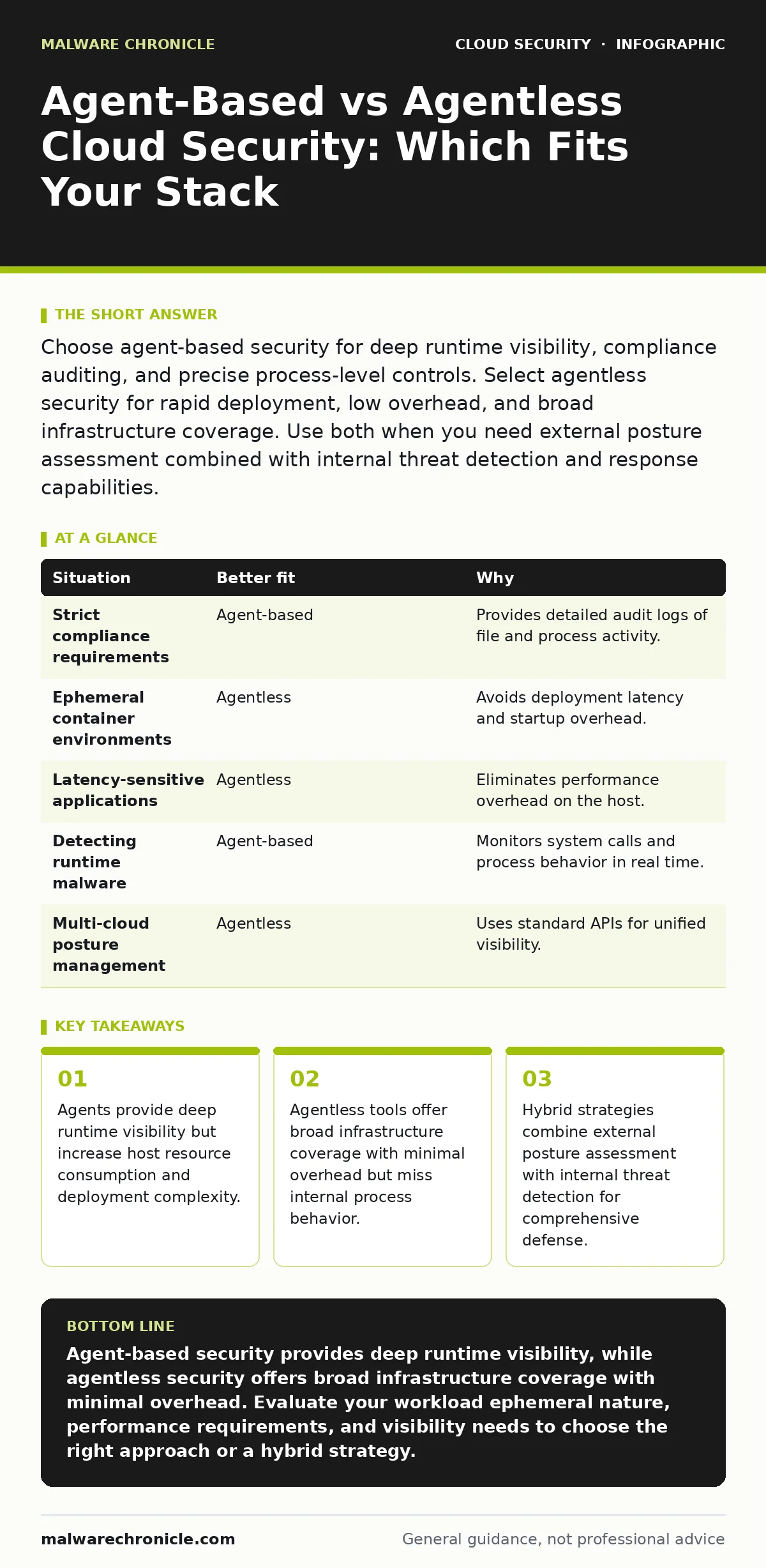
Choose agent-based security for deep runtime visibility, compliance auditing, and precise process-level controls. Select agentless security for rapid deployment, low overhead, and broad infrastructure coverage. Use both when you need external posture assessment combined with internal threat detection and response capabilities.
What visibility depth does your threat model require?
Agent-based security solutions install software directly on virtual machines or containers. This placement allows the agent to monitor system calls, file access, and network connections in real time. You gain insight into what processes are actually doing, not just what the cloud provider says they are doing. This depth is necessary when you must detect malware that hides within legitimate processes or when you need to enforce strict application control policies.
Agentless solutions rely on cloud provider APIs and external probes. They inspect metadata, configuration settings, and network traffic flows from the outside. You see the posture of your infrastructure, but you cannot see inside the operating system. If your threat model focuses on misconfigurations, exposed storage buckets, or unauthorized resource creation, agentless tools provide sufficient visibility without touching the workload.
How ephemeral are your workloads?
Ephemeral workloads start and stop frequently. Containers often live for minutes or hours. Microservices scale up and down based on demand. Installing an agent on every new instance adds latency to startup times and requires complex orchestration to ensure the agent is present before the application runs. If your infrastructure changes faster than your security tool can deploy, you create coverage gaps.
Agentless security handles ephemeral environments better. It scans resources as they appear in the cloud control plane. You do not need to modify your deployment pipelines or wait for software installation. The trade-off is that you lose the ability to monitor the internal state of short-lived containers. If a container escapes its sandbox, an agentless tool may not detect the breach until the container terminates.
Imagine a development environment where containers spin up for every pull request. An agent-based approach would slow down the feedback loop for developers. An agentless approach ensures every container is checked for compliance without adding friction to the development workflow. This aligns well with DevSecOps principles by shifting security left without blocking velocity.
What is your acceptable performance overhead?
Every process running on a host consumes CPU cycles and memory. Security agents are no exception. They must intercept system calls, log events, and transmit data to a central console. In high-throughput applications, this overhead can degrade performance. You must measure the impact of the agent on your application’s latency and throughput before deploying it at scale.
Agentless tools run on separate infrastructure. They query the cloud provider’s API or analyze traffic from a sidecar or network tap. Your workloads do not pay the performance cost. This is critical for latency-sensitive applications, such as high-frequency trading platforms or real-time gaming servers. The cost is shifted to the security infrastructure, which must be sized to handle the volume of API calls or traffic analysis.
How do you manage security across hybrid environments?
Many organizations run workloads across multiple cloud providers and on-premises data centers. Agent-based solutions often require different agents for different environments. You must manage updates, versions, and configurations for each agent type. This increases operational complexity and the risk of inconsistent security policies.
Agentless solutions can provide a unified view across hybrid environments. They use standard APIs to query resources regardless of where they run. You can enforce consistent compliance policies across AWS, Azure, and on-premises servers from a single console. However, you may lose the deep runtime visibility provided by agents in specific environments.
| Situation | Better fit | Why |
|---|---|---|
| Strict compliance requirements | Agent-based | Provides detailed audit logs of file and process activity. |
| Ephemeral container environments | Agentless | Avoids deployment latency and startup overhead. |
| Latency-sensitive applications | Agentless | Eliminates performance overhead on the host. |
| Detecting runtime malware | Agent-based | Monitors system calls and process behavior in real time. |
| Multi-cloud posture management | Agentless | Uses standard APIs for unified visibility. |
When should you use both approaches?
Using both agent-based and agentless security is not mutually exclusive. It is a layered defense strategy. Agentless tools handle the broad infrastructure posture, checking for misconfigurations, exposed ports, and compliance violations. They provide a wide net that catches low-hanging fruit. Agent-based tools handle the deep runtime monitoring, detecting threats that bypass perimeter controls and hiding within legitimate processes.
This hybrid approach reduces the blind spots of each method. The agentless layer ensures that your infrastructure is configured securely. The agent layer ensures that your workloads are running securely. You must manage the integration between the two to avoid alert fatigue and conflicting policies. Centralized logging and correlation are necessary to make sense of the combined data.
See also: Unified Kill Chain: Map Attacks Across Cloud and On-Premises
How do you integrate with existing security workflows?
Your choice of security tool must fit into your existing operational workflows. If you use infrastructure-as-code scanning, agentless tools integrate naturally. They can validate configurations before deployment. If you rely on runtime threat detection, agent-based tools are necessary. They provide the data needed for security information and event management systems to correlate events.
Consider the maintenance burden. Agents require updates and patches. They must be compatible with your operating systems and application frameworks. Agentless tools require API access and permissions. They must be kept in sync with your cloud provider’s API changes. Both approaches require ongoing management, but the nature of the work differs.
Key takeaways
- Agents provide deep runtime visibility but increase host resource consumption and deployment complexity.
- Agentless tools offer broad infrastructure coverage with minimal overhead but miss internal process behavior.
- Hybrid strategies combine external posture assessment with internal threat detection for comprehensive defense.
Agent-based security provides deep runtime visibility, while agentless security offers broad infrastructure coverage with minimal overhead. Evaluate your workload ephemeral nature, performance requirements, and visibility needs to choose the right approach or a hybrid strategy.
Frequently asked questions
Can agentless security detect malware inside a container?
No, agentless tools cannot see inside the container. They rely on external indicators and metadata. Malware hiding within a process will not change the container’s external configuration.
Do security agents slow down application performance?
Yes, agents consume CPU and memory resources. The impact varies by application and agent configuration. High-throughput applications may experience noticeable latency increases.
Is it possible to use agentless security for compliance auditing?
Yes, agentless tools can verify configuration compliance against standards. They cannot, however, verify that specific processes or files are present or behaving correctly.
How do agents handle container lifecycle events?
Agents must be deployed as part of the container image or sidecar. They must start and stop with the container. This requires integration with container orchestration platforms.
How this guide was produced: written by the Malware Chronicle editorial team with AI assistance, checked against the public references listed below, and reviewed when the facts change. See our editorial policy or report an error.