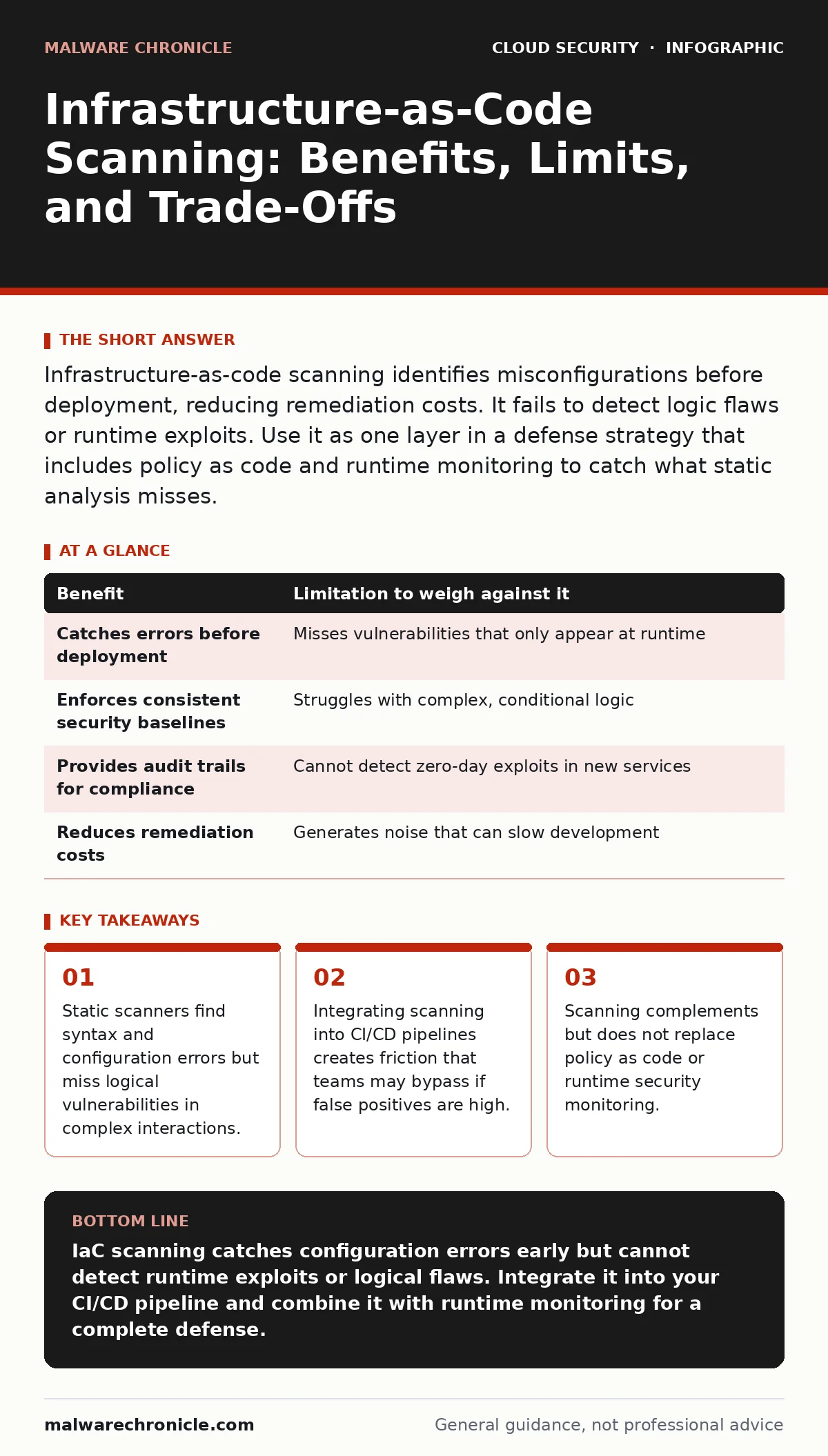
Infrastructure-as-code scanning identifies misconfigurations before deployment, reducing remediation costs. It fails to detect logic flaws or runtime exploits. Use it as one layer in a defense strategy that includes policy as code and runtime monitoring to catch what static analysis misses.
The Static Nature of Code Analysis
Infrastructure-as-code (IaC) allows you to define cloud resources using text files rather than clicking through a dashboard. This practice brings version control and repeatability to infrastructure management. However, it also shifts the attack surface. If your code contains a misconfiguration, that error deploys automatically every time you run the script. Scanning tools analyze these files before they execute. They look for known bad patterns, such as open storage buckets or disabled logging. This process is static. The tool reads the text but never runs the infrastructure. This distinction defines both its power and its blindness.
Concrete Benefits of Early Detection
The primary benefit of scanning is cost reduction. Fixing a security flaw in code is significantly cheaper than patching a live environment. When a scanner flags an issue, you address it while the resource still exists only as text. This prevents the "drift" where manual changes to live environments diverge from your intended secure state. Scanning also enforces consistency. It ensures that every deployment adheres to the same security baseline, regardless of who wrote the code. This is particularly valuable when managing complex setups involving cloud landing zones, where a single misstep can expose multiple services.
Another benefit is auditability. Scans generate reports that document exactly what was checked and what was found. This creates a paper trail for compliance requirements. You can prove that you reviewed configurations before deployment. This documentation matters when regulators or internal auditors ask how you manage risk. It turns security from an abstract concept into a measurable process.
| Benefit | Limitation to weigh against it |
|---|---|
| Catches errors before deployment | Misses vulnerabilities that only appear at runtime |
| Enforces consistent security baselines | Struggles with complex, conditional logic |
| Provides audit trails for compliance | Cannot detect zero-day exploits in new services |
| Reduces remediation costs | Generates noise that can slow development |
The Blind Spots of Static Analysis
Static scanning cannot see what happens when the code runs. It checks the blueprint, not the building. Imagine a firewall rule that allows traffic from a specific IP range. The scanner sees the rule is present and may approve it. It cannot verify if that IP range is actually safe or if an attacker has compromised a host within it. This is a critical gap. Many attacks exploit the interaction between services, not just the configuration of a single resource. For example, a service might be correctly configured, but the identity it uses has excessive permissions. The scanner might miss this if the permission logic is complex or distributed across multiple files.
Another limitation is the inability to detect insecure container images if the IaC only pulls from a registry. The scanner sees the command to pull an image. It does not inspect the image contents. If you are building your own images, you need separate checks for insecure container images. IaC scanning alone will not tell you if your application has a known vulnerability in a library. It only tells you if you told the cloud provider to run that image.
When It Is Worth It
Scanning is worth it when you deploy frequently and at scale. If you push changes daily, manual review is impossible. Automation becomes necessary. It is also worth it when you lack deep expertise in every cloud service. Scanners encode best practices from thousands of scenarios. They act as a safety net for teams that are still learning the platform. This is especially true during cloud migration security efforts, where legacy practices often carry over into new environments. Using scanners helps break those bad habits early.
It is also valuable for open-source projects or teams with high turnover. New developers may not know the subtle security implications of certain configurations. Scanners provide immediate feedback. This accelerates onboarding and reduces the risk of accidental exposure. If your organization uses policy as code to enforce standards, scanning is the mechanism that validates compliance before deployment. It bridges the gap between written policy and actual implementation.
When It Is Not Worth It
Scanning is not worth it if you treat it as a silver bullet. If you believe a clean scan means you are secure, you are vulnerable. This false sense of security is dangerous. It leads to neglecting other critical controls, such as monitoring and incident response. Scanning is also less valuable if your infrastructure is static and rarely changes. If you deploy once a year, manual review might be more efficient than configuring and maintaining a scanning pipeline. The overhead of integrating tools, managing false positives, and tuning rules may outweigh the benefits.
It is also not worth it if you ignore the results. If your team consistently overrides scanner warnings without justification, the tool becomes noise. This erodes trust in the security process. You end up with a tool that runs but provides no value. In such cases, it is better to stop scanning and focus on education and better policy design. Fix the root cause of why warnings are ignored. This often involves collaborating with developers to understand their constraints and finding a balance between security and speed.
See also: DevSecOps vs CI/CD: Why Security Needs Its Own Pipeline
Integrating With Other Controls
Scanning works best when combined with other layers of defense. For instance, it complements cloud encryption by ensuring that storage services are configured to encrypt data at rest. However, it cannot verify that the encryption keys are managed securely. That requires separate controls. It also pairs well with service mesh security, which manages traffic between services. While IaC scanning ensures the services are deployed correctly, the mesh ensures they communicate securely.
Consider also the role of confidential computing. This technology protects data in use, which is outside the scope of IaC scanning. Scanning can ensure that confidential computing features are enabled, but it cannot verify the integrity of the execution environment. By understanding these boundaries, you can build a more effective security strategy. You use scanning for configuration, runtime tools for behavior, and cryptographic controls for data protection.
Managing the Trade-Offs
The main trade-off is between security and developer velocity. Strict scanning can block deployments if developers do not understand the issues. This creates friction. To manage this, start with a few high-risk rules. Gradually add more as the team adapts. Provide clear explanations for each warning. Help developers understand why a configuration is risky. This turns scanning from a blocker into a learning tool.
Another trade-off is the maintenance burden. Scanners need updates to keep pace with new cloud features. If you do not update your rules, you will miss new risks. This requires dedicated effort. Assign ownership of the scanning configuration to a specific team or individual. Ensure they have the time to maintain it. Otherwise, the tool will become outdated and ineffective.
Key takeaways
- Static scanners find syntax and configuration errors but miss logical vulnerabilities in complex interactions.
- Integrating scanning into CI/CD pipelines creates friction that teams may bypass if false positives are high.
- Scanning complements but does not replace policy as code or runtime security monitoring.
IaC scanning catches configuration errors early but cannot detect runtime exploits or logical flaws. Integrate it into your CI/CD pipeline and combine it with runtime monitoring for a complete defense.
Frequently asked questions
Does IaC scanning replace manual security reviews?
No, it complements them. Scanners catch common misconfigurations, but humans are needed to assess complex logic and business context.
Can IaC scanning detect insecure container images?
No, it only checks the deployment instructions. You need separate tools to scan the image contents for vulnerabilities.
How do I reduce false positives from IaC scanners?
Tune your rules to match your specific environment and suppress warnings for known, accepted risks. Document these exceptions.
Is IaC scanning enough for cloud security?
No, it is one layer. You also need monitoring, identity management, and encryption to protect data and services at runtime.
How this guide was produced: written by the Malware Chronicle editorial team with AI assistance, checked against the public references listed below, and reviewed when the facts change. See our editorial policy or report an error.