
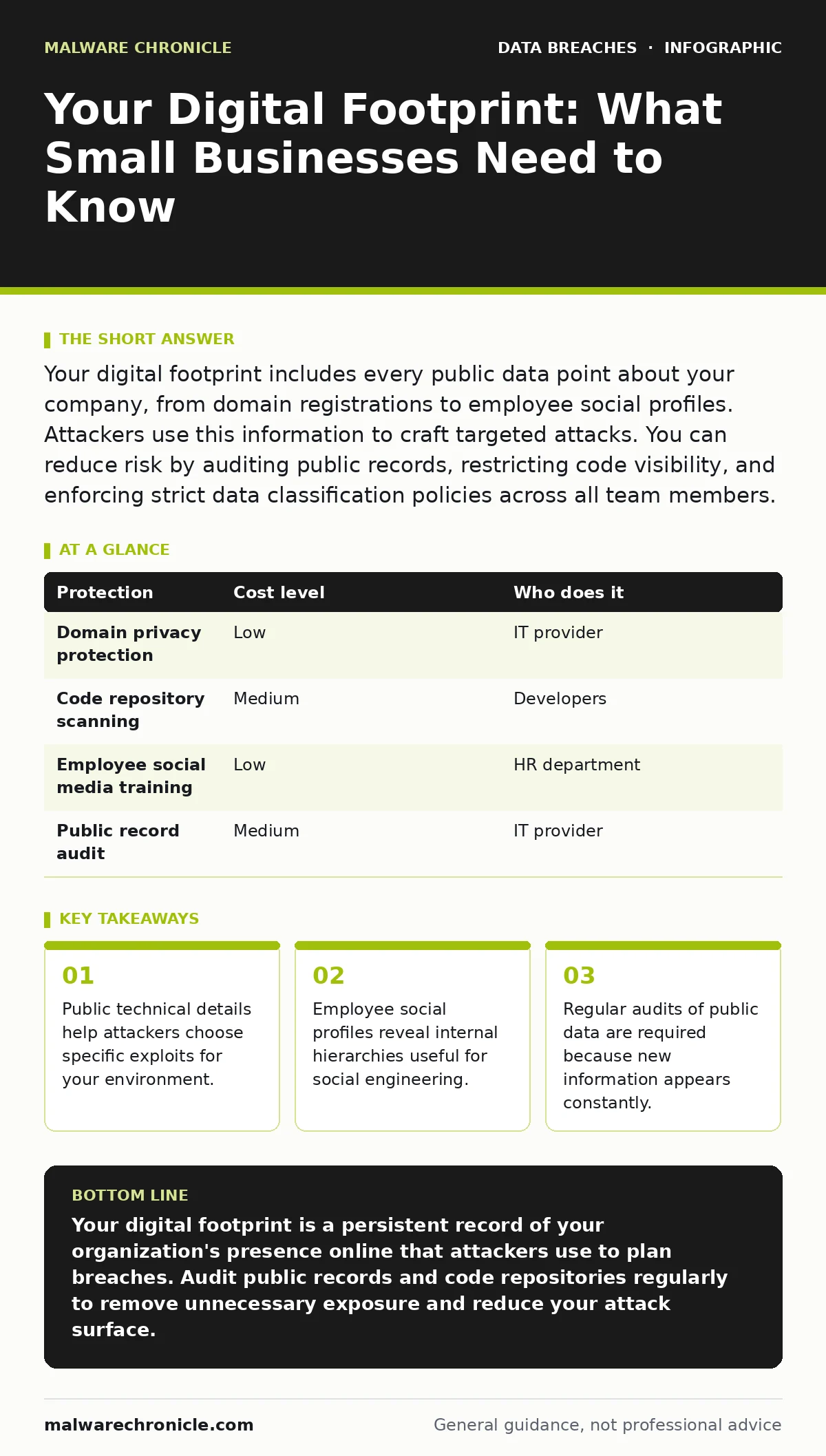
Your digital footprint includes every public data point about your company, from domain registrations to employee social profiles. Attackers use this information to craft targeted attacks. You can reduce risk by auditing public records, restricting code visibility, and enforcing strict data classification policies across all team members.
Why technical metadata expands your attack surface
Your digital footprint is the collection of all digital traces your organization leaves online. This includes domain registration details, server configurations, and public code repositories. Attackers gather this data to map your infrastructure before launching an attack. They look for specific software versions that have known vulnerabilities.
If your web server reveals its version number in error messages, an attacker can search for exploits targeting that exact build. This process is called reconnaissance. It allows adversaries to bypass generic defenses by using attacks tailored to your specific setup. You must assume that any technical detail exposed to the public internet is known to your adversaries. Hiding behind a firewall does not protect data that is already published in plaintext.
The hidden cost of employee social profiles
Employee social media accounts are part of your corporate footprint. Attackers scrape LinkedIn and Twitter to identify key personnel and their relationships. They use this information to craft convincing phishing emails. Suppose an attacker knows the name of your CFO and the marketing director. They can send an email that appears to come from the marketing director, asking the CFO to approve an urgent payment.
This is known as business email compromise. The attack succeeds because the context is accurate. You cannot control what employees post on personal accounts, but you can train them on the risks. Encourage staff to limit the disclosure of their role, company projects, and travel plans. Privacy settings on social platforms should be set to the highest level for work-related accounts.
Code repositories and open source exposure
Developers often share code on public platforms to showcase skills or collaborate. This practice can expose sensitive configuration files or internal logic. Even if you remove secrets from a repository, the history may still contain them. Attackers review commit history to find deleted credentials or database connection strings. You must treat public code repositories as external-facing systems.
Use automated tools to scan for secrets before pushing code. Separate your public and private repositories strictly. Never commit configuration files that contain passwords or API keys. If you use open source libraries, monitor them for vulnerabilities. This connects to the broader topic of password leaks, where compromised credentials are reused across services.
Domain and DNS record visibility
Domain registration records often contain personal information about the administrator. Whois data can reveal the owner's name, phone number, and email address. Attackers use this information to verify targets for social engineering. You should enable privacy protection for your domain registrations. This masks personal details from public view.
DNS records also reveal subdomains and hosting providers. Attackers enumerate subdomains to find forgotten or insecure services. A forgotten subdomain might host an outdated application with no security patches. Regularly review your DNS records and remove unused entries. This reduces the number of entry points available to attackers. It is a simple step that significantly lowers your exposure.
Practical steps to audit and minimize exposure
You need a systematic approach to manage your digital footprint. Start by searching for your company name, domain, and key employees. Note every result that appears in search engines. Categorize the results by risk level. High risk includes exposed credentials or internal network diagrams. Medium risk includes employee profiles with detailed role descriptions.
Low risk includes generic business listings. Create a plan to remove or secure high-risk items. Ask employees to update their social media privacy settings. Review public code repositories for sensitive data. Update domain registration details to use privacy protection. Document these findings for future reference. This baseline helps you detect new exposures quickly.
| Protection | Cost level | Who does it |
|---|---|---|
| Domain privacy protection | Low | IT provider |
| Code repository scanning | Medium | Developers |
| Employee social media training | Low | HR department |
| Public record audit | Medium | IT provider |
See also: Configuration Hardening for Small Teams: Secure Defaults · Database Activity Monitoring Mistakes and How to Fix Them
Questions to ask your IT provider
Your IT provider should help you manage your external exposure. They must have a clear process for identifying and mitigating footprint risks. Ask them how they monitor for new public data. Inquire about their methods for scanning code repositories. Discuss their approach to domain registration security. Ensure they understand the difference between internal and external data. A provider who only focuses on internal network security may ignore external risks. You need a partner who views security as a holistic practice. This aligns with the principles of data classification, where data is labeled based on sensitivity and access requirements.
- How do you monitor for new public records about our company?
- What tools do you use to scan code repositories for secrets?
- How do you ensure domain registration privacy is maintained?
- Can you provide a report on our current external attack surface?
- What is your process for responding to exposed credentials?
Integrating footprint management into daily operations
Managing your digital footprint is not a one-time task. New data appears regularly as you hire staff, launch products, or update software. You must integrate footprint checks into your regular security routine. Include footprint audits in your quarterly security reviews. Assign responsibility for monitoring specific areas to team members. Developers own code repositories. HR owns employee social media guidelines. IT owns domain and server configurations. This shared responsibility ensures continuous coverage. It prevents gaps where new exposures can accumulate unnoticed. Regular reviews keep your security posture aligned with your current operations.
The long term impact of a clean footprint
A minimized digital footprint reduces the effectiveness of targeted attacks. It forces attackers to rely on generic methods that are easier to detect. It also improves your overall security hygiene. When you care about external exposure, you become more careful with internal data. This mindset shift leads to better security practices across the organization. It supports initiatives like encryption at rest and database activity monitoring by reducing the initial entry points. A clean footprint is a foundational element of a strong security posture. It requires ongoing effort but delivers lasting protection against evolving threats.
Key takeaways
- Public technical details help attackers choose specific exploits for your environment.
- Employee social profiles reveal internal hierarchies useful for social engineering.
- Regular audits of public data are required because new information appears constantly.
Your digital footprint is a persistent record of your organization's presence online that attackers use to plan breaches. Audit public records and code repositories regularly to remove unnecessary exposure and reduce your attack surface.
Frequently asked questions
How often should I audit my digital footprint?
You should perform a full audit at least quarterly. New data appears frequently due to hires, software updates, and marketing activities. Regular checks ensure you catch new exposures before attackers do.
Can I remove all traces of my company online?
You cannot remove all traces, as business registration and domain data are public by default. You can minimize sensitive details and secure technical metadata. Focus on reducing high-risk exposure rather than achieving total invisibility.
What is the biggest risk for a small business?
The biggest risk is exposed credentials or internal configuration details. Attackers use these to bypass authentication and access sensitive data. Public code repositories and forgotten subdomains are common sources of this exposure.
Does dark web monitoring help with footprint management?
Dark web monitoring alerts you to stolen credentials. It does not reduce your footprint but helps you respond to breaches. Combine monitoring with active footprint reduction for comprehensive protection against identity theft and account takeover.
How this guide was produced: written by the Malware Chronicle editorial team with AI assistance, checked against the public references listed below, and reviewed when the facts change. See our editorial policy or report an error.