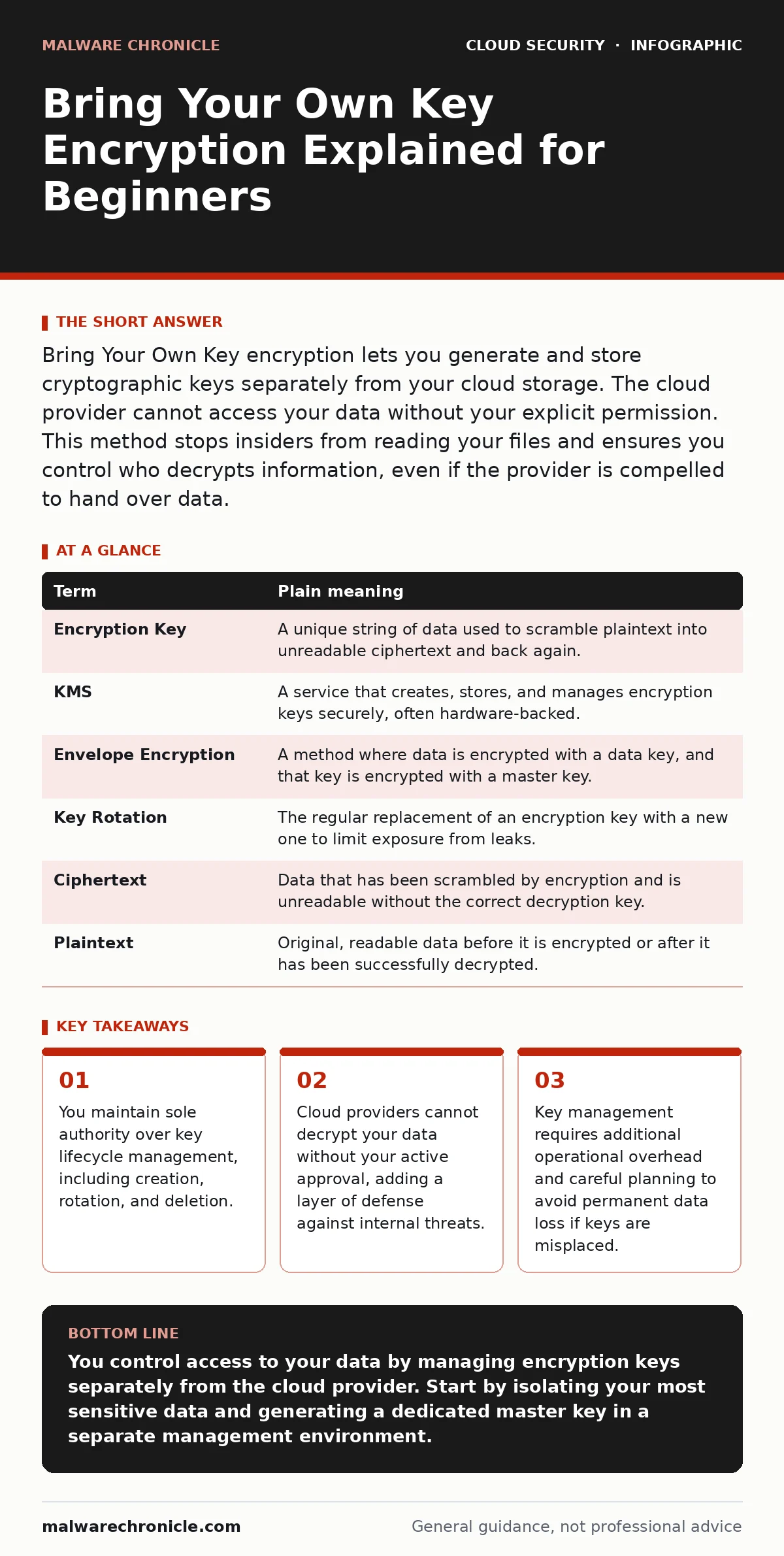
Bring Your Own Key encryption lets you generate and store cryptographic keys separately from your cloud storage. The cloud provider cannot access your data without your explicit permission. This method stops insiders from reading your files and ensures you control who decrypts information, even if the provider is compelled to hand over data.
The Locked Box Analogy
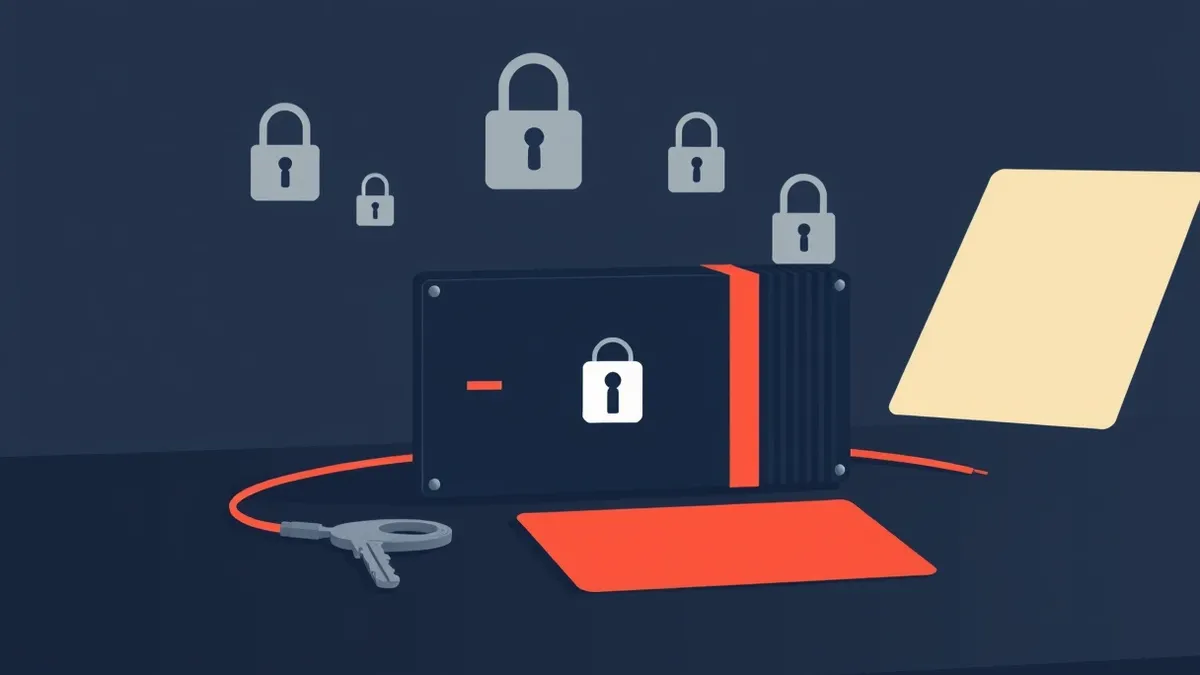
Imagine you rent a storage unit. The provider locks the door with their own key. They can enter anytime to inspect, move, or copy your items. This is how default cloud encryption works. The provider holds the master key. Now imagine you bring your own padlock and keep the only key in your pocket. The provider can still store your box, but they cannot open it. You must hand them the key to access contents. This separation of custody is the core principle of Bring Your Own Key encryption. It shifts trust from the provider’s infrastructure to your own key management practices.
Core Terminology Defined
Understanding the mechanics requires clarity on specific terms. These concepts define how data remains secure while stored in third-party environments.
| Term | Plain meaning |
|---|---|
| Encryption Key | A unique string of data used to scramble plaintext into unreadable ciphertext and back again. |
| KMS | A service that creates, stores, and manages encryption keys securely, often hardware-backed. |
| Envelope Encryption | A method where data is encrypted with a data key, and that key is encrypted with a master key. |
| Key Rotation | The regular replacement of an encryption key with a new one to limit exposure from leaks. |
| Ciphertext | Data that has been scrambled by encryption and is unreadable without the correct decryption key. |
| Plaintext | Original, readable data before it is encrypted or after it has been successfully decrypted. |
Why Default Encryption Falls Short
Default cloud encryption protects data from external theft during transit or storage. It does not protect against the provider itself. Provider employees with high-level access can potentially decrypt your data. Legal orders may compel the provider to hand over decrypted information. Bring Your Own Key encryption breaks this chain. The provider never holds the unencrypted master key. They only hold the ciphertext and the encrypted data keys. Without your master key, the provider’s systems are mathematically unable to reveal your data. This adds a critical barrier against insider threats and legal coercion.
Operational Trade-offs and Costs
Implementing this model introduces complexity. You must manage the lifecycle of your keys. This includes generating strong keys, rotating them regularly, and handling access permissions. If your key management system goes offline, your applications cannot decrypt data. This creates a dependency on your own infrastructure’s availability. You also face higher costs for key management services and storage. The security gain comes at the price of operational burden. You are no longer relying on the provider’s automated systems for key handling. You must ensure your key management service is highly available and secure.
Integration with Secure Workflows
This approach fits naturally into DevSecOps pipelines. Developers can embed key usage checks into their deployment scripts. It complements policy as code by allowing automated enforcement of key usage rules. For teams using cloud encryption broadly, Bring Your Own Key provides a tiered security model. Sensitive data gets individual keys, while less critical data uses default encryption. This granularity helps balance security needs with operational efficiency. It also aligns with confidential computing principles by ensuring data remains encrypted even during processing in some advanced setups.
See also: Unified Kill Chain: Map Attacks Across Cloud and On-Premises
First Practical Step for Implementation
Start by identifying your most sensitive data. Not all data needs this level of protection. Focus on data that would cause severe harm if exposed. Create a dedicated key management environment. Generate a master key in this isolated environment. Configure your cloud storage to use this key for encryption. Test the decryption process thoroughly. Ensure your applications can retrieve the key and decrypt data without errors. Monitor access logs for any unusual key usage. This initial setup proves the concept before scaling.
- Identify high-value data sets requiring strict access control.
- Provision a separate key management service outside the main cloud account.
- Generate a master key and configure storage buckets to use it.
Common Pitfalls to Avoid
Many teams fail to plan for key rotation. Old keys must be archived securely to decrypt historical data. Deleting a key before all data is re-encrypted causes immediate loss. Another mistake is granting overly broad permissions to the key management service. Least privilege access is critical. Only specific applications should be able to request decryption. Regularly audit who has access to the master key. Ensure that no single person holds sole access. Multi-person control prevents insider abuse and accidental deletion.
Key takeaways
- You maintain sole authority over key lifecycle management, including creation, rotation, and deletion.
- Cloud providers cannot decrypt your data without your active approval, adding a layer of defense against internal threats.
- Key management requires additional operational overhead and careful planning to avoid permanent data loss if keys are misplaced.
You control access to your data by managing encryption keys separately from the cloud provider. Start by isolating your most sensitive data and generating a dedicated master key in a separate management environment.
Frequently asked questions
Does Bring Your Own Key encryption slow down my applications?
It can add latency if not implemented correctly. Using envelope encryption minimizes the performance impact by reducing the frequency of master key interactions.
Can I use my existing on-premise key management system?
Yes, if it supports the necessary APIs and can securely communicate with your cloud environment. You must ensure the connection is encrypted and authenticated.
What happens if the cloud provider goes bankrupt?
You retain your keys and can decrypt your data. You can then migrate the ciphertext to another provider and decrypt it there, assuming the new provider supports your encryption format.
Is this compatible with multi-cloud strategies?
Yes, you can manage keys centrally and use them across different cloud providers. This ensures consistent security policies and key control regardless of where data is stored.
How this guide was produced: written by the Malware Chronicle editorial team with AI assistance, checked against the public references listed below, and reviewed when the facts change. See our editorial policy or report an error.