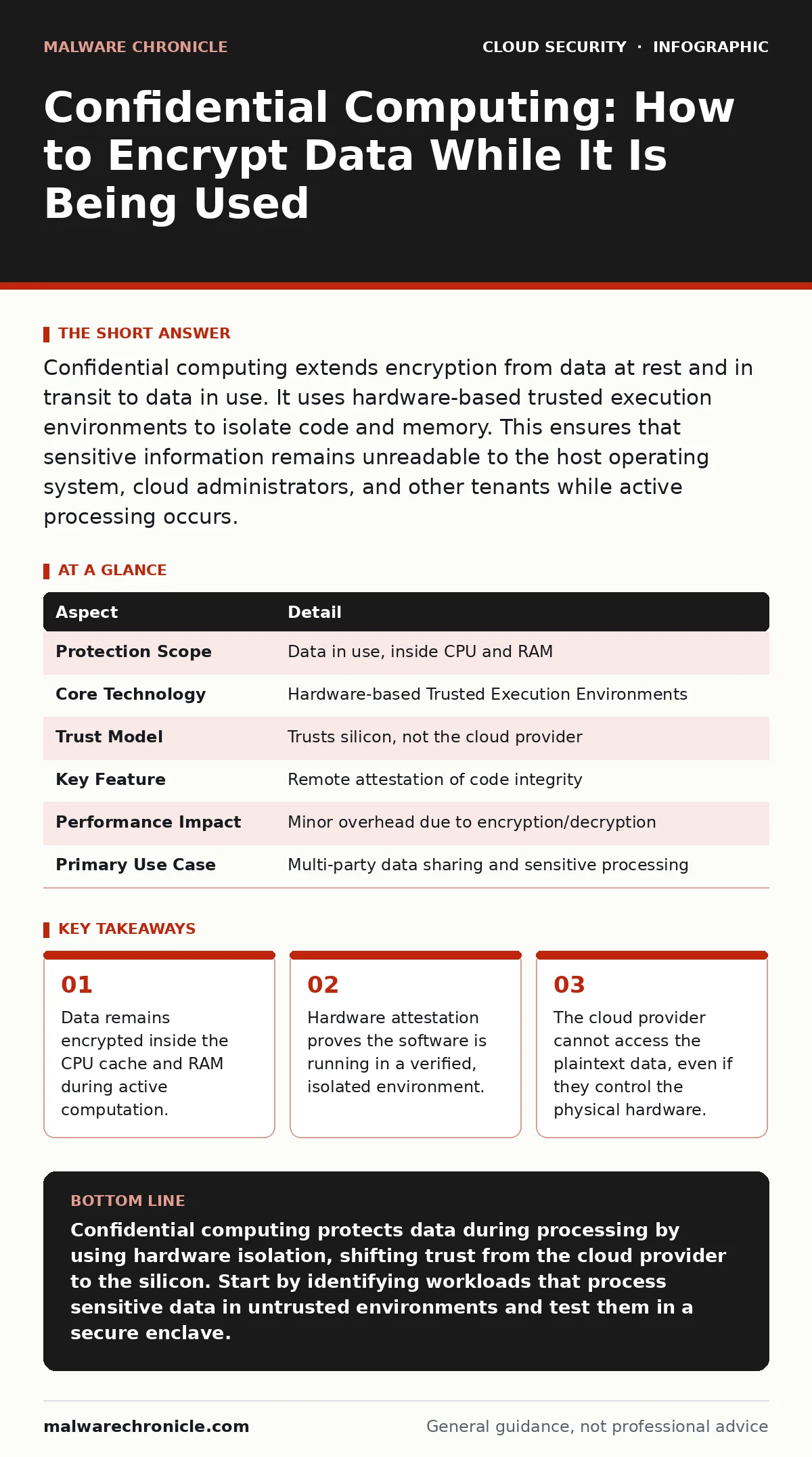
Confidential computing extends encryption from data at rest and in transit to data in use. It uses hardware-based trusted execution environments to isolate code and memory. This ensures that sensitive information remains unreadable to the host operating system, cloud administrators, and other tenants while active processing occurs.
The Locked Room Analogy
Imagine you hire a contractor to renovate your kitchen. You trust them to do the work, but you do not want them seeing your personal documents stored in the pantry. In traditional cloud computing, you hand over the keys. The contractor can see everything while they work.
Confidential computing changes this dynamic. It is like putting the pantry inside a transparent, unbreakable safe. The contractor can watch the safe and interact with the controls, but they cannot see the documents inside. They can only perform the specific tasks you authorized, and the documents remain visible only to you.
This analogy highlights the core shift: moving from trusting the environment to trusting the hardware. You stop relying on the cloud provider’s policies and start relying on mathematical proofs and silicon boundaries.
Defining the Mechanism
Confidential computing is a security model that encrypts data while it is being processed in the CPU and memory. Most security frameworks focus on data at rest (stored on disk) and data in transit (moving across networks). Confidential computing protects the third state: data in use.
It achieves this by creating a Trusted Execution Environment. A TEE is an isolated area of the main processor. Code and data loaded into this area are encrypted at the hardware level. The rest of the system, including the hypervisor and the host operating system, cannot access the plaintext.
This isolation happens at the instruction set level. The CPU itself enforces the boundary. If a process tries to read memory outside its assigned TEE, the hardware blocks the request. This creates a strong perimeter that software vulnerabilities cannot easily cross.
Where the Term Comes From
The concept emerged from a coalition of major technology companies. They recognized that traditional encryption methods had a blind spot. You could encrypt data on a server, but to use it, you had to decrypt it first. That moment of decryption was the vulnerability.
Researchers and engineers realized that existing hardware features could solve this. Processors already had mechanisms for isolating sensitive keys. By expanding these mechanisms to cover general application data, they created a new category of protection.
This collaboration standardized the approach. It moved the technology from niche academic research to a practical engineering solution. The goal was to allow organizations to use public cloud resources without fearing data exposure.
How It Works in Practice
You deploy your application into a container or virtual machine. This workload is configured to run inside a TEE. Before the code executes, a process called attestation takes place. Attestation is a cryptographic proof that the software is running in the expected, unmodified environment.
Your application requests sensitive data from a secure key management service. The service verifies the attestation report. If the report matches the expected configuration, the service decrypts the data directly into the TEE’s memory. The cloud provider never sees the plaintext.
Your application processes the data within the secure boundary. Results can be encrypted before leaving the TEE. This ensures that even the output is protected. The entire lifecycle, from loading to processing to output, stays within the encrypted zone.
| Aspect | Detail |
|---|---|
| Protection Scope | Data in use, inside CPU and RAM |
| Core Technology | Hardware-based Trusted Execution Environments |
| Trust Model | Trusts silicon, not the cloud provider |
| Key Feature | Remote attestation of code integrity |
| Performance Impact | Minor overhead due to encryption/decryption |
| Primary Use Case | Multi-party data sharing and sensitive processing |
Daily Operational Reality
Integrating confidential computing requires changes to your deployment pipeline. You must manage the lifecycle of the secure enclave. This includes configuring the attestation parameters and handling key rotation.
Developers must write code that is aware of the TEE boundaries. Data cannot simply be passed to standard libraries that expect direct memory access. You need libraries designed for secure enclaves. This adds complexity to the development process.
Operational monitoring also changes. You cannot inspect the memory of a running TEE. Traditional debugging tools are ineffective. You must rely on logs that are generated inside the enclave and then securely transmitted out.
See also: DevSecOps vs CI/CD: Why Security Needs Its Own Pipeline · How to Set Up Single Sign On: Protocol Choices and Risk Controls
Common Misconceptions
Many assume confidential computing replaces traditional security controls. It does not. It is a layer of defense, not a complete solution. You still need strong identity management and network segmentation.
Another mistake is assuming the TEE is immune to all attacks. Side-channel attacks can still extract information. These attacks measure physical properties like power consumption or timing to infer data. You must design your application to resist these specific threats.
Some believe this technology eliminates the need for cloud encryption. It complements it. Data at rest and in transit must still be encrypted. Confidential computing only protects the window of time when the data is active in memory.
Hidden Costs and Trade-offs
Performance is the most visible trade-off. Encryption and decryption consume CPU cycles. Memory access patterns change to accommodate the secure enclave. This can slow down latency-sensitive applications.
Complexity is the hidden cost. Debugging issues inside a TEE is difficult. You lose visibility into the runtime state. This can prolong incident response times. You need specialized tools and expertise to troubleshoot these environments.
Portability is another challenge. Different hardware vendors implement TEEs differently. Code written for one processor may not run efficiently on another. This can lock you into specific hardware architectures.
Integrating With Existing Security
You should view confidential computing as part of a broader strategy. It works well with microsegmentation. By limiting network access to the TEE, you reduce the attack surface further.
It also complements infrastructure-as-code scanning. You must ensure that the deployment scripts correctly configure the secure enclaves. A misconfiguration in the infrastructure code can disable the protections entirely.
Consider how this fits with cloud landing zones. Your baseline security architecture should include support for attestation and key management. This ensures that confidential workloads can be deployed consistently across your environment.
Key takeaways
- Data remains encrypted inside the CPU cache and RAM during active computation.
- Hardware attestation proves the software is running in a verified, isolated environment.
- The cloud provider cannot access the plaintext data, even if they control the physical hardware.
- This model shifts trust from the platform operator to the cryptographic hardware.
Confidential computing protects data during processing by using hardware isolation, shifting trust from the cloud provider to the silicon. Start by identifying workloads that process sensitive data in untrusted environments and test them in a secure enclave.
Frequently asked questions
Does confidential computing protect against insider threats?
Yes, it protects against insiders at the cloud provider who might try to access your data. The hardware prevents them from reading the memory, even if they have administrative access.
Can I use confidential computing with my existing applications?
You may need to refactor your code. Applications must be designed to work within the constraints of a TEE, such as limited memory and specific library support.
Is confidential computing the same as homomorphic encryption?
No. Homomorphic encryption allows computation on encrypted data without decrypting it. Confidential computing decrypts data inside a secure hardware zone, which is generally faster.
What happens if the hardware is compromised?
Hardware vulnerabilities
How this guide was produced: written by the Malware Chronicle editorial team with AI assistance, checked against the public references listed below, and reviewed when the facts change. See our editorial policy or report an error.