Encryption at rest protects static data on storage media from unauthorized physical access or database extraction. Encryption in transit secures data moving between systems using secure channels. You need both because one protects against theft of devices while the other prevents eavesdropping on network traffic.
The Core Difference Between Encryption at Rest vs In Transit
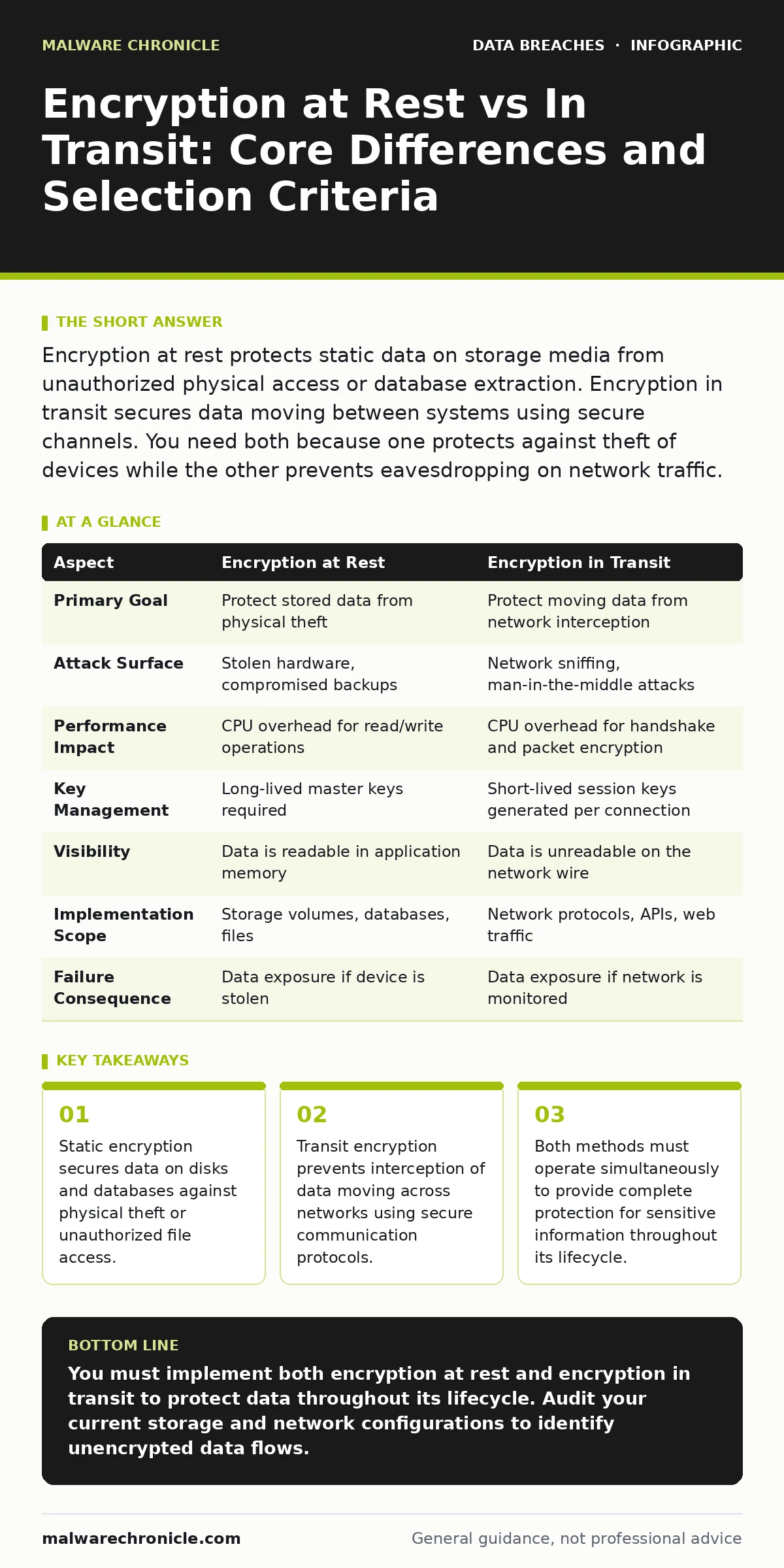
Encryption at rest vs in transit defines two distinct security states for your data. Encryption at rest applies cryptographic protection to data stored on physical media like hard drives, solid-state drives, or cloud storage buckets. This protects information when it is not moving. Encryption in transit secures data while it travels between endpoints, such as from a web browser to a server or between database clusters. This prevents interception during movement. You must implement both because data spends significant time in each state. Protecting only one state leaves a critical gap where attackers can easily access your information.
How Encryption at Rest Works
Encryption at rest transforms readable data into ciphertext before writing it to storage. The system uses a master key to encrypt data blocks. When an application requests data, the system decrypts it in memory before processing. This process happens transparently to the user. Full disk encryption is a common implementation that protects the entire volume. Database-level encryption allows finer control over specific tables or columns. The primary risk this mitigates is physical theft of storage devices or unauthorized access to backup tapes. Without this layer, anyone with physical access to the drive can read the raw data.
How Encryption in Transit Works
Encryption in transit secures data as it moves across a network. It establishes a secure tunnel between the sender and receiver. This tunnel uses handshake protocols to verify identities and exchange session keys. All data passing through this tunnel is encrypted. This prevents man-in-the-middle attacks where an attacker intercepts and reads network traffic. It also ensures data integrity, confirming the information was not altered in transit. This method protects credentials, personal details, and transaction data while they travel over public or private networks.
Point-by-Point Comparison of Security Methods
| Aspect | Encryption at Rest | Encryption in Transit |
|---|---|---|
| Primary Goal | Protect stored data from physical theft | Protect moving data from network interception |
| Attack Surface | Stolen hardware, compromised backups | Network sniffing, man-in-the-middle attacks |
| Performance Impact | CPU overhead for read/write operations | CPU overhead for handshake and packet encryption |
| Key Management | Long-lived master keys required | Short-lived session keys generated per connection |
| Visibility | Data is readable in application memory | Data is unreadable on the network wire |
| Implementation Scope | Storage volumes, databases, files | Network protocols, APIs, web traffic |
| Failure Consequence | Data exposure if device is stolen | Data exposure if network is monitored |
When to Choose Encryption at Rest
Choose encryption at rest when your primary concern is physical security or insider threats with storage access. This is mandatory for laptops, mobile devices, and external drives that leave the secure office environment. It is also critical for cloud storage buckets that hold sensitive personal data. If your organization handles credential dumps or other high-value static assets, this layer is non-negotiable. It ensures that even if a server is stolen or a backup tape is lost, the data remains unreadable without the decryption keys. This method also helps comply with data classification requirements for stored archives.
See also: SYN Flood Attack Response: Containment, Recovery, and Prevention Steps · Intrusion Detection Systems: Benefits, Limits, and When to Deploy
When to Choose Encryption in Transit
Choose encryption in transit when data moves between different systems or users. This is required for any web application, API, or remote access service. If your users log in over public Wi-Fi, this encryption prevents attackers from capturing their sessions. It is also vital for microservices architectures where internal components communicate over a network. Without this protection, an attacker on the same network segment can read all traffic. This method ensures that sensitive information remains confidential from the moment it leaves the source until it reaches the destination.
Overlapping Requirements and Combined Strategy
Most modern systems require both methods simultaneously. Data is encrypted at rest in the database, then decrypted for processing, and finally encrypted in transit when sent to the user. You cannot rely on one to cover the other. A common mistake is assuming that secure network channels protect stored data. They do not. You must also consider database activity monitoring to detect unauthorized access attempts. Combining these methods creates a defense-in-depth strategy. This approach ensures that even if one layer fails, the other still provides protection.
Managing Keys and Operational Costs
Encryption introduces operational complexity. You must manage keys securely using a hardware security module or a dedicated key management service. If you lose the keys, your data is permanently inaccessible. This is a hidden cost of encryption. You must also balance performance impacts. Heavy encryption can slow down database queries and network throughput. Test your systems under load to ensure acceptable performance. Implement the 3-2-1 backup rule to ensure you have copies of your keys and data. This prevents total data loss in case of corruption or ransomware attacks.
Key takeaways
- Static encryption secures data on disks and databases against physical theft or unauthorized file access.
- Transit encryption prevents interception of data moving across networks using secure communication protocols.
- Both methods must operate simultaneously to provide complete protection for sensitive information throughout its lifecycle.
You must implement both encryption at rest and encryption in transit to protect data throughout its lifecycle. Audit your current storage and network configurations to identify unencrypted data flows.
Frequently asked questions
Does HTTPS protect data at rest?
No. HTTPS only encrypts data while it is moving between the browser and the server. Once the server receives the data, it must store it, requiring separate at-rest encryption.
Can I use the same key for both methods?
It is possible but not recommended. Transit keys are short-lived and change frequently. Rest keys are long-lived. Using different keys limits the impact of a key compromise.
What happens if I lose my encryption key?
Your data becomes permanently inaccessible. You cannot recover it without the key. This is why secure key backup and management are critical components of your security strategy.
Is encryption enough to prevent data breaches?
No. Encryption protects data confidentiality but does not prevent unauthorized access attempts. You need additional controls like access management and monitoring to prevent breaches.
How this guide was produced: written by the Malware Chronicle editorial team with AI assistance, checked against the public references listed below, and reviewed when the facts change. See our editorial policy or report an error.