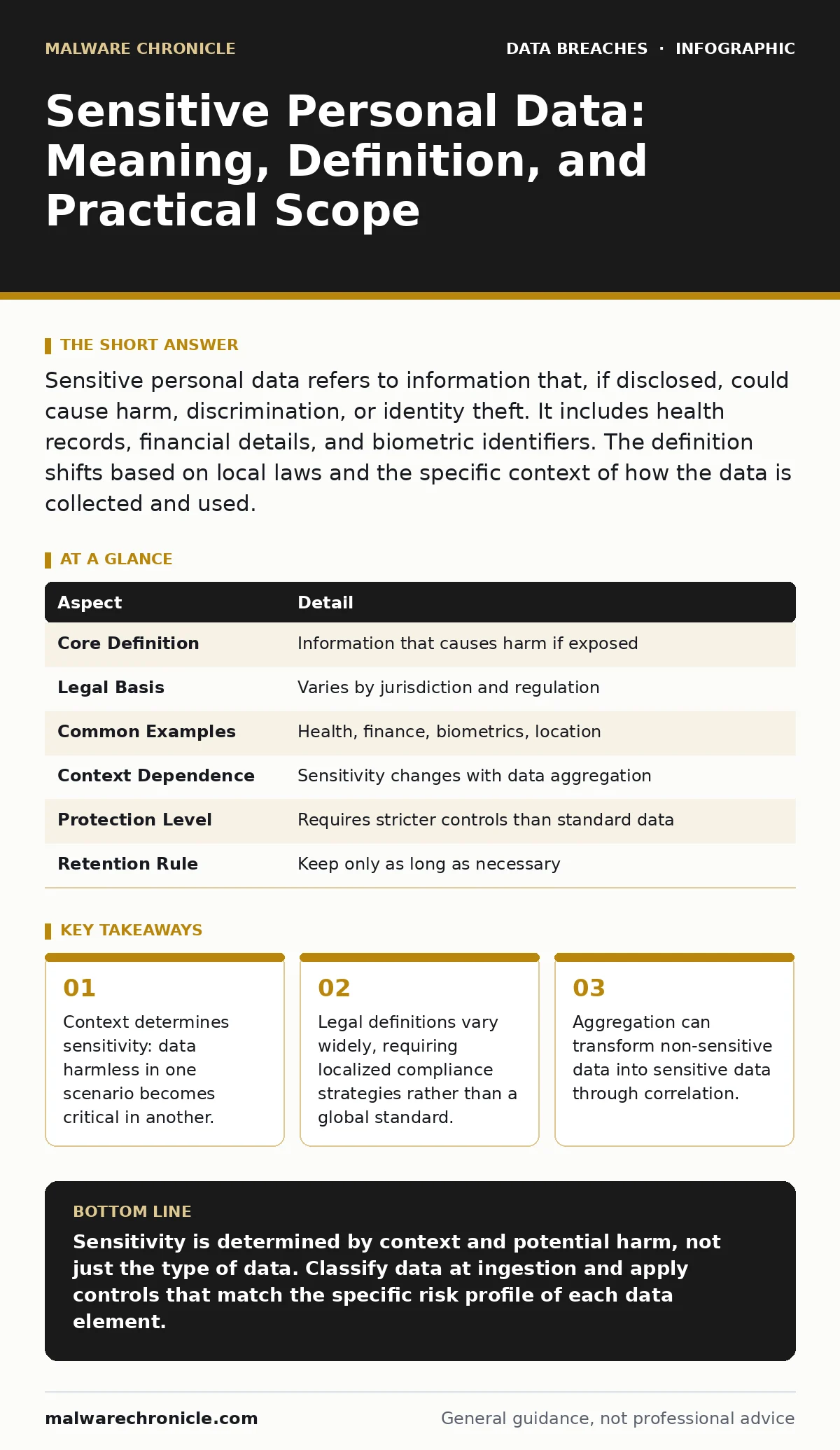
Sensitive personal data refers to information that, if disclosed, could cause harm, discrimination, or identity theft. It includes health records, financial details, and biometric identifiers. The definition shifts based on local laws and the specific context of how the data is collected and used.
The Contextual Nature of Sensitivity
Imagine you leave a sticky note with your house key code on your fridge. To anyone inside your home, this is mundane information. To a stranger, it is a direct path into your private space. Sensitive personal data operates on the same principle. The sensitivity does not reside in the data itself, but in the relationship between the data, the holder, and the potential observer.
You cannot treat all personal information as equally dangerous. A public email address is personal data, but it is rarely sensitive. Your blood type, however, is highly sensitive. The distinction matters because the controls you apply must match the risk. Over-protecting low-risk data wastes resources. Under-protecting high-risk data invites catastrophe.
Defining the Boundary in Practice
There is no single global dictionary definition for sensitive personal data. Instead, the term emerges from legal frameworks and industry standards. In many jurisdictions, laws separate "personal data" from "special category data." Personal data identifies a living individual. Special category data includes race, political opinions, religious beliefs, health, and sexual orientation.
In practice, you must look at the specific regulations applicable to your users. If you operate in Europe, the GDPR provides a strict list. If you operate in California, the CCPA and CPRA define sensitive personal information differently. Other regions have their own nuances. You must map your data flows to these specific definitions. Ignoring local variations creates compliance gaps that are difficult to close later.
| Aspect | Detail |
|---|---|
| Core Definition | Information that causes harm if exposed |
| Legal Basis | Varies by jurisdiction and regulation |
| Common Examples | Health, finance, biometrics, location |
| Context Dependence | Sensitivity changes with data aggregation |
| Protection Level | Requires stricter controls than standard data |
| Retention Rule | Keep only as long as necessary |
The Mechanics of Aggregation
One of the most misunderstood aspects of sensitivity is aggregation. A single data point is often harmless. A user’s zip code is not sensitive. Their purchase history for prenatal vitamins is not sensitive. Their age is not sensitive. Combine these three, and you can infer pregnancy status with high accuracy. This inferred data is often as sensitive as explicitly stated health records.
This phenomenon means you cannot simply classify data at the field level. You must consider how data points interact. If your system joins tables from different sources, the resulting view may contain sensitive information that neither source held alone. This is where many security models fail. They protect the inputs but leave the outputs exposed.
Biometrics and Behavioral Data
Biometric data is uniquely sensitive because it is immutable. You can change a password. You cannot change your fingerprint or your iris pattern. If biometric data is compromised, the damage is permanent. This makes the security requirements for biometrics significantly higher than for traditional credentials.
Behavioral data is another emerging category. This includes how a user holds their phone, their typing rhythm, or their mouse movements. While not traditionally classified as sensitive, this data can be used for continuous authentication and identity verification. If leaked, it can allow attackers to mimic a user’s behavior to bypass security checks. You must treat behavioral templates with the same rigor as biometric templates.
What People Usually Get Wrong
Many teams assume that anonymization removes sensitivity. This is often incorrect. True anonymization is difficult to achieve. If you can re-identify an individual by linking the "anonymized" data with other public datasets, the data remains sensitive. Pseudonymization, where you replace identifiers with fake ones, does not remove sensitivity. It only adds a layer of indirection. The underlying data retains its risk profile.
Another common error is assuming that consent removes the need for protection. Just because a user agrees to share their health data does not mean you can store it in plain text. Consent governs the legal basis for processing. It does not dictate the technical security controls. You must still protect the data against unauthorized access, even if the user authorized the collection.
See also: Credential Dumps Prevention Checklist for Secure Systems
Operationalizing the Definition
To handle sensitive personal data effectively, you must classify it at ingestion. This means tagging data as it enters your system. If you receive a form with a health question, tag that field as sensitive. This tag should follow the data through your entire pipeline. It should trigger stricter encryption, more limited access logs, and shorter retention periods.
You should also implement data minimization. Collect only what you need. If you do not need a user’s date of birth, do not ask for it. If you need it for age verification, hash it immediately after validation and discard the plain text. This reduces the attack surface. It also reduces the impact of a breach.
Integrating with Security Frameworks
Sensitive data handling does not exist in a vacuum. It intersects with several other security practices. For instance, if you suspect a breach involving sensitive data, your incident communication plans must be ready. The tone and content of your message will depend on the type of data exposed. Health data requires different messaging than email addresses.
You should also consider tokenization for sensitive fields. Tokenization replaces sensitive data with a non-sensitive equivalent that has no exploitable value. This is particularly useful for payment data and health identifiers. Unlike encryption, tokens cannot be reversed without access to the tokenization vault. This adds a strong layer of separation between the data processor and the data owner.
Regular backup testing is also critical. If you back up sensitive data, you must ensure the backups are encrypted and protected with the same rigor as the live data. A backup that is easy to restore is also easy to steal if unprotected. Verify that your restoration process does not expose sensitive data to unauthorized personnel.
The Hidden Cost of Misclassification
Misclassifying data has hidden costs. If you classify sensitive data as non-sensitive, you risk regulatory fines and reputational damage. If you classify non-sensitive data as sensitive, you incur unnecessary operational costs. You may encrypt data that does not need encryption, slowing down your application. You may restrict access that should be open, hindering productivity.
Finding the balance requires a clear understanding of your data flows. You must know where the data comes from, where it goes, and who can see it. This visibility is the foundation of any effective data protection strategy. Without it, you are guessing. Guessing is not a viable security posture.
Key takeaways
- Context determines sensitivity: data harmless in one scenario becomes critical in another.
- Legal definitions vary widely, requiring localized compliance strategies rather than a global standard.
- Aggregation can transform non-sensitive data into sensitive data through correlation.
Sensitivity is determined by context and potential harm, not just the type of data. Classify data at ingestion and apply controls that match the specific risk profile of each data element.
Frequently asked questions
Is an email address considered sensitive personal data?
Generally, no. An email address is personal data because it identifies an individual. It is usually not sensitive unless combined with other data that reveals private details, such as health or financial status.
How long should sensitive personal data be retained?
Only as long as necessary to fulfill the purpose for which it was collected. Once the purpose is complete, the data should be securely deleted or anonymized. Legal requirements may mandate longer retention for certain types of records.
Does encryption make data non-sensitive?
No. Encryption protects the confidentiality of the data. It does not change the nature of the data. If the encryption keys are compromised, the sensitive data is exposed. The data remains sensitive regardless of its encrypted state.
Can I use sensitive data for marketing purposes?
Usually, no. Most regulations prohibit using special category data for marketing without explicit, separate consent. Even with consent, you must ensure the processing is necessary and proportionate. Always consult legal counsel for specific use cases.
How this guide was produced: written by the Malware Chronicle editorial team with AI assistance, checked against the public references listed below, and reviewed when the facts change. See our editorial policy or report an error.