
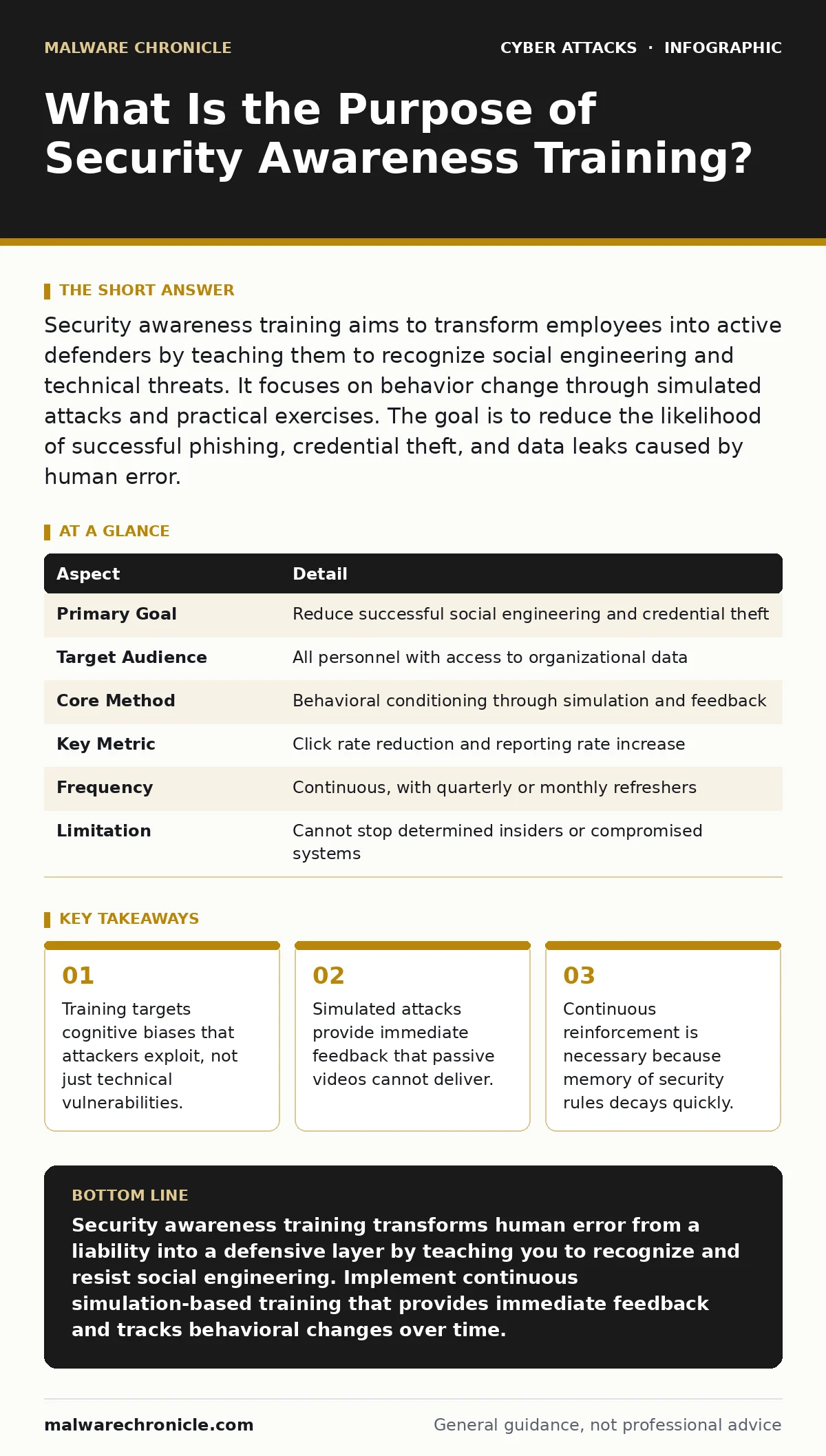
Security awareness training aims to transform employees into active defenders by teaching them to recognize social engineering and technical threats. It focuses on behavior change through simulated attacks and practical exercises. The goal is to reduce the likelihood of successful phishing, credential theft, and data leaks caused by human error.
The Human Firewall Analogy
Imagine a castle with thick stone walls and a deep moat. Most attackers cannot breach these physical defenses. They instead send a messenger dressed as a trusted ally, carrying a letter that convinces the gatekeeper to open the door. Security awareness training teaches the gatekeeper to question the messenger, check the letter for inconsistencies, and verify the sender’s identity before acting.
The walls represent your technical controls. Firewalls block unauthorized network traffic. Intrusion detection systems monitor for suspicious patterns. These tools are effective against automated attacks and direct probes. They fail when an insider willingly hands over access. Training addresses this specific gap. It ensures that the human element does not become the weakest link in your defense chain.
What Is the Purpose of Security Awareness Training?
Security awareness training serves to align human behavior with security policy requirements. Its primary purpose is to reduce the risk of successful social engineering attacks. Social engineering manipulates people into breaking security procedures. Attackers use urgency, authority, or fear to bypass rational thinking. Training exposes these tactics so you can recognize them in real time.
The purpose is not to make you a security expert. It is to make you a skeptical participant. You learn to pause before clicking a link. You learn to verify unusual requests. This pause creates friction for the attacker. Friction breaks the momentum of an exploit. A delayed response often allows automated defenses to detect and block the threat.
| Aspect | Detail |
|---|---|
| Primary Goal | Reduce successful social engineering and credential theft |
| Target Audience | All personnel with access to organizational data |
| Core Method | Behavioral conditioning through simulation and feedback |
| Key Metric | Click rate reduction and reporting rate increase |
| Frequency | Continuous, with quarterly or monthly refreshers |
| Limitation | Cannot stop determined insiders or compromised systems |
How Cognitive Bias Exploitation Works
Attackers do not rely on technical skill alone. They rely on predictable human psychology. Fear is a powerful motivator. A message claiming your account will be locked if you do not act immediately triggers panic. Panic shuts down critical thinking. You click the link to restore access. Authority works similarly. A message appearing to come from a CEO or IT support demands compliance. You obey the perceived hierarchy.
Curiosity is another vector. A subject line promising a bonus or a confidential document invites investigation. You click to see what is inside. Training teaches you to identify these emotional triggers. You learn to step back and assess the context. Did you expect this message? Does the sender’s email address match their name? Is the request consistent with normal operations? These checks disrupt the attacker’s psychological leverage.
Understanding these mechanisms is vital. It shifts your perspective from passive recipient to active analyst. You stop looking for viruses and start looking for manipulation. This mental shift is the core benefit of effective training. It prepares you for novel attacks that have not been seen before.
The Mechanics of Effective Programs
Effective training uses simulation and immediate feedback. Passive videos and annual quizzes have low retention rates. They do not change behavior. Simulated phishing attacks send fake malicious emails to your inbox. When you click the link, you land on a training page that explains the mistake. This immediate correction reinforces the lesson.
The system tracks your responses. It identifies users who are vulnerable. It provides targeted remediation for those individuals. This personalized approach is more efficient than generic training. It focuses resources where they are needed most. The program also rewards correct behavior. Reporting a suspicious email triggers positive reinforcement. This encourages vigilance across the organization.
Technical controls support this process. Secure email gateways filter known malicious content before it reaches your inbox. They reduce the noise, allowing you to focus on ambiguous messages that require human judgment. Conditional access policies ensure that even if credentials are stolen, the attacker cannot access sensitive data without additional verification. These tools work together with training to create layers of defense.
Who Affected by Security Risks
Security awareness training affects every person with access to organizational resources. Developers, executives, and interns all face different threats. Developers may receive messages with malicious code snippets. They need training on secure coding practices and supply chain risks. Executives face whaling attacks that target their authority and access. They need training on verification protocols and identity theft.
Interns and new hires are particularly vulnerable. They lack context about normal operations. They may not know who to trust or how to verify requests. They need onboarding training that establishes baseline expectations. Seasoned employees can become complacent. They may ignore warnings because they have survived previous attacks. They need regular refreshers to maintain vigilance.
The impact extends beyond direct targets. A successful attack on one person can compromise the entire network. If an attacker gains access to a junior employee’s account, they can move laterally to more valuable targets. Training creates a culture of shared responsibility. Everyone understands that their actions affect the collective security. This cultural shift is difficult to achieve but necessary for long-term resilience.
See also: Phishing Simulations: 8 Practices That Actually Work · Payroll Diversion Fraud: How Attackers Steal Your Money
Common Misconceptions About Training
Many organizations treat training as a compliance checkbox. They assume that completing a course means the employee is secure. This is a dangerous misconception. Knowledge does not equal behavior. You can know the rules and still break them under pressure. Training must focus on habit formation, not just information transfer.
Another misconception is that training prevents all attacks. It does not. Determined attackers will find ways around human defenses. Training reduces the success rate of broad campaigns. It does not stop targeted attacks that use deep research and patience. You must combine training with technical controls. Hardware security keys provide strong authentication that training cannot replace. Payroll diversion fraud often succeeds despite training because attackers exploit financial processes, not just email.
Some believe that negative reinforcement works best. Showing horror stories of breaches can create fear. Fear leads to avoidance. Employees may stop reporting incidents to avoid blame. This hides the problem. Positive reinforcement builds a reporting culture. You want employees to report suspicious activity without fear of punishment. This visibility allows the security team to respond quickly.
What To Do Next
Start by auditing your current training program. Does it use simulation and feedback? Does it track individual progress? If not, consider a platform that offers these features. Define clear metrics. Measure click rates and reporting rates. Track changes over time. Use this data to refine your content.
Integrate training into daily workflows. Do not isolate it in annual events. Use micro-learning modules that take minutes to complete. Address current threats and trends. Keep the content relevant and engaging. Encourage discussion. Allow employees to share their experiences. This peer-to-peer learning reinforces lessons.
Review your technical controls. Ensure they align with your training goals. If you train users to report phishing, ensure the reporting mechanism is easy to use. If you train users to verify identities, ensure verification tools are available. Consistency between training and tools builds trust. Trust leads to compliance. Compliance reduces risk.
Key takeaways
- Training targets cognitive biases that attackers exploit, not just technical vulnerabilities.
- Simulated attacks provide immediate feedback that passive videos cannot deliver.
- Continuous reinforcement is necessary because memory of security rules decays quickly.
Security awareness training transforms human error from a liability into a defensive layer by teaching you to recognize and resist social engineering. Implement continuous simulation-based training that provides immediate feedback and tracks behavioral changes over time.
Frequently asked questions
How often should security awareness training occur?
Training should be continuous rather than annual. Monthly or quarterly simulations provide regular reinforcement. This frequency prevents skill decay and keeps threats top of mind.
Can training stop a sophisticated attack?
Training reduces the success rate of broad attacks but cannot stop targeted campaigns. Determined attackers will use multiple vectors. Training must be combined with technical controls like multi-factor authentication.
What is the difference between phishing and whaling?
Phishing targets large groups with generic messages. Whaling targets specific high-value individuals like executives. Whaling messages are highly personalized and require deeper scrutiny.
How do I measure training effectiveness?
Track click rates on simulated phishing emails and reporting rates for suspicious messages. A decreasing click rate and increasing reporting rate indicate improved awareness and culture.
How this guide was produced: written by the Malware Chronicle editorial team with AI assistance, checked against the public references listed below, and reviewed when the facts change. See our editorial policy or report an error.