
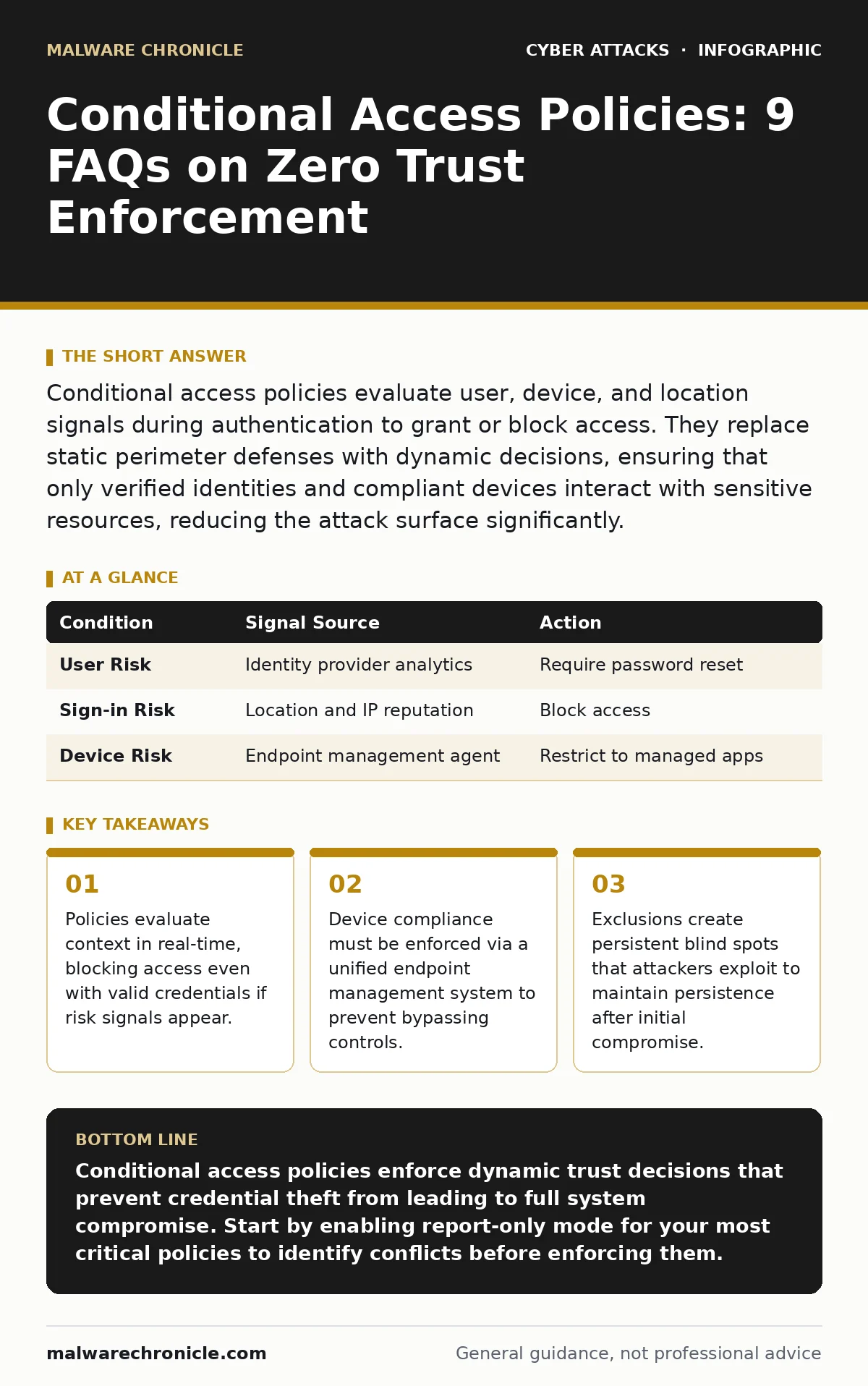
Conditional access policies evaluate user, device, and location signals during authentication to grant or block access. They replace static perimeter defenses with dynamic decisions, ensuring that only verified identities and compliant devices interact with sensitive resources, reducing the attack surface significantly.
What is a conditional access policy?
A conditional access policy is a rule that determines whether a user can access a resource based on specific conditions. Instead of granting access once and forgetting it, the system evaluates identity, device health, and location at every sign-in attempt. This shifts security from a static perimeter to a dynamic, context-aware model. You define the conditions, such as requiring multi-factor authentication for sensitive apps, and the system enforces them automatically.
How does it differ from multi-factor authentication?
Multi-factor authentication is a single control, while conditional access is the framework that decides when to apply it. MFA asks for a second proof of identity, but conditional access determines if that proof is sufficient for the specific request. You can configure policies to require MFA only for high-risk sign-ins or for users accessing critical data. This granularity reduces friction for low-risk activities while tightening security where it matters most.
Can conditional access protect against stolen passwords?
Yes, by requiring additional verification steps that a stolen password alone cannot satisfy. If an attacker obtains credentials through a breach or brand impersonation phishing, they still face the policy controls. The system checks for device compliance, location, and risk level before granting access. Even with valid credentials, the attacker is blocked if their environment does not meet the defined trust requirements.
What happens if a device is not compliant?
The policy denies access or restricts functionality until the device meets compliance standards. Compliance is verified through a unified endpoint management agent that reports on encryption, patch levels, and jailbreak status. If a device fails these checks, the user cannot access corporate data, regardless of their password. This prevents attackers from using compromised or unmanaged devices to enter your environment.
How do I handle legitimate users who are blocked?
You must balance security with usability by designing policies that allow for safe remediation. If a user is blocked, they should have a clear path to fix the issue, such as registering a new device or updating software. Avoid creating a support ticket dependency for every block, as this creates bottlenecks. Instead, provide self-service options that guide users through the compliance steps without administrative intervention.
See also: Account Takeover: Definition, Vectors, and Defense Strategies · Prevent Whaling Attacks: Stop Targeted CEO Fraud Attempts
Are there risks in using policy exclusions?
Exclusions create permanent gaps in your security posture that attackers actively seek out. When you exclude a group or application from a policy, you remove all protective checks for those entities. If an attacker compromises an excluded account, they gain unrestricted access without triggering alerts. Use exclusions sparingly and only for technical necessities, such as service accounts that cannot support MFA, while monitoring them closely.
How does risk-based conditional access work?
Risk-based policies evaluate the likelihood of compromise based on behavioral signals and threat intelligence. The system analyzes factors like impossible travel, unfamiliar locations, and known malicious IPs. If the risk score exceeds a threshold, the policy enforces stricter controls, such as blocking access or requiring password reset. This dynamic approach adapts to emerging threats without manual rule updates.
| Condition | Signal Source | Action |
|---|---|---|
| User Risk | Identity provider analytics | Require password reset |
| Sign-in Risk | Location and IP reputation | Block access |
| Device Risk | Endpoint management agent | Restrict to managed apps |
Can conditional access stop lateral movement?
It significantly hinders lateral movement by ensuring every access request is re-evaluated. Attackers who compromise an account cannot simply move to other systems without passing the policy checks again. If they switch to a different device or location, the risk score may increase, triggering additional controls. This breaks the chain of persistence that attackers rely on after an initial breach.
What is the impact on application performance?
Conditional access adds a small processing delay during the authentication handshake. The system must query identity providers, device management servers, and risk engines before granting access. This latency is typically negligible for users but can affect automated scripts or legacy applications that do not handle redirects well. Ensure your applications support modern authentication protocols to avoid compatibility issues.
How do I test policies before deployment?
Use report-only mode to simulate enforcement without blocking actual users. This mode logs what would have happened if the policy were active, allowing you to identify conflicts and false positives. Monitor the logs for a period to ensure that legitimate users are not impacted. Once you are confident in the policy’s behavior, switch it to enforcement mode. This cautious approach prevents accidental lockouts that disrupt business operations.
Does conditional access replace a firewall?
No, it complements network security by adding identity-based controls at the application layer. Firewalls filter traffic based on IP addresses and ports, while conditional access evaluates who is requesting access. An attacker may bypass network controls through a legitimate user’s device, making identity verification critical. Combining both layers ensures that traffic is scrutinized at every point of entry.
How does it interact with secure email gateways?
Secure email gateways filter malicious content before it reaches the user, reducing the chance of credential theft. Conditional access then protects the accounts even if a phishing email slips through. Together, they create a defense-in-depth strategy that addresses both prevention and detection. If an attacker uses browser-in-the-browser attacks to steal credentials, the gateway may not catch it, but conditional access can block the subsequent login.
What is the role of a cyber incident response team?
The cyber incident response team uses conditional access logs to detect and contain breaches. When a policy blocks an access attempt, it generates an alert that the team can investigate. If a breach occurs, they can use conditional access to remotely disable access for compromised accounts. This integration speeds up containment and reduces the damage caused by unauthorized access.
How do I prevent payroll diversion fraud?
Payroll diversion fraud often involves attackers manipulating bank details in HR systems. Conditional access policies can restrict access to these systems to specific roles and devices. By requiring multi-factor authentication and device compliance for any changes to payment information, you add a layer of verification. This makes it difficult for attackers to alter financial data without triggering additional security checks.
Can conditional access stop SYN flood attacks?
No, conditional access does not protect against network-layer attacks like SYN flood attacks. These attacks overwhelm the network infrastructure before authentication occurs. You need rate limiting and network intrusion prevention systems to mitigate such threats. Conditional access operates at the application layer, focusing on identity and device trust rather than network traffic volume.
Key takeaways
- Policies evaluate context in real-time, blocking access even with valid credentials if risk signals appear.
- Device compliance must be enforced via a unified endpoint management system to prevent bypassing controls.
- Exclusions create persistent blind spots that attackers exploit to maintain persistence after initial compromise.
Conditional access policies enforce dynamic trust decisions that prevent credential theft from leading to full system compromise. Start by enabling report-only mode for your most critical policies to identify conflicts before enforcing them.
Frequently asked questions
Does conditional access work for guest users?
Yes, you can apply specific policies to guest users, such as restricting access to certain applications or requiring additional verification steps.
Can I use conditional access for on-premises applications?
You need a proxy or connector to extend conditional access policies to on-premises applications,
How this guide was produced: written by the Malware Chronicle editorial team with AI assistance, checked against the public references listed below, and reviewed when the facts change. See our editorial policy or report an error.