
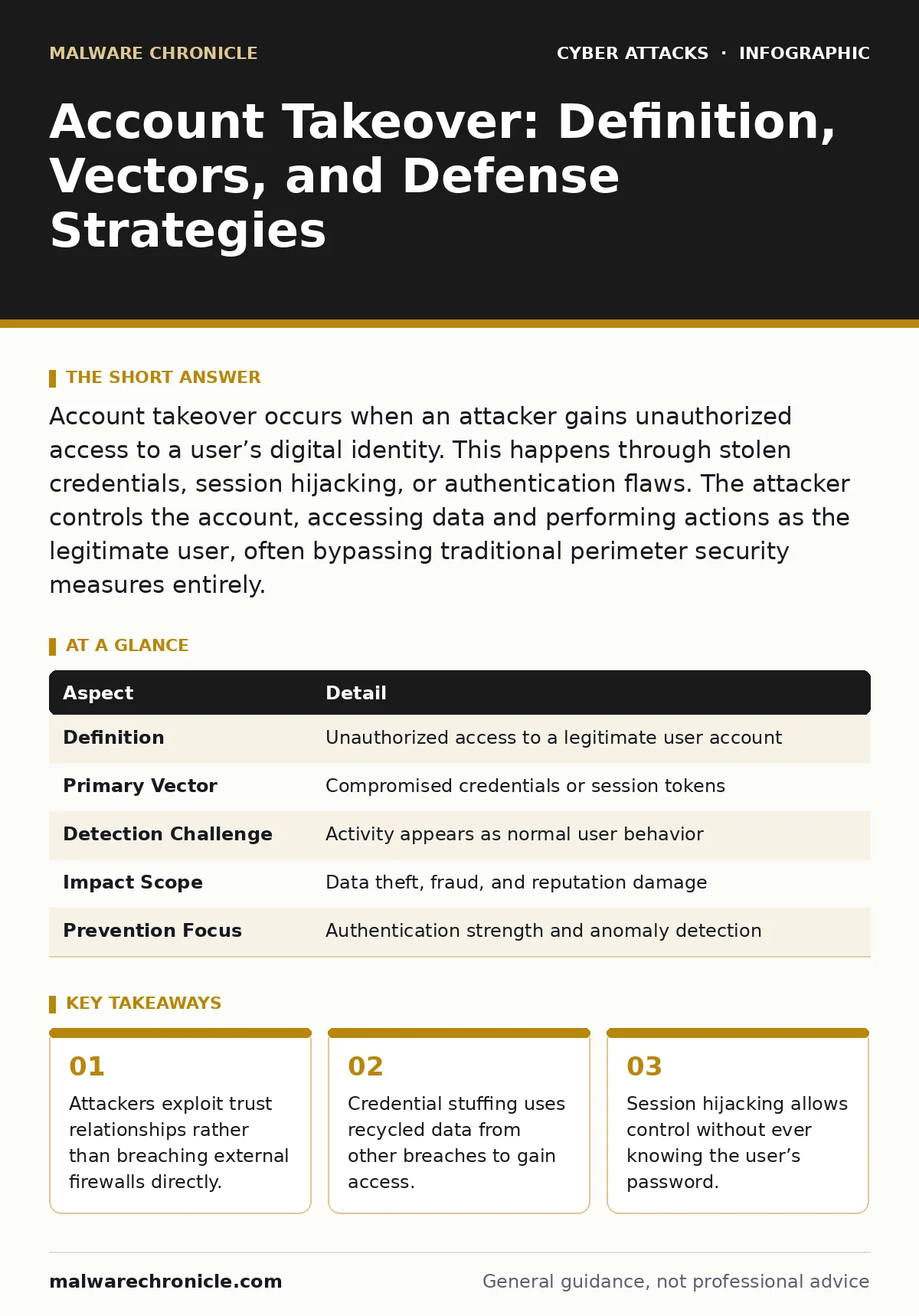
Account takeover occurs when an attacker gains unauthorized access to a user’s digital identity. This happens through stolen credentials, session hijacking, or authentication flaws. The attacker controls the account, accessing data and performing actions as the legitimate user, often bypassing traditional perimeter security measures entirely.
What Is Account Takeover
Account takeover is the unauthorized control of a user account by an attacker. The attacker does not break into the server infrastructure. Instead, they convince the application that they are the legitimate user. This distinction matters because traditional network defenses often fail to detect this activity. The system sees valid credentials or a valid session token. It processes requests as normal operations. The attacker inherits all permissions the original user held.
| Aspect | Detail |
|---|---|
| Definition | Unauthorized access to a legitimate user account |
| Primary Vector | Compromised credentials or session tokens |
| Detection Challenge | Activity appears as normal user behavior |
| Impact Scope | Data theft, fraud, and reputation damage |
| Prevention Focus | Authentication strength and anomaly detection |
How Account Takeover Happens
Attackers use several methods to seize control. Credential stuffing is the most common. Attackers obtain lists of usernames and passwords from previous data breaches. They automate login attempts against your service. If a user reused a password, the attacker gains entry. This method relies on human habit rather than technical vulnerability. The speed of automation makes manual detection nearly impossible.
Session hijacking offers a different path. When you log in, the server issues a session token. This token proves your identity for subsequent requests. If an attacker steals this token, they become you. They do not need the password. They do not need to bypass multi-factor authentication. They simply present the valid token to the server. The server grants access immediately.
Who Is Affected by Account Takeover
Every user with a digital identity is a target. High-value accounts attract sophisticated attackers. These include executives, finance staff, and system administrators. Compromising these accounts grants access to sensitive data and financial controls. Low-value accounts are also targeted. Attackers use them to send spam or create bot networks. The volume of low-value accounts creates noise. This noise masks the activity of high-value compromises.
Organizations suffer indirect consequences. A single compromised account can lead to payroll diversion fraud. Attackers redirect payments to accounts they control. The organization loses funds and faces legal liability. Trust erodes when users lose control of their data. Reputation damage often exceeds the immediate financial loss.
Common Forms of Account Takeover
Phishing remains a primary entry point. Attackers send deceptive messages that mimic trusted brands. These messages contain links to fake login pages. When users enter their credentials, the attackers capture them. Brand impersonation is a key tactic here. The attacker copies the visual identity of a legitimate service. This tricks users into lowering their guard.
Browser-in-the-browser attacks represent a newer threat. The attacker opens a fake login window inside the real browser. The fake window mimics the operating system’s security prompt. Users see a legitimate-looking overlay asking for multi-factor authentication codes. They enter the code, believing it is for their real application. The attacker captures the code and completes the login. This bypasses standard URL checks because the URL bar shows the legitimate site.
What People Usually Get Wrong
Many assume that strong passwords prevent account takeover. Passwords are only the first barrier. If an attacker steals a session token, the password is irrelevant. If an attacker uses a stolen credential, the password strength does not matter. The authentication mechanism must verify identity continuously, not just at login.
Another misconception is that multi-factor authentication stops all takeovers. It stops many, but not all. If the attacker intercepts the second factor in real-time, they can log in. This is known as man-in-the-middle attack. The user sees a legitimate prompt. The attacker sees the same prompt. The user enters the code. The attacker forwards it to the service. The attacker logs in. The user receives a notification that their account was accessed. By then, the damage is done.
See also: What Is the Purpose of Security Awareness Training? · Email Filtering FAQ: 8 Answers for Secure Inbox Management
How to Reduce the Risk
Implement continuous authentication. Do not trust a session just because it started cleanly. Monitor for behavioral anomalies. Sudden changes in location, device, or activity patterns should trigger re-authentication. Intrusion detection systems can help flag these anomalies at the network level. However, application-layer controls are more effective for account-specific risks.
Enforce adaptive multi-factor authentication. Require stronger verification for risky actions. Changing a password or adding a new payment method should demand higher assurance than reading an email. Use risk-based authentication. Evaluate the context of each request. If the request is unusual, demand additional proof of identity.
Rotate session tokens frequently. Invalidate tokens when users log out or after a short period of inactivity. This limits the window for session hijacking. If an attacker steals a token, it expires before they can cause significant damage. Implement strict cookie policies. Use the HttpOnly flag to prevent JavaScript from accessing session cookies. This mitigates cross-site scripting attacks that aim to steal tokens.
The Role of Technical Controls
Software architecture plays a defensive role. Principle of least privilege limits damage. Even if an account is taken over, the attacker can only do what the account allows. Regularly review permissions. Remove access that is no longer needed. Segment accounts so that one compromise does not expose the entire system.
Implement rate limiting on login endpoints. This slows down credential stuffing attacks. If an attacker tries thousands of passwords, the system blocks the source IP after a few failures. This adds friction to automated attacks. It does not stop them completely, but it makes them less efficient. Combine this with CAPTCHA challenges to distinguish humans from bots.
A cyber incident response team must be prepared for account takeovers. Detection is only half the battle. Rapid containment prevents further damage. Freeze the compromised account immediately. Revoke all active sessions. Force a password reset. Investigate the scope of the breach. Determine what data was accessed. Notify affected parties. Document the incident for future improvement.
Key takeaways
- Attackers exploit trust relationships rather than breaching external firewalls directly.
- Credential stuffing uses recycled data from other breaches to gain access.
- Session hijacking allows control without ever knowing the user’s password.
Frequently asked questions
Can antivirus software stop account takeover?
No, antivirus software protects the device from malware. Account takeover exploits valid credentials or session tokens. The device may be clean, but the attacker controls the account remotely.
How do I know if my account is taken over?
Look for unexpected password change emails, unknown devices in your login history, or contacts reporting strange messages from you. Check your account activity logs for unfamiliar locations or times.
Does two-factor authentication guarantee safety?
No, two-factor authentication adds a layer of security but is not foolproof. Attackers can use social engineering or browser-in-the-browser attacks to bypass it. It reduces risk but does not eliminate it.
What is the difference between hacking and account takeover?
Hacking typically involves exploiting software vulnerabilities to gain system access. Account takeover involves stealing or guessing credentials to gain user-level access. The latter relies on identity theft rather than code exploitation.
How this guide was produced: written by the Malware Chronicle editorial team with AI assistance, checked against the public references listed below, and reviewed when the facts change. See our editorial policy or report an error.