
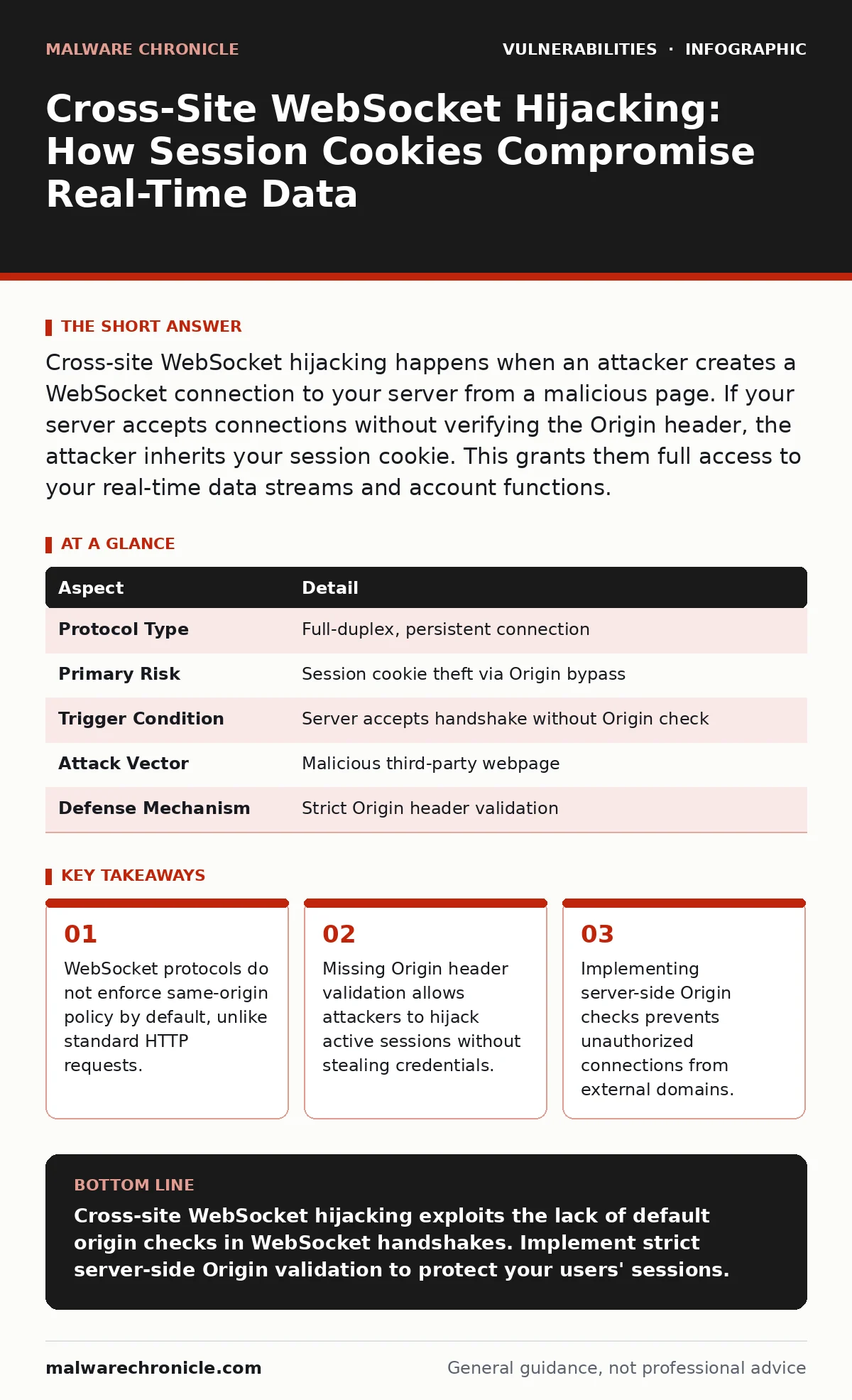
Cross-site WebSocket hijacking happens when an attacker creates a WebSocket connection to your server from a malicious page. If your server accepts connections without verifying the Origin header, the attacker inherits your session cookie. This grants them full access to your real-time data streams and account functions.
Understanding the Connection Mechanism
WebSocket technology creates a persistent, full-duplex communication channel between a client and a server. This protocol allows servers to push data to clients instantly without the client needing to request it. Unlike traditional HTTP, which follows a strict request-response cycle, WebSocket maintains an open connection. This efficiency makes it ideal for live chat, stock tickers, and collaborative editing tools. The initial handshake uses HTTP, but once upgraded, the connection bypasses many standard browser security restrictions. This transition is where the vulnerability often hides.
| Aspect | Detail |
|---|---|
| Protocol Type | Full-duplex, persistent connection |
| Primary Risk | Session cookie theft via Origin bypass |
| Trigger Condition | Server accepts handshake without Origin check |
| Attack Vector | Malicious third-party webpage |
| Defense Mechanism | Strict Origin header validation |
How Cross-Site WebSocket Hijacking Works
The attack relies on a fundamental difference between WebSocket and standard web requests. When you visit a malicious website, that site can instruct your browser to open a WebSocket connection to a trusted server where you are already logged in. The browser automatically attaches your session cookies to this handshake request. If the trusted server does not verify the Origin header, it assumes the connection is legitimate. The attacker then gains a proxy to your account. They can read incoming messages and send commands as if they were you. This happens in real time, often without any alert on your end.
Who Is Affected by This Vulnerability
Any application using WebSocket for authenticated users is at risk. Real-time collaboration platforms, online gaming services, and live notification systems are common targets. The vulnerability affects the server-side implementation more than the client-side code. If your backend accepts connections from any source, your users are exposed. This includes internal tools and administrative dashboards. Attackers often target high-value accounts where real-time data has immediate monetary or operational value. The impact is direct account compromise, not just data leakage.
What People Usually Get Wrong
Many developers assume the browser's same-origin policy protects WebSocket connections. This assumption is incorrect. The WebSocket specification explicitly allows cross-origin connections to facilitate legitimate use cases like cross-domain APIs. The browser does not block the handshake automatically. Another common error is relying solely on CORS headers. CORS does not apply to WebSocket handshakes in the same way it applies to XHR or Fetch requests. Developers must implement explicit server-side logic to reject unauthorized origins. Relying on middleware defaults without verification leaves a wide gap in your security posture.
Implementing Server-Side Origin Validation
The primary defense is strict validation of the Origin header during the handshake phase. Your server must compare the Origin header against a whitelist of allowed domains. If the header is missing or does not match a trusted domain, the server must reject the connection. This check happens before the WebSocket connection is fully established. You should define this whitelist explicitly rather than using wildcard patterns. Wildcards can inadvertently allow malicious subdomains or typo-squatting sites. This validation ensures that only your own interfaces can initiate real-time sessions.
Handling Edge Cases and Proxy Configurations
Proxies and load balancers can strip or modify the Origin header. If you use a reverse proxy, ensure it forwards the original Origin header to your application server. Misconfigured proxies can cause legitimate connections to fail validation. You must also handle cases where the Origin header is absent, such as in older browsers or specific mobile environments. In these cases, failing open is dangerous. Consider requiring an additional authentication token within the initial WebSocket message if the Origin header cannot be verified. This adds a layer of defense without breaking compatibility for all clients.
Integrating with Broader Security Practices
WebSocket security does not exist in isolation. You should combine Origin validation with other controls. Secure your session cookies with the SameSite attribute to limit cross-site sending. Use HTTPS to encrypt the WebSocket connection, preventing man-in-the-middle attacks. Regular vulnerability scanning can identify misconfigured endpoints that accept unvalidated connections. Incorporate static application security testing (SAST) into your development pipeline to catch missing Origin checks early. These measures create a defense-in-depth strategy. They reduce the likelihood of a successful hijacking attempt even if one control fails.
Monitoring and Incident Response
Once deployed, monitor WebSocket connections for anomalies. Look for connections originating from unexpected IP ranges or user agents. Implement logging for rejected handshake attempts. This data helps identify active scanning or attack attempts. If you suspect a breach, rotate session cookies immediately. Force users to re-authenticate. Document the incident for responsible disclosure if the vulnerability affects a third-party component. Review your security advisories to ensure you have applied recent patches to your WebSocket library. Continuous monitoring ensures you detect and respond to threats quickly.
Key takeaways
- WebSocket protocols do not enforce same-origin policy by default, unlike standard HTTP requests.
- Missing Origin header validation allows attackers to hijack active sessions without stealing credentials.
- Implementing server-side Origin checks prevents unauthorized connections from external domains.
Cross-site WebSocket hijacking exploits the lack of default origin checks in WebSocket handshakes. Implement strict server-side Origin validation to protect your users' sessions.
Frequently asked questions
Does HTTPS prevent cross-site WebSocket hijacking?
No. HTTPS encrypts the data in transit but does not verify the source of the connection. An attacker can still initiate a valid HTTPS WebSocket connection from a malicious site if the server lacks Origin validation.
Can I use authentication tokens instead of cookies?
Yes. Using tokens that are not automatically sent by the browser can mitigate this risk. However, you must still validate the Origin header to prevent unauthorized connection attempts and ensure the token is not exposed to cross-site scripts.
How do I test for this vulnerability?
Use browser developer tools or command-line utilities to send a WebSocket handshake request with a modified or missing Origin header. If the server accepts the connection, it is vulnerable to cross-site WebSocket hijacking.
Is this vulnerability common in modern frameworks?
Many modern frameworks include default protections, but configuration errors are frequent. Custom WebSocket implementations often forget to add Origin validation. Always verify your specific framework's default behavior and documentation.
How this guide was produced: written by the Malware Chronicle editorial team with AI assistance, checked against the public references listed below, and reviewed when the facts change. See our editorial policy or report an error.