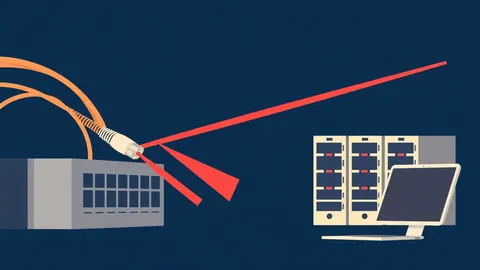
Intrusion detection systems monitor network traffic for suspicious patterns. They alert you to potential breaches but do not block them. Deploy them when you have resources to investigate alerts and combine them with prevention controls for effective defense.
The Visibility Gap in Perimeter Defense
Firewalls enforce access rules based on IP addresses and ports. They allow or deny connections before the data enters your internal network. This binary approach leaves a blind spot. Once traffic is allowed through, the firewall stops inspecting the payload for malicious intent. An intrusion detection system fills this gap. It sits inline or in bypass mode to examine packet contents against known threat signatures and behavioral anomalies.
You gain insight into what happens inside the trusted zone. This is where attackers operate after bypassing initial controls. Without this visibility, you assume safety simply because the perimeter held. That assumption is dangerous. The system logs events that suggest compromise, such as unusual data transfers or repeated failed logins from internal hosts.
Signal Versus Noise in Alert Generation
The primary benefit of detection is early warning. You learn about an attack before it causes significant damage. However, this benefit comes with a heavy cost. Most detection systems generate a high volume of false positives. These are alerts triggered by benign activity that mimics malicious patterns. A software update might look like a command-and-control beacon. A user downloading a large file might trigger a data exfiltration alert.
If you cannot filter noise, the signal disappears. Your team becomes desensitized to warnings. This is known as alert fatigue. You stop investigating alerts because most turn out to be harmless. Meanwhile, a real attack slips through unnoticed because it looks like just another routine alert. The value of the system depends entirely on your ability to tune it and prioritize incidents.
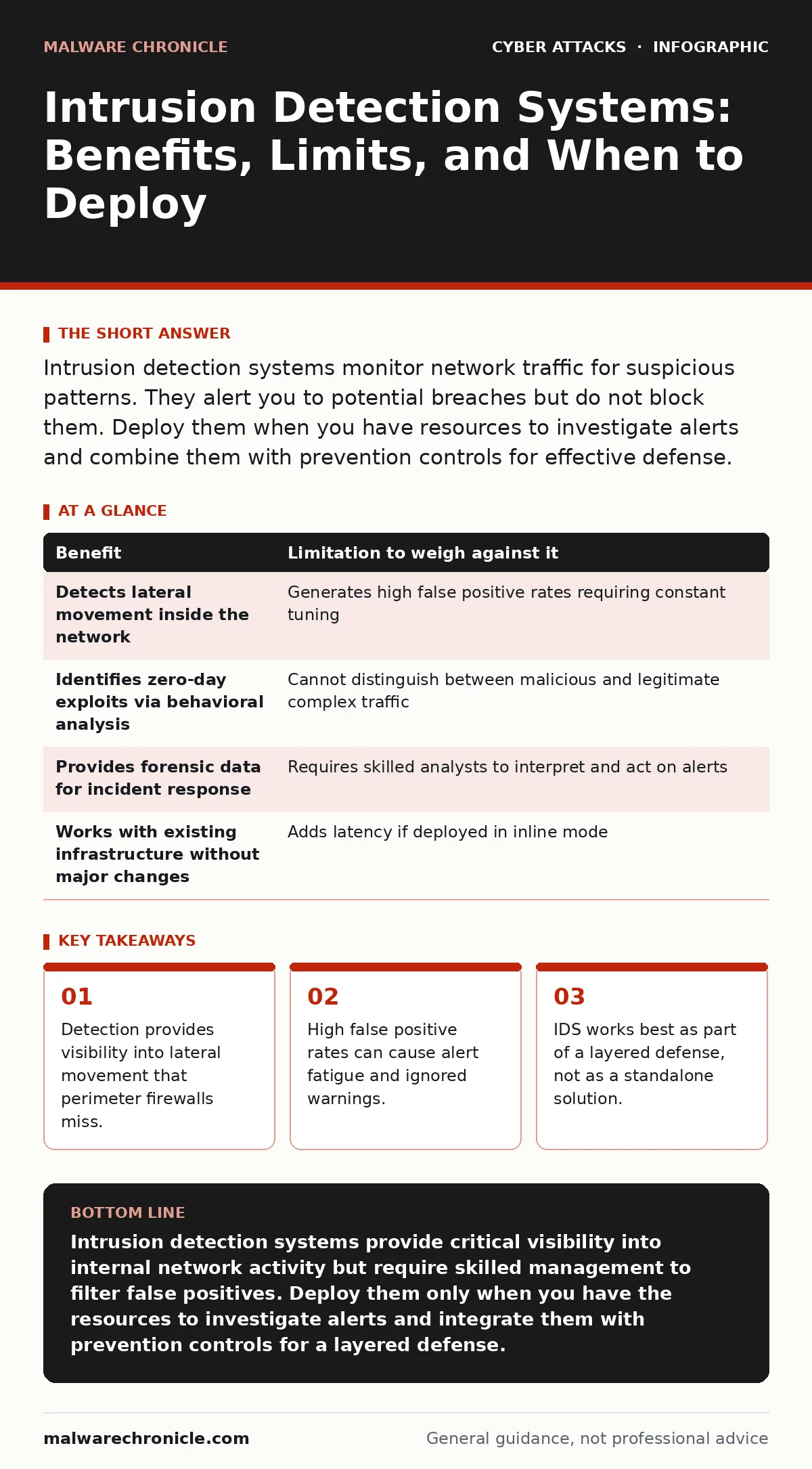
| Benefit | Limitation to weigh against it |
|---|---|
| Detects lateral movement inside the network | Generates high false positive rates requiring constant tuning |
| Identifies zero-day exploits via behavioral analysis | Cannot distinguish between malicious and legitimate complex traffic |
| Provides forensic data for incident response | Requires skilled analysts to interpret and act on alerts |
| Works with existing infrastructure without major changes | Adds latency if deployed in inline mode |
The Hidden Cost of False Positives
Consider the operational burden. Every alert requires human judgment. You must determine if the event is a threat. This takes time and expertise. If your organization lacks a dedicated security operations center, you are likely relying on IT staff who have other duties. They will deprioritize investigation. The system becomes an expensive paperweight.
This connects to the broader challenge of cyber incident response team readiness. Detection is only the first step. You need a process to handle what the system finds. If you buy detection without building response capability, you create a liability. You know you are under attack but lack the bandwidth to react. This delays containment and increases damage.
When Detection Adds Real Value
Detection is worth the investment when you have sensitive data that requires ongoing monitoring. Financial records, intellectual property, and customer information are prime targets. Attackers often move laterally inside the network to find these assets. A firewall cannot see this movement. An IDS can.
It is also valuable when you must comply with regulatory requirements. Many standards mandate continuous monitoring of network traffic. The system provides the audit trail you need to prove due diligence. Furthermore, if you have a mature security team, the tool amplifies their effectiveness. They can correlate alerts with other data sources to identify sophisticated threats.
Imagine a scenario where an attacker uses DNS spoofing to redirect traffic to a malicious server. The firewall sees valid DNS queries and allows the connection. The IDS, however, sees the unusual volume of requests or the specific domain patterns. It flags the activity. Your team can then investigate and block the malicious domain. This layered approach catches what single tools miss.
When to Avoid or Delay Deployment
Do not deploy an IDS if you lack the resources to manage it. If you have no staff to review alerts, the system will not protect you. It will only create anxiety. Similarly, avoid it if your network traffic is highly encrypted and you cannot decrypt it for inspection. Many modern protocols use strong encryption. If the IDS cannot see the payload, it can only look at metadata. This limits its effectiveness significantly.
Rate limiting is a simpler control that can mitigate many common attacks without the complexity of deep packet inspection. If your main concern is volume-based attacks like SYN flood attacks, a firewall with rate limiting rules is more effective and easier to manage. You do not need deep inspection to stop a flood of connection requests. You just need to drop excess traffic.
See also: Difference Between Network Scanning and Port Scanning: How to Detect and Respond · SYN Flood Attack Response: Containment, Recovery, and Prevention Steps
Integrating with Other Security Layers
An IDS works best when integrated with other controls. For example, secure email gateways block malicious attachments before they reach your users. This reduces the chance of an infection that the IDS would later detect. The fewer threats that reach your network, the easier it is for the IDS to focus on real anomalies.
You can also use detection data to improve your prevention rules. If the IDS flags a specific IP address as malicious, you can update your firewall to block it. This creates a feedback loop. Detection informs prevention, and prevention reduces the load on detection. This synergy is more effective than either tool working alone.
Consider phishing simulations as a way to reduce human error. If users click fewer malicious links, there are fewer infections for the IDS to detect. This reduces noise and improves the signal-to-noise ratio. You are addressing the root cause rather than just monitoring the symptoms.
The Reality of Behavioral Analysis
Modern systems use behavioral analysis to detect unknown threats. They look for deviations from normal baseline activity. This is powerful but imperfect. Normal behavior changes over time. New applications, software updates, and user habits shift the baseline. If the system is not updated, it will flag legitimate changes as malicious.
This requires continuous tuning. You must adjust the baseline to reflect current operations. If you ignore this, the system becomes useless. It will either alert on everything or nothing. Behavioral analysis is not a set-and-forget solution. It demands ongoing attention and expertise.
Key takeaways
- Detection provides visibility into lateral movement that perimeter firewalls miss.
- High false positive rates can cause alert fatigue and ignored warnings.
- IDS works best as part of a layered defense, not as a standalone solution.
Intrusion detection systems provide critical visibility into internal network activity but require skilled management to filter false positives. Deploy them only when you have the resources to investigate alerts and integrate them with prevention controls for a layered defense.
Frequently asked questions
Does an IDS block malware automatically?
No, standard intrusion detection systems only alert on suspicious activity. You need an intrusion prevention system or manual intervention to block the threat.
Can I use an IDS for cloud environments?
Yes, many cloud providers offer detection services that monitor virtual network traffic. The principles remain the same, but the deployment method differs.
How do I reduce false positives?
Tune the system regularly by adjusting thresholds and whitelisting known benign traffic. Start with a narrow scope and expand as your team gains experience.
Is an IDS enough for compliance?
It helps meet monitoring requirements, but compliance usually demands a broader set of controls including access management, encryption, and incident response plans.
How this guide was produced: written by the Malware Chronicle editorial team with AI assistance, checked against the public references listed below, and reviewed when the facts change. See our editorial policy or report an error.