
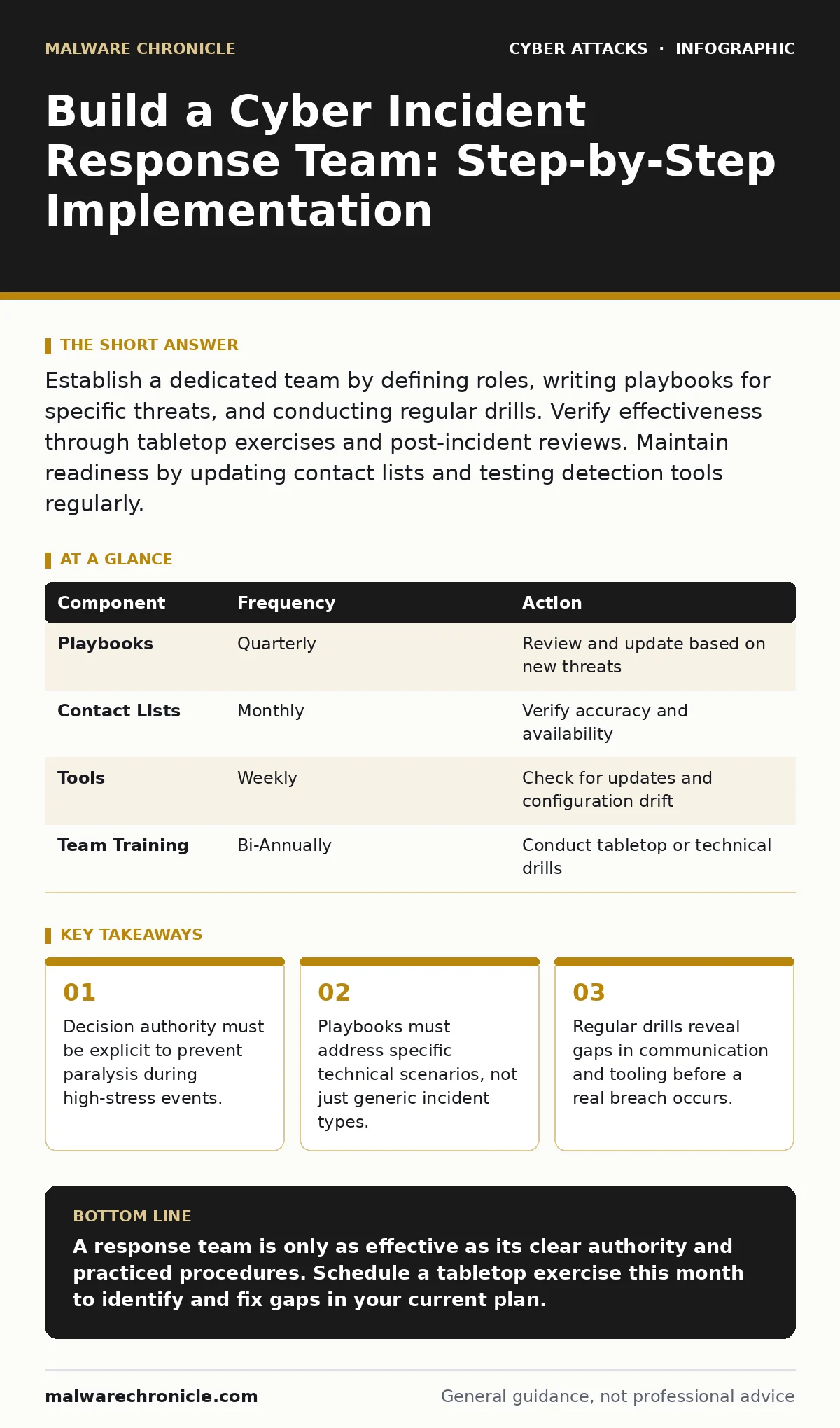
Establish a dedicated team by defining roles, writing playbooks for specific threats, and conducting regular drills. Verify effectiveness through tabletop exercises and post-incident reviews. Maintain readiness by updating contact lists and testing detection tools regularly.
Define Decision Authority and Roles
A response team fails when members hesitate because they do not know who holds final authority. You must assign a single incident commander who dictates the technical and operational direction. This person overrides conflicting advice from legal, HR, or senior management during the active containment phase.
Supporting roles include technical responders who execute containment, communicators who handle internal and external messaging, and legal advisors who assess liability. Each role needs a primary owner and a designated backup. If the primary responder is unavailable, the backup must have immediate access to all necessary systems.
Draft Scenario-Specific Playbooks
Generic procedures fail because they do not address the unique mechanics of specific threats. You need detailed playbooks for the most likely incidents your organization faces. Start with credential compromise, ransomware, and data exfiltration.
Each playbook must define the trigger condition, the immediate containment steps, and the evidence preservation requirements. For example, a ransomware playbook must specify which backups to isolate and which network segments to disconnect. A credential compromise playbook must detail how to reset tokens without locking out legitimate users.
Establish Secure Communication Channels
Standard email and chat tools are often compromised or monitored by attackers during an incident. You need a dedicated, out-of-band communication channel that remains accessible even if internal systems go dark. This could be a separate messaging platform or a secure phone tree.
The communication plan must include a distribution list for internal stakeholders and a script for external notifications. Define who approves public statements before they are released. Delaying communication to craft the perfect message often causes more reputational damage than an initial, factual update.
Numbered Rollout Steps
Step 1: Inventory Critical Assets and Dependencies
You cannot protect what you cannot identify. Create a detailed map of your critical data stores, application servers, and network boundaries. Identify which systems depend on others for functionality.
Verification: Draw a dependency map for three critical applications. Confirm that the map matches the actual network traffic patterns observed by your intrusion detection systems. If the IDS shows traffic between systems not listed on your map, update the inventory immediately.
Step 2: Define Detection Triggers and Alerts
Alerts must be actionable. You need to configure your monitoring tools to distinguish between routine anomalies and genuine threats. This reduces alert fatigue and ensures responders focus on real incidents.
Verification: Review the last week of alerts. Identify which alerts required investigation and which were false positives. Adjust thresholds so that only high-fidelity events trigger the incident response workflow. Consider how rate limiting might mask certain brute-force attacks, requiring different detection logic.
Step 3: Execute a Tabletop Exercise
A tabletop exercise is a discussion-based simulation where team members walk through a hypothetical incident. You present a scenario, such as a phishing simulations success that leads to data theft, and ask each team member what they would do next.
Verification: Record the decisions made and the time taken to reach consensus. Identify any gaps in knowledge or authority. If the team debates who should contact law enforcement, your role definition is unclear. Fix this ambiguity before a real event.
Step 4: Conduct a Technical Drill
A technical drill tests your tools and processes in a controlled environment. You simulate an incident by introducing a benign threat, such as a simulated SYN flood attacks or a test ransomware file, and measure the response time.
Verification: Measure the time from detection to containment. Compare this against your service level objectives. If the containment took longer than expected, identify the bottleneck. Was it a slow log query or a missing administrative privilege?
Step 5: Integrate External Support
Define when and how you will involve external partners, such as forensic investigators or legal counsel. Establish contracts and data-sharing agreements before an incident occurs. This reduces negotiation time when seconds count.
Verification: Confirm that external partners have up-to-date contact information and access credentials. Test the data transfer mechanism to ensure you can share logs securely and quickly.
Verify Effectiveness Through Post-Incident Reviews
After every drill or real incident, conduct a blameless post-mortem. The goal is to improve processes, not to assign fault. Document what worked, what failed, and what needs to change.
Update playbooks based on these findings. If a step was skipped because it was unclear, rewrite it. If a tool failed, replace or reconfigure it. This continuous improvement loop is the only way to maintain readiness.
See also: Attacker Dwell Time: Definition, Measurement and Reduction Tactics · How Threat Hunting Works: The Mechanics of Proactive Defense
Maintain Readiness Through Regular Upkeep
Incident response capabilities decay if not exercised. You must schedule regular reviews of your playbooks, contact lists, and tool configurations. Technology changes, and so do threats.
Review your conditional access policies to ensure they align with current business needs. Check that secure email gateways are filtering correctly. Verify that DNS spoofing protections are active. These technical controls form the first line of defense, reducing the load on your response team.
Common Pitfalls to Avoid
One common pitfall is neglecting payroll diversion fraud in financial playbooks. This type of attack often bypasses traditional technical controls by targeting human processes. Ensure your playbooks include steps for verifying payment changes through secondary channels.
Another pitfall is assuming that technical responders can handle all communication. Separating technical and communication roles prevents missteps that could escalate the incident legally or reputationally.
| Component | Frequency | Action |
|---|---|---|
| Playbooks | Quarterly | Review and update based on new threats |
| Contact Lists | Monthly | Verify accuracy and availability |
| Tools | Weekly | Check for updates and configuration drift |
| Team Training | Bi-Annually | Conduct tabletop or technical drills |
Key takeaways
- Decision authority must be explicit to prevent paralysis during high-stress events.
- Playbooks must address specific technical scenarios, not just generic incident types.
- Regular drills reveal gaps in communication and tooling before a real breach occurs.
A response team is only as effective as its clear authority and practiced procedures. Schedule a tabletop exercise this month to identify and fix gaps in your current plan.
Frequently asked questions
How many people should be on an incident response team?
The size depends on your organization, but a core team of four to six people with defined roles is typical for small to mid-sized businesses.
Do we need a dedicated incident response team if we outsource security?
Yes, you still need an internal point of contact and decision-maker to coordinate with external providers and manage internal communications.
How often should we update our incident response plan?
Update it after every significant infrastructure change, every drill, and at least once a year to account for evolving threats.
What is the first step in an incident response plan?
The first step is detection and analysis, where you confirm that an incident has occurred and classify its severity.
How this guide was produced: written by the Malware Chronicle editorial team with AI assistance, checked against the public references listed below, and reviewed when the facts change. See our editorial policy or report an error.