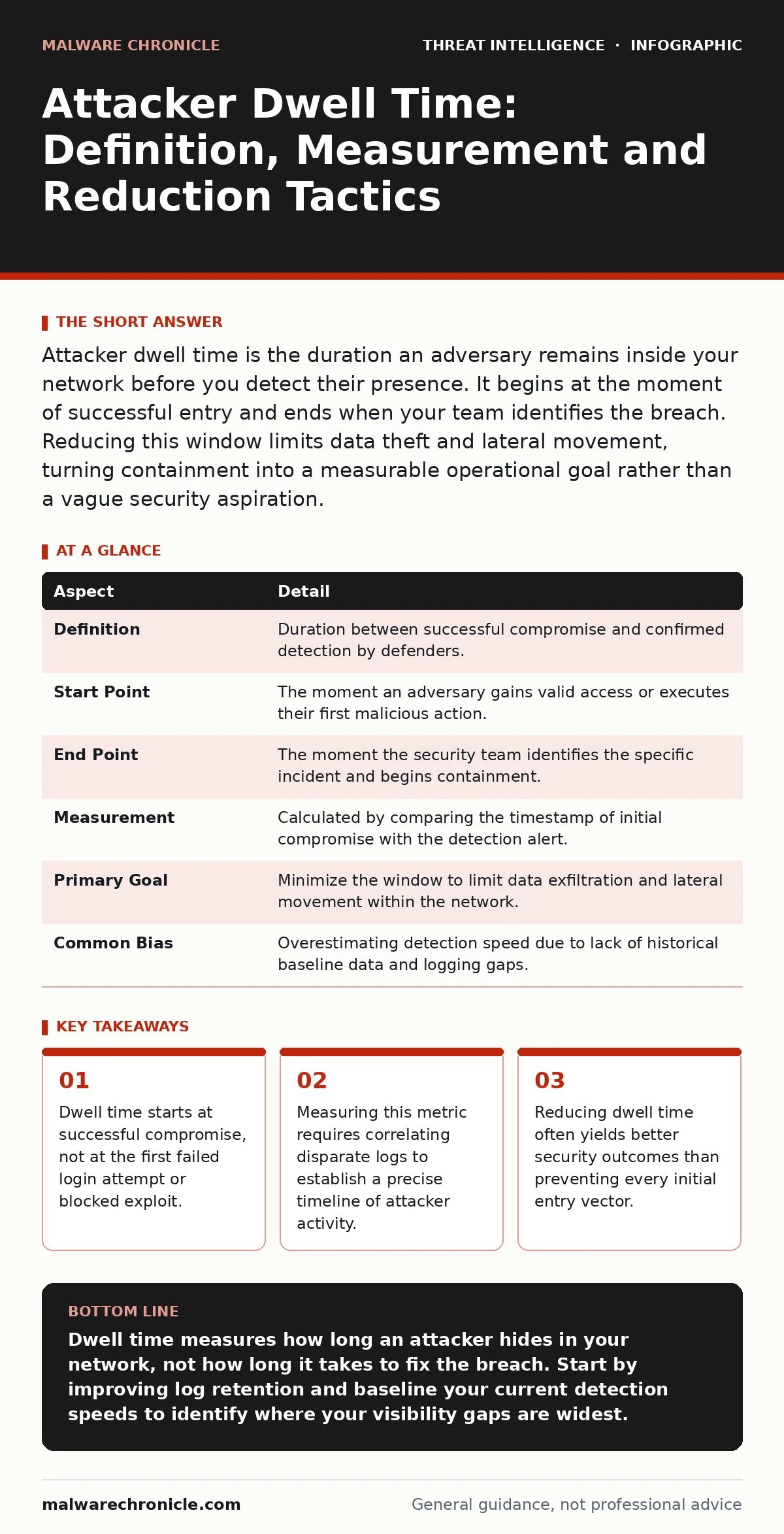
Attacker dwell time is the duration an adversary remains inside your network before you detect their presence. It begins at the moment of successful entry and ends when your team identifies the breach. Reducing this window limits data theft and lateral movement, turning containment into a measurable operational goal rather than a vague security aspiration.
The Clock Starts at Entry
Imagine a burglar who picks your lock, walks in, and waits in the shadows while you check your alarm system. The time between their entry and your discovery of them is the critical window. In cybersecurity, this interval is known as attacker dwell time. It is not the time spent planning the attack from the outside. It is not the duration of the initial phishing email campaign. It is the specific period during which the adversary has valid access and is operating within your environment.
This definition matters because it shifts the focus from prevention alone to detection and response. No perimeter is impenetrable. Accepting that breaches will occur forces organizations to prioritize how quickly they can find the intruder. The goal is not to make the burglar unable to pick the lock. The goal is to spot the burglar before they reach the safe.
| Aspect | Detail |
|---|---|
| Definition | Duration between successful compromise and confirmed detection by defenders. |
| Start Point | The moment an adversary gains valid access or executes their first malicious action. |
| End Point | The moment the security team identifies the specific incident and begins containment. |
| Measurement | Calculated by comparing the timestamp of initial compromise with the detection alert. |
| Primary Goal | Minimize the window to limit data exfiltration and lateral movement within the network. |
| Common Bias | Overestimating detection speed due to lack of historical baseline data and logging gaps. |
Origins in Field Practice
The concept emerged from the realization that traditional perimeter defenses fail against determined adversaries. Early network security assumed that if you stopped the entry, you won. When attackers bypassed firewalls and antivirus software, defenders realized the battle moved inside. The term became standard in incident response methodologies as teams began tracking how long they were blind to intrusions.
In practice, dwell time is a diagnostic tool. It reveals the effectiveness of your monitoring capabilities. If an attacker moves laterally across your systems for weeks before you notice, your telemetry is insufficient. If you detect them within hours, your visibility is strong. This metric forces a conversation about what you can see versus what you assume is safe. It moves security from a static state of compliance to a dynamic state of awareness.
Daily Operational Usage
Security operations teams use dwell time to benchmark their detection capabilities. They compare current incidents against historical averages to identify regression. If dwell time increases, it indicates that attackers are adapting or that monitoring has degraded. Teams also use it to prioritize alert triage. Incidents with longer potential dwell times often indicate more sophisticated adversaries who are careful to avoid triggering alarms.
This metric also drives resource allocation. If most breaches are detected within days, investing in real-time endpoint detection may yield diminishing returns. If breaches persist for months, improving log collection and correlation becomes the priority. It helps leaders justify budgets for better tools or training. It transforms abstract fear into a concrete operational target. The daily work involves reviewing alerts, validating them, and backtracking to find the true start time of the intrusion.
The Measurement Challenge
Calculating dwell time accurately is difficult. Most organizations do not know when an attacker first entered. They only know when they found him. This creates a survivorship bias. You measure what you detect. You cannot measure what you miss. The true dwell time for undetected breaches is unknown, meaning your average is likely an underestimate.
To improve accuracy, teams must enhance their logging infrastructure. They need detailed records of authentication events, process creation, and network connections. Without these logs, backtracking is guesswork. The challenge is balancing storage costs with retention periods. If logs are deleted after thirty days, you cannot measure breaches that took forty days to detect. This limitation often leads to inaccurate reporting and false confidence in security posture.
Common Misconceptions
Many professionals confuse dwell time with response time. Response time is how long it takes to contain the breach after detection. Dwell time is how long the attacker was hidden. A fast response does not fix a long dwell time. You can contain a breach in minutes, but if the attacker was inside for six months, the damage is already done.
Another error is assuming that lower dwell time equals perfect security. It does not. It means you are good at finding intruders. It does not mean they cannot enter. Some teams focus so much on reducing dwell time that they neglect prevention. This is a false trade-off. Both are necessary. Prevention reduces the frequency of breaches. Detection reduces the impact of those that slip through. Ignoring either leaves you vulnerable.
See also: Cryptojacking Response: Immediate Steps to Contain and Recover · Security Misconfigurations: Response and Recovery Steps
Hidden Costs of Visibility
Reducing dwell time requires significant investment in visibility. You must collect, store, and analyze vast amounts of data. This creates noise. More data means more alerts. More alerts mean analyst fatigue. When teams are overwhelmed by false positives in threat detection, they miss the real signals. The cost of visibility is not just financial. It is cognitive.
You must tune your detection rules carefully. Broad rules catch everything but drown analysts in noise. Narrow rules miss novel attacks. The balance is delicate. You also need skilled personnel to interpret the data. Tools alone do not reduce dwell time. Human analysis does. This creates a hidden labor cost that many organizations underestimate. They buy the sensor but not the analyst to watch it.
Strategic Implications for Architecture
Your network architecture influences dwell time. Flat networks allow attackers to move freely once they breach the perimeter. Segmented networks limit lateral movement. Even if an attacker enters, they cannot reach critical assets quickly. This architectural choice reduces the impact of a long dwell time. You cannot always control when an attacker enters. You can control what they can do once inside.
Integrating threat hunting into your routine helps find the hidden attackers. Proactive searches uncover threats that automated systems miss. This reduces the average dwell time by finding intruders before they trigger alerts. It also improves your detection rules for the future. The architecture must support both containment and rapid detection. Designing for speed is as important as designing for strength.
Key takeaways
- Dwell time starts at successful compromise, not at the first failed login attempt or blocked exploit.
- Measuring this metric requires correlating disparate logs to establish a precise timeline of attacker activity.
- Reducing dwell time often yields better security outcomes than preventing every initial entry vector.
- Operational visibility gaps, not just tool failures, typically extend the period an attacker remains hidden.
Dwell time measures how long an attacker hides in your network, not how long it takes to fix the breach. Start by improving log retention and baseline your current detection speeds to identify where your visibility gaps are widest.
Frequently asked questions
Does zero dwell time mean I am secure?
No. Zero dwell time implies immediate detection of every attempt. This is theoretically possible but practically unachievable. It also does not prevent the initial entry, which may still cause damage before detection.
How do I reduce dwell time without buying more tools?
Improve your existing log collection and correlation. Ensure you are capturing authentication and process events. Train analysts to recognize subtle anomalies rather than relying solely on automated alerts.
Is dwell time the same as mean time to detect?
They are related but distinct. Mean time to detect (MTTD) is an average metric across all incidents. Dwell time is the specific duration for a single incident. MTTD is a statistical average derived from individual dwell times.
Can attackers manipulate dwell time metrics?
Yes. Adversaries may pause their activity to avoid detection, artificially extending the apparent dwell time. They may also delete logs to obscure their entry point, making accurate measurement impossible for defenders.
How this guide was produced: written by the Malware Chronicle editorial team with AI assistance, checked against the public references listed below, and reviewed when the facts change. See our editorial policy or report an error.