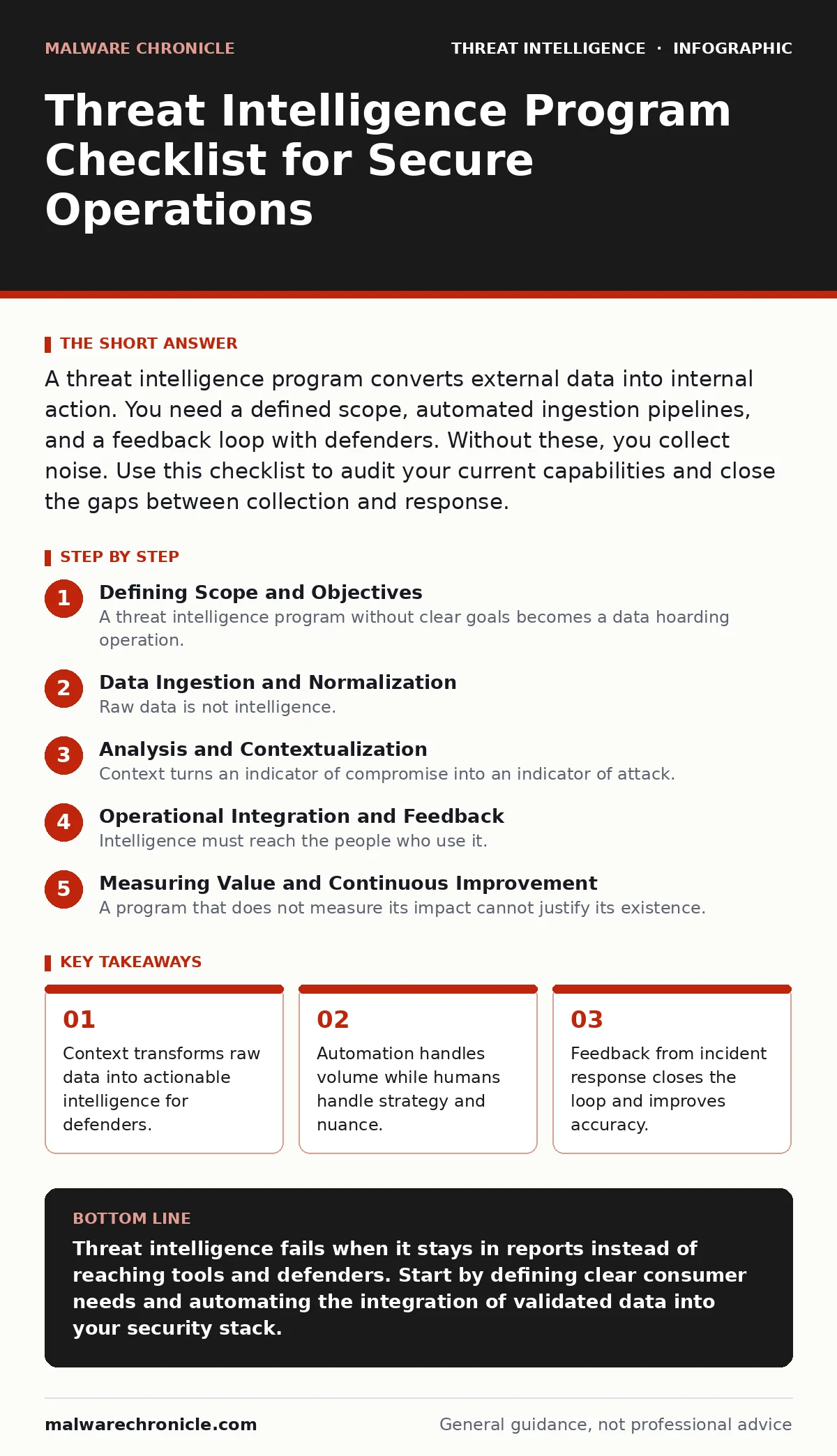
A threat intelligence program converts external data into internal action. You need a defined scope, automated ingestion pipelines, and a feedback loop with defenders. Without these, you collect noise. Use this checklist to audit your current capabilities and close the gaps between collection and response.
Defining Scope and Objectives
A threat intelligence program without clear goals becomes a data hoarding operation. You must define what questions the program answers before collecting a single datum. This prevents alert fatigue and ensures resources focus on relevant risks.
- Define specific consumer needs: aligning intelligence with defender workflows prevents irrelevant noise from overwhelming security operations.
- Identify key assets and attack surfaces: focusing on what matters most reduces the signal-to-noise ratio in your monitoring tools.
- Establish measurable success criteria: defining what "good" looks like allows you to validate the program's impact over time.
Imagine you track every new vulnerability published globally. That is wasted effort. A scoped program filters for relevance first. This approach mirrors the principles in the Unified Kill Chain, where you focus on stages that actually impact your environment.
Data Ingestion and Normalization
Raw data is not intelligence. You must ingest feeds, open-source reports, and internal logs into a single platform. Normalization ensures that disparate sources speak the same language. Without this step, correlation fails.
- Integrate multiple data sources: combining open-source, commercial, and internal data provides a holistic view of the threat environment.
- Normalize data formats: using standard schemas like STIX/TAXII allows automated tools to process and correlate information effectively.
- Automate initial filtering: removing low-quality or irrelevant data at the ingestion stage reduces processing overhead for analysts.
Normalizing data means converting different formats into a common structure. This allows your systems to match an IP address from a firewall log with a known malicious domain from a threat feed. If you skip this, your analysts spend hours manually matching records. This foundational work supports operational threat intelligence, which focuses on immediate defense rather than long-term strategy.
Analysis and Contextualization
Context turns an indicator of compromise into an indicator of attack. You must analyze data to understand intent, capability, and impact. This step separates noise from signal.
- Contextualize indicators of compromise: linking IPs or domains to specific campaigns helps defenders prioritize responses based on actual risk.
- Profile threat actors: understanding who is attacking and why informs defensive strategies and resource allocation.
- Map findings to MITRE ATT&CK: connecting techniques to a standard framework enables better detection engineering and gap analysis.
Contextualization answers the "so what?" question. A malicious IP is just a number until you know it belongs to a group targeting your industry. This process aligns with threat actor profiling, where you study motivations and methods. By mapping to frameworks, you create reusable knowledge that survives personnel changes. This prevents the loss of institutional memory when analysts leave.
Operational Integration and Feedback
Intelligence must reach the people who use it. Integration into security tools ensures timely action. Feedback from defenders validates the intelligence and improves future cycles.
- Push intelligence to security tools: integrating feeds into SIEM, EDR, and firewalls enables automated blocking and detection.
- Develop detection rules: creating Sigma rules based on intelligence ensures consistent detection across different platforms.
- Establish a feedback loop: gathering input from responders helps refine intelligence quality and relevance.
Without integration, intelligence sits in a dashboard no one visits. Pushing data to endpoints and networks allows for proactive blocking. When defenders use your intelligence, they should report back. Did the alert fire? Was it a false positive? This feedback loop is critical. It ensures your program evolves with the threat environment. Consider how process injection techniques evolve; your detection rules must update accordingly.
See also: Difference Between Network Scanning and Port Scanning: How to Detect and Respond · Sysmon Configuration Mistakes That Blind Your Threat Detection
Measuring Value and Continuous Improvement
A program that does not measure its impact cannot justify its existence. You must track metrics that demonstrate value to stakeholders. Continuous improvement ensures the program remains relevant.
- Track detection and response times: measuring how quickly intelligence leads to action demonstrates operational efficiency.
- Monitor false positive rates: keeping false positives low maintains trust and ensures defenders prioritize your alerts.
- Review and update processes regularly: adapting to new threats and technologies keeps the program effective and relevant.
Measuring value goes beyond counting reports produced. You need to know if intelligence reduced dwell time or prevented an incident. Tracking false positive rates is equally important. High noise levels cause alert fatigue. Regular reviews ensure you discard outdated methods and adopt new ones. This continuous cycle ensures resilience against evolving tactics like Kerberoasting or sophisticated phishing infrastructure.
Key takeaways
- Context transforms raw data into actionable intelligence for defenders.
- Automation handles volume while humans handle strategy and nuance.
- Feedback from incident response closes the loop and improves accuracy.
Threat intelligence fails when it stays in reports instead of reaching tools and defenders. Start by defining clear consumer needs and automating the integration of validated data into your security stack.
Frequently asked questions
How do I start a threat intelligence program with limited resources?
Begin by identifying your top 3 critical assets and finding 2-3 reliable open-source feeds. Focus on integrating these into your existing tools before expanding.
What is the difference between tactical and strategic intelligence?
Tactical intelligence supports immediate defense, like blocking IPs. Strategic intelligence informs long-term risk decisions and resource planning.
How often should I update my detection rules?
Update rules when new intelligence emerges or when false positive rates rise. Regular weekly reviews are a good baseline for most environments.
Can I rely solely on automated threat intelligence feeds?
No. Automation handles volume, but human analysis provides context. Relying only on automation misses nuanced threats and leads to high false positive rates.
How this guide was produced: written by the Malware Chronicle editorial team with AI assistance, checked against the public references listed below, and reviewed when the facts change. See our editorial policy or report an error.