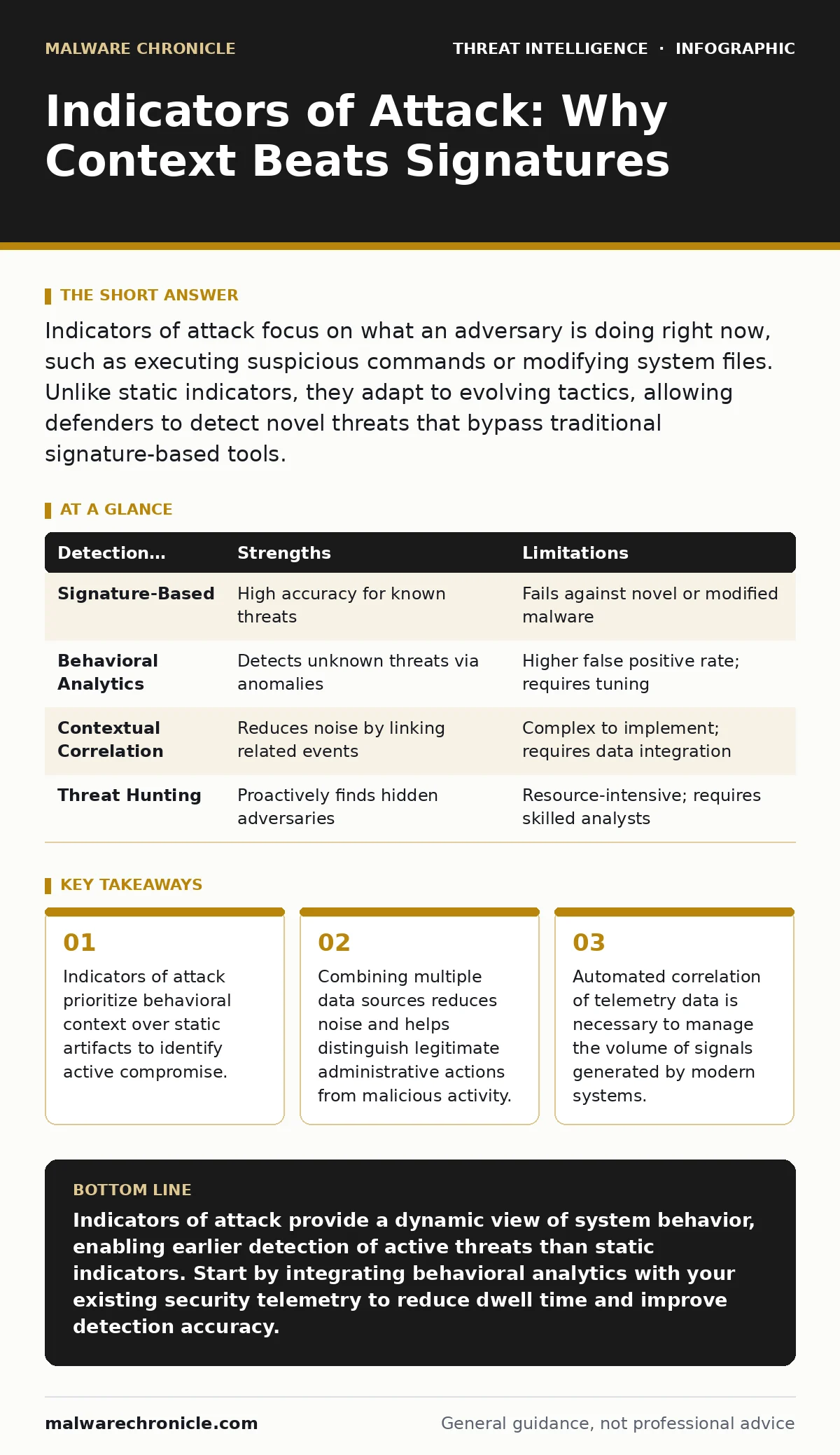
Indicators of attack focus on what an adversary is doing right now, such as executing suspicious commands or modifying system files. Unlike static indicators, they adapt to evolving tactics, allowing defenders to detect novel threats that bypass traditional signature-based tools.
What distinguishes an indicator of attack from a traditional indicator of compromise?
An indicator of attack focuses on active behaviors and system states, while an indicator of compromise relies on static artifacts like file hashes or known malicious IP addresses. Traditional indicators often fail against novel threats because they require prior knowledge of the specific malware or infrastructure. Indicators of attack, by contrast, look for patterns of behavior that suggest an adversary is present, regardless of the specific tools used. This shift allows defenders to detect previously unseen threats that mimic legitimate activity.
How do behavioral patterns help identify active adversaries?
Behavioral patterns reveal intent by tracking sequences of actions that deviate from normal system operations. An adversary might execute a series of commands to enumerate user accounts, disable security logging, or establish persistence mechanisms. These actions create a distinct signature of activity that differs from routine administrative tasks. By monitoring these sequences, you can identify intrusions even when the adversary uses clean tools or living-off-the-land binaries.
Which system telemetry sources provide the most value for detection?
Process creation events, network connection logs, and file system modifications offer the highest signal-to-noise ratio for detecting active attacks. Process creation logs show which executables are running and their command-line arguments. Network logs reveal unexpected outbound connections to unknown destinations. File system changes highlight unauthorized modifications to critical system directories. Combining these sources provides a holistic view of system activity, making it harder for adversaries to hide their tracks.
Why is context critical for reducing false positives?
Context transforms raw data into actionable intelligence by correlating events with user roles, system baselines, and historical behavior. A command that looks suspicious in isolation might be routine for a specific service account. Without context, you generate excessive alerts that overwhelm analysts and lead to alert fatigue. By establishing baselines for normal activity, you can flag deviations that are statistically unlikely to be legitimate. This approach significantly reduces noise and focuses attention on genuine threats.
How can you automate the correlation of disparate signals?
Automation tools ingest logs from multiple sources and apply rules to identify correlated events. These tools use algorithms to link related activities, such as a process spawning a child process that then connects to an external server. Manual correlation is too slow and error-prone for modern environments. Automated systems can process millions of events per second, identifying patterns that human analysts would miss. This speed is vital for detecting fast-moving attacks that leave little time for manual investigation.
See also: Process Injection Mechanics: Step-by-Step Execution Flow · Sysmon Best Practices: Reduce Noise and Catch Hidden Threats
What role do behavioral analytics play in modern detection strategies?
Behavioral analytics use machine learning models to identify anomalies in system behavior without relying on predefined rules. These models learn what normal activity looks like for each user and system, then flag deviations. This approach detects novel attacks that do not match known signatures. However, behavioral analytics require high-quality data and careful tuning to avoid generating excessive false positives. They complement rule-based detection by covering gaps where traditional methods fail.
How do you handle the complexity of multi-stage attacks?
Multi-stage attacks involve a sequence of actions across different systems and timeframes, making them difficult to detect in isolation. You must correlate events across endpoints, network devices, and cloud services to see the full picture. This requires a centralized view of security data and sophisticated correlation logic. Breaking down the attack into individual stages and tracking the progression helps identify the adversary's ultimate goal. This approach reveals the broader campaign rather than just individual incidents.
| Detection Method | Strengths | Limitations |
|---|---|---|
| Signature-Based | High accuracy for known threats | Fails against novel or modified malware |
| Behavioral Analytics | Detects unknown threats via anomalies | Higher false positive rate; requires tuning |
| Contextual Correlation | Reduces noise by linking related events | Complex to implement; requires data integration |
| Threat Hunting | Proactively finds hidden adversaries | Resource-intensive; requires skilled analysts |
Can indicators of attack detect fileless malware?
Yes, indicators of attack are effective against fileless malware because they monitor runtime behavior rather than static files. Fileless malware executes directly in memory, leaving no traditional artifacts on disk. However, it still generates process creation events, network connections, and registry modifications. By monitoring these behavioral indicators, you can detect fileless attacks that evade signature-based tools. This capability is critical for defending against sophisticated adversaries who avoid leaving traces on disk.
How do you balance detection sensitivity with operational efficiency?
Balancing sensitivity and efficiency requires continuous tuning of detection rules and thresholds. Overly sensitive rules generate excessive alerts, wasting analyst time and leading to burnout. Overly restrictive rules miss genuine threats, leaving the organization vulnerable. You must regularly review alert quality, adjust thresholds based on historical data, and eliminate redundant rules. This iterative process ensures that your detection system remains effective without overwhelming your team.
What is the impact of attacker dwell time on detection success?
Attacker dwell time refers to the period between initial compromise and detection. Longer dwell times allow adversaries to move laterally, exfiltrate data, and establish persistence. Reducing dwell time requires rapid detection and response capabilities. By focusing on indicators of attack, you can identify intrusions earlier in the kill chain. This reduces the window of opportunity for adversaries and limits the potential damage.
Key takeaways
- Indicators of attack prioritize behavioral context over static artifacts to identify active compromise.
- Combining multiple data sources reduces noise and helps distinguish legitimate administrative actions from malicious activity.
- Automated correlation of telemetry data is necessary to manage the volume of signals generated by modern systems.
Indicators of attack provide a dynamic view of system behavior, enabling earlier detection of active threats than static indicators. Start by integrating behavioral analytics with your existing security telemetry to reduce dwell time and improve detection accuracy.
Frequently asked questions
How do indicators of attack differ from threat intelligence feeds?
Threat intelligence feeds provide static data about known threats, while indicators of attack focus on real-time behavioral patterns within your environment.
Can small organizations implement indicators of attack effectively?
Yes, by focusing on high-value telemetry sources like process creation and network logs, small teams can achieve significant detection improvements without excessive complexity.
Do indicators of attack replace the need for antivirus software?
No, they complement antivirus by detecting behaviors that signatures miss, such as novel malware or legitimate tools used maliciously.
How often should detection rules be updated?
Rules should be reviewed and updated regularly based on new threat trends, internal changes, and false positive analysis to maintain effectiveness.
How this guide was produced: written by the Malware Chronicle editorial team with AI assistance, checked against the public references listed below, and reviewed when the facts change. See our editorial policy or report an error.