
Security telemetry fails when treated as raw data rather than contextual signals. You must correct misreadings around volume, correlation, and noise. Focus on behavior over signatures. Verify your stack against known attack patterns. Use structured formats to reduce blind spots in your detection logic.
Misreading: More Data Equals Better Security
You might assume that collecting every possible log entry guarantees visibility. This belief leads to storage bloat and analysis paralysis. In reality, unstructured noise drowns out critical signals. Without normalization, you cannot correlate events across different systems. You need a common schema to make sense of the data.
Correct reading: Quality outweighs quantity. Focus on collecting high-fidelity events that describe actions, not just status updates. Normalize these events into a standard format so your tools can process them efficiently. This approach reduces storage costs and speeds up detection. It also allows you to compare behaviors across different environments.
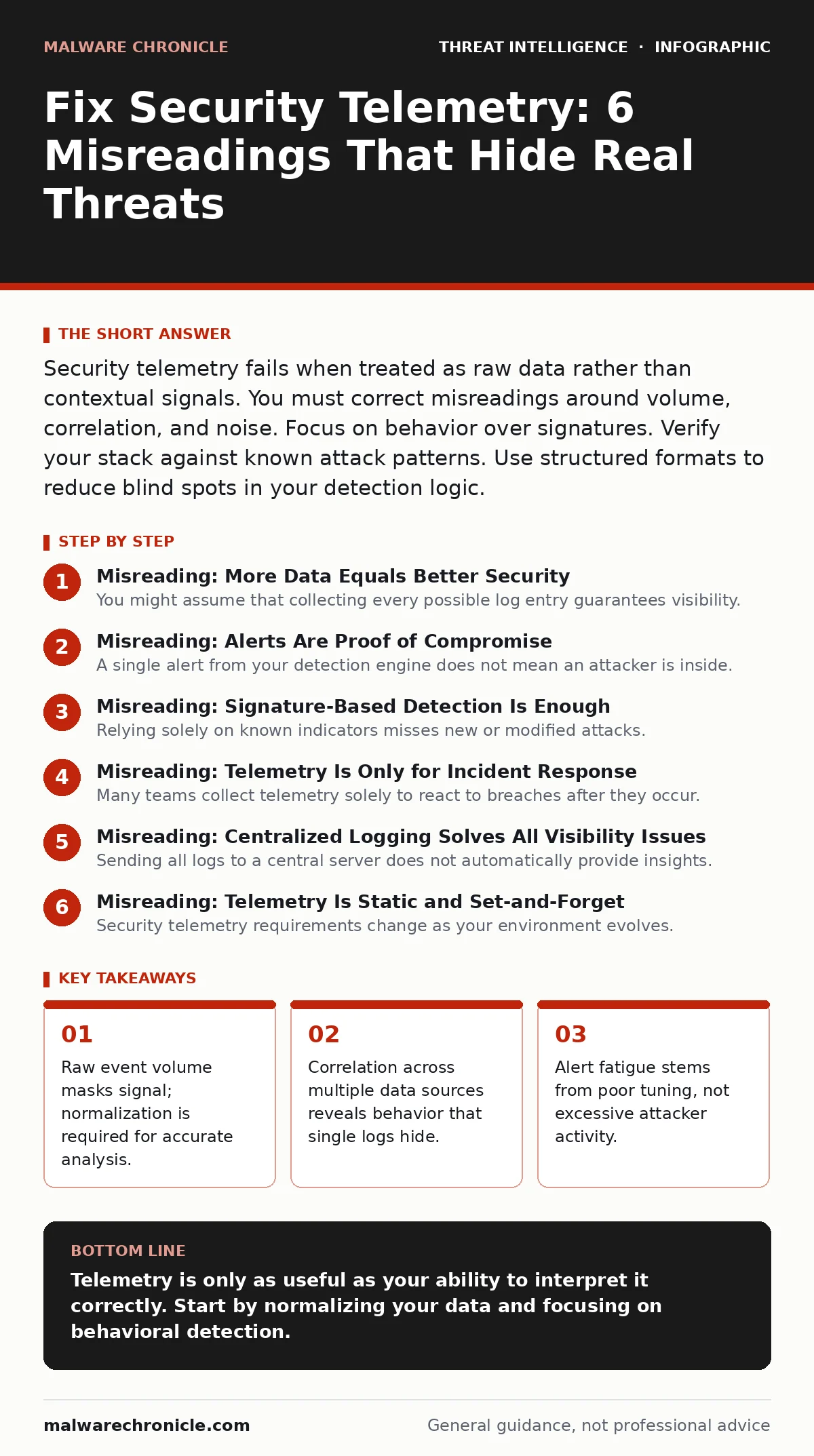
Misreading: Alerts Are Proof of Compromise
A single alert from your detection engine does not mean an attacker is inside. Many alerts trigger on benign activities that mimic malicious patterns. Treating every alert as a confirmed breach wastes investigator time. It also leads to alert fatigue, where teams ignore genuine threats. You must validate findings before taking action.
Correct reading: Alerts are hypotheses, not conclusions. They indicate potential anomalies that require further investigation. Context from other sources is necessary to confirm malicious intent. For example, a login failure might be a user error or a brute-force attempt. You must check for additional signs, such as multiple failures from different locations. This validation process reduces false positives in threat detection.
Misreading: Signature-Based Detection Is Enough
Relying solely on known indicators misses new or modified attacks. Signatures only catch threats that have been seen before. Attackers constantly change their code to bypass these checks. This creates a gap in your defense where novel techniques go unnoticed. You cannot wait for a signature to be published.
Correct reading: Focus on behavior rather than specific file hashes or strings. Behavioral detection looks for actions that are abnormal for a user or system. For instance, a process accessing sensitive files at unusual hours is suspicious. This method catches variants of known malware and zero-day exploits. It requires a baseline of normal activity to identify deviations.
Misreading: Telemetry Is Only for Incident Response
Many teams collect telemetry solely to react to breaches after they occur. This reactive stance ignores the value of proactive monitoring. You can use telemetry to identify weaknesses before attackers exploit them. It also helps in understanding the normal state of your environment. This baseline is crucial for detecting subtle changes.
Correct reading: Telemetry supports both reactive and proactive security strategies. Use it for threat hunting to find hidden activity. Analyze historical data to identify trends and anomalies. This proactive use helps you reduce attacker dwell time. It also informs your security architecture improvements. You gain a deeper understanding of your risk posture.
Misreading: Centralized Logging Solves All Visibility Issues
Sending all logs to a central server does not automatically provide insights. Without proper parsing and enrichment, the data remains difficult to use. Network issues can also cause data loss during transmission. You might miss critical events if the pipeline fails. Reliability and completeness are key concerns.
Correct reading: Ensure your logging pipeline is resilient and efficient. Use agents that buffer data locally if the connection drops. This prevents data loss during network outages. Enrich logs with context, such as user identity or asset value. This makes the data more useful for analysis. A reliable pipeline ensures you have the data you need when you need it.
See also: Threat Intelligence Program Checklist for Secure Operations · Process Injection Mechanics: Step-by-Step Execution Flow
Misreading: Telemetry Is Static and Set-and-Forget
Security telemetry requirements change as your environment evolves. New applications, services, and threats emerge regularly. Ignoring these changes leaves gaps in your coverage. You must continuously review and update your collection strategy. This ensures you are monitoring the right things.
Correct reading: Treat telemetry as a dynamic component of your security program. Regularly audit your data sources for completeness and relevance. Add new sources as your infrastructure grows. Remove obsolete ones to reduce noise. This continuous improvement keeps your detection capabilities aligned with current risks. It also helps you stay ahead of evolving attack techniques.
Misreading: Automated Analysis Replaces Human Expertise
Automated tools can process large volumes of data quickly. However, they lack the intuition and context of human analysts. Complex attacks often require creative thinking to detect. Relying solely on automation can miss nuanced threats. Human oversight is necessary for high-stakes decisions.
Correct reading: Use automation to handle routine tasks and initial triage. Let human analysts focus on complex investigations and strategic decisions. This hybrid approach maximizes efficiency and accuracy. Automation speeds up the response to known threats. Humans provide the depth needed for novel attacks. Together, they form a stronger defense.
Misreading: Telemetry Is Only for Internal Networks
Many teams focus exclusively on internal network traffic and logs. This ignores threats that originate from outside or target remote workers. Cloud services and third-party applications also generate valuable telemetry. Ignoring these sources creates blind spots. Attackers often exploit these external vectors.
Correct reading: Include external and cloud telemetry in your collection strategy. Monitor traffic to and from cloud services. Collect logs from third-party applications and APIs. This provides a complete view of your attack surface. It helps you detect threats that bypass traditional perimeter defenses. Comprehensive coverage is essential for modern security.
Key takeaways
- Raw event volume masks signal; normalization is required for accurate analysis.
- Correlation across multiple data sources reveals behavior that single logs hide.
- Alert fatigue stems from poor tuning, not excessive attacker activity.
- Structured schemas like OCSF improve machine readability and reduce parsing errors.
Telemetry is only as useful as your ability to interpret it correctly. Start by normalizing your data and focusing on behavioral detection.
Frequently asked questions
How do I know if my telemetry coverage is sufficient?
Compare your collected data against a standard framework like MITRE ATT&CK. Identify gaps where you lack visibility for specific tactics. Prioritize filling these gaps based on your risk profile.
What is the difference between telemetry and logs?
Logs are raw records of events, while telemetry includes additional context and metadata. Telemetry is structured for analysis, making it easier to correlate and detect anomalies. Logs are the building blocks of telemetry.
How can I reduce false positives in my detection rules?
Tune your rules based on historical data and known benign activities. Use machine learning models to identify patterns. Regularly review and update your rules to reflect changes in your environment. This reduces noise and improves accuracy.
How this guide was produced: written by the Malware Chronicle editorial team with AI assistance, checked against the public references listed below, and reviewed when the facts change. See our editorial policy or report an error.