
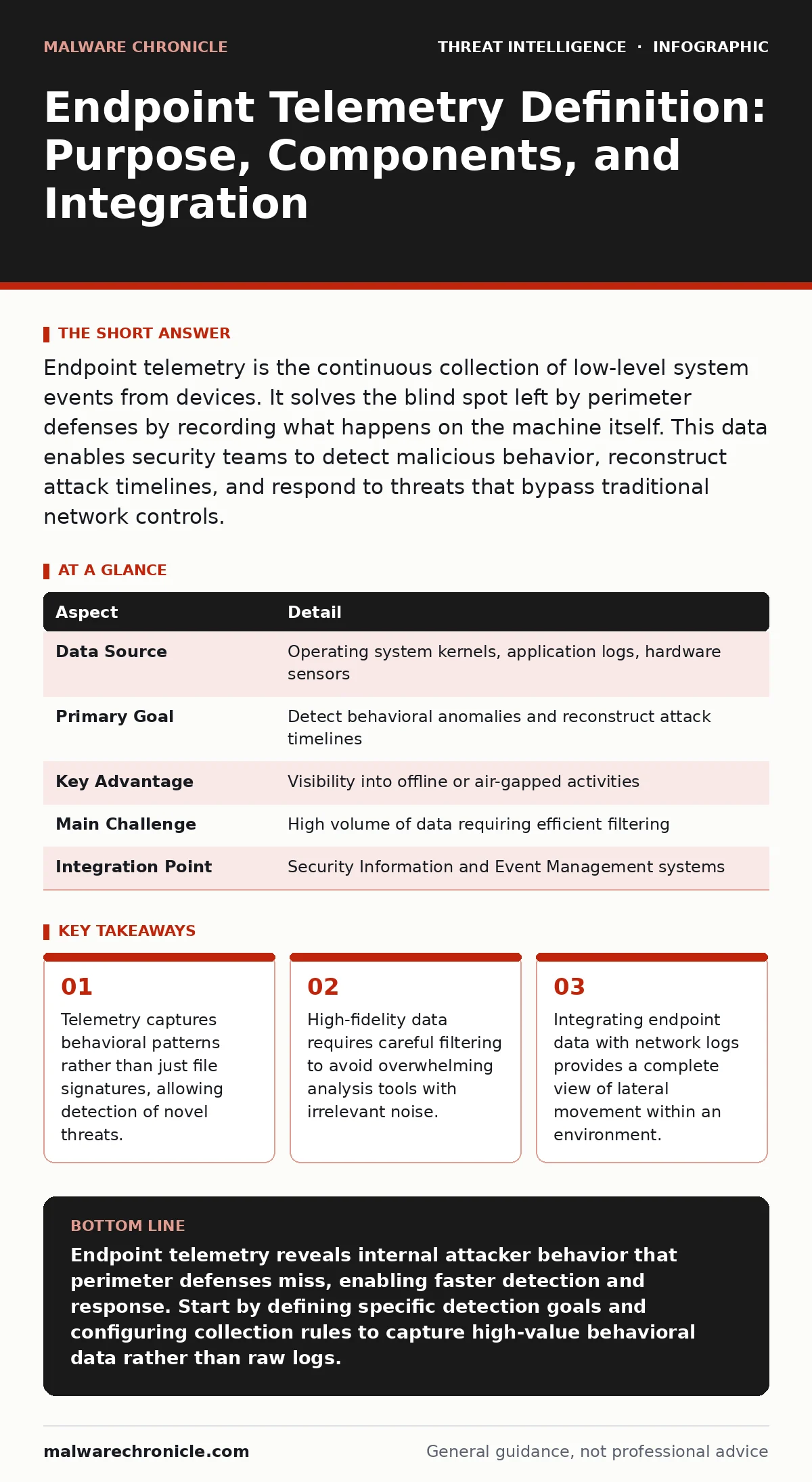
Endpoint telemetry is the continuous collection of low-level system events from devices. It solves the blind spot left by perimeter defenses by recording what happens on the machine itself. This data enables security teams to detect malicious behavior, reconstruct attack timelines, and respond to threats that bypass traditional network controls.
The Concept of Digital Exhaust
Imagine a busy highway where traffic cameras only record cars entering and exiting the city limits. If a vehicle breaks down in the middle of town or changes its license plate, the cameras miss it entirely. Endpoint telemetry acts as dashboards inside every vehicle, recording speed, direction, and engine health. This internal view reveals problems that external sensors cannot see. It provides visibility into activities that occur strictly on the device, such as memory manipulation or process injection.
Defining Endpoint Telemetry and Its Purpose
Endpoint telemetry is the systematic collection of data points generated by operating systems, applications, and hardware on user devices. The purpose is to establish a baseline of normal behavior so that anomalies stand out clearly. Traditional antivirus software relies on known signatures of malware, which fails against new or modified threats. Telemetry shifts the focus to behavior. It records what processes do, not just what they are called. This approach allows defenders to identify malicious activity even when the attacker uses custom code that has never been seen before.
| Aspect | Detail |
|---|---|
| Data Source | Operating system kernels, application logs, hardware sensors |
| Primary Goal | Detect behavioral anomalies and reconstruct attack timelines |
| Key Advantage | Visibility into offline or air-gapped activities |
| Main Challenge | High volume of data requiring efficient filtering |
| Integration Point | Security Information and Event Management systems |
The Problem of Invisible Activity
Perimeter defenses assume that if traffic passes through the firewall, it is safe. This assumption creates a dangerous blind spot. Once an attacker gains initial access, they often operate entirely within the endpoint environment. They may use legitimate administrative tools to move laterally, encrypt files, or exfiltrate data. These actions generate no external network alerts. Endpoint telemetry solves this by recording internal system calls. It captures the execution of scripts, the creation of new processes, and changes to file permissions. This data reveals the attacker’s presence even when they avoid external communication.
Core Components of Telemetry Data
Effective telemetry relies on three main categories of data. Process creation logs record when a new program starts, including its command-line arguments. This helps identify when a legitimate tool like PowerShell is used for malicious purposes. File system events track changes to critical directories and sensitive files. Network connections from the endpoint show where data is being sent. Combining these sources provides context. A process creating a file and then sending it to an unknown IP address is far more suspicious than either event alone.
Integration with Broader Security Defenses
Endpoint telemetry does not work in isolation. It must feed into a broader security architecture. When combined with security telemetry from network devices, defenders can correlate internal actions with external traffic. This correlation helps distinguish between a compromised device and a legitimate user accessing a risky website. Integrating endpoint data with a threat intelligence program allows automated matching of observed behaviors against known attacker tactics. This integration reduces the time needed to identify whether an event is part of a larger campaign or an isolated incident.
See also: Email Filtering FAQ: 8 Answers for Secure Inbox Management · Sysmon Best Practices: Reduce Noise and Catch Hidden Threats
Common Misconceptions About Telemetry
Many organizations believe that collecting all possible data is the best strategy. This approach leads to alert fatigue. Analysts become overwhelmed by thousands of low-value events, causing them to miss critical signals. Another misconception is that telemetry replaces human analysis. While automation helps filter noise, complex attacks require human context to interpret. Additionally, some assume that endpoint telemetry provides complete visibility. It does not capture encrypted content inside applications or activities that occur in memory without touching the disk. Understanding these limits prevents over-reliance on any single data source.
The Cost of High-Fidelity Data
High-fidelity telemetry provides detailed insights but comes with hidden costs. Storing and processing vast amounts of data requires significant infrastructure investment. More importantly, it increases the attack surface. If an attacker compromises the telemetry collection agent, they can delete their tracks or feed false data to security tools. This manipulation hides their activities from defenders. To mitigate this risk, organizations must secure the telemetry pipeline itself. This includes encrypting data in transit and validating the integrity of collection agents.
Reducing Attacker Dwell Time
The primary benefit of endpoint telemetry is reducing attacker dwell time. This term refers to the period between initial compromise and detection. Traditional defenses may take weeks to identify a breach. Telemetry enables near-real-time detection of suspicious behavior. By identifying anomalies quickly, defenders can isolate affected devices before the attacker moves deeper into the network. This rapid response limits the damage and reduces the amount of data exposed. Effective telemetry transforms security from a reactive posture to a proactive one, catching threats as they unfold rather than after they cause harm.
Balancing Privacy and Security
Endpoint telemetry often collects data from employee devices, raising privacy concerns. Organizations must balance security needs with individual rights. Collecting keystrokes or screen captures is generally unnecessary and invasive. Instead, focus on system-level events that indicate malicious activity. Clear policies should define what data is collected, how it is stored, and who can access it. Transparency builds trust and ensures compliance with legal requirements. This balance allows organizations to maintain strong security postures without violating employee privacy.
The Role of Behavioral Analysis
Signature-based detection fails against polymorphic malware that changes its code to avoid recognition. Behavioral analysis, powered by telemetry, looks for patterns of action rather than specific code. For instance, a process that rapidly creates many files and then deletes them may be ransomware in preparation. A process that injects code into another process may be trying to hide its presence. These behaviors are consistent across different malware families. By focusing on behavior, defenders can detect new variants of known threats and entirely new attack methods.
Conclusion of Telemetry Strategy
Endpoint telemetry provides the visibility needed to detect modern attacks. It complements perimeter defenses by revealing internal activities. Successful implementation requires careful planning, clear use cases, and integration with other security tools. By focusing on behavioral data and reducing noise, organizations can detect threats faster and respond more effectively. This approach minimizes the impact of breaches and strengthens overall security posture. Continuous improvement and adaptation are necessary to stay ahead of evolving threats.
Key takeaways
- Telemetry captures behavioral patterns rather than just file signatures, allowing detection of novel threats.
- High-fidelity data requires careful filtering to avoid overwhelming analysis tools with irrelevant noise.
- Integrating endpoint data with network logs provides a complete view of lateral movement within an environment.
Endpoint telemetry reveals internal attacker behavior that perimeter defenses miss, enabling faster detection and response. Start by defining specific detection goals and configuring collection rules to capture high-value behavioral data rather than raw logs.
Frequently asked questions
How does endpoint telemetry differ from antivirus software?
Antivirus relies on known malware signatures to block threats. Endpoint telemetry records system behavior to detect anomalies, allowing it to identify new or modified attacks that lack known signatures.
What is the main challenge of implementing endpoint telemetry?
The main challenge is managing the volume of data. Collecting too much information creates noise that overwhelms analysts, while collecting too little misses critical events. Filtering and prioritization are key.
Can endpoint telemetry detect insider threats?
Yes, it can detect insider threats by identifying unusual access patterns or data exfiltration attempts. However, it must be configured carefully to avoid flagging legitimate user activities as malicious.
Does endpoint telemetry require internet access to function?
Telemetry collection works locally on the device. However, sending data to a central server for analysis typically requires network connectivity. Air-gapped systems require local storage and manual export.
How this guide was produced: written by the Malware Chronicle editorial team with AI assistance, checked against the public references listed below, and reviewed when the facts change. See our editorial policy or report an error.