
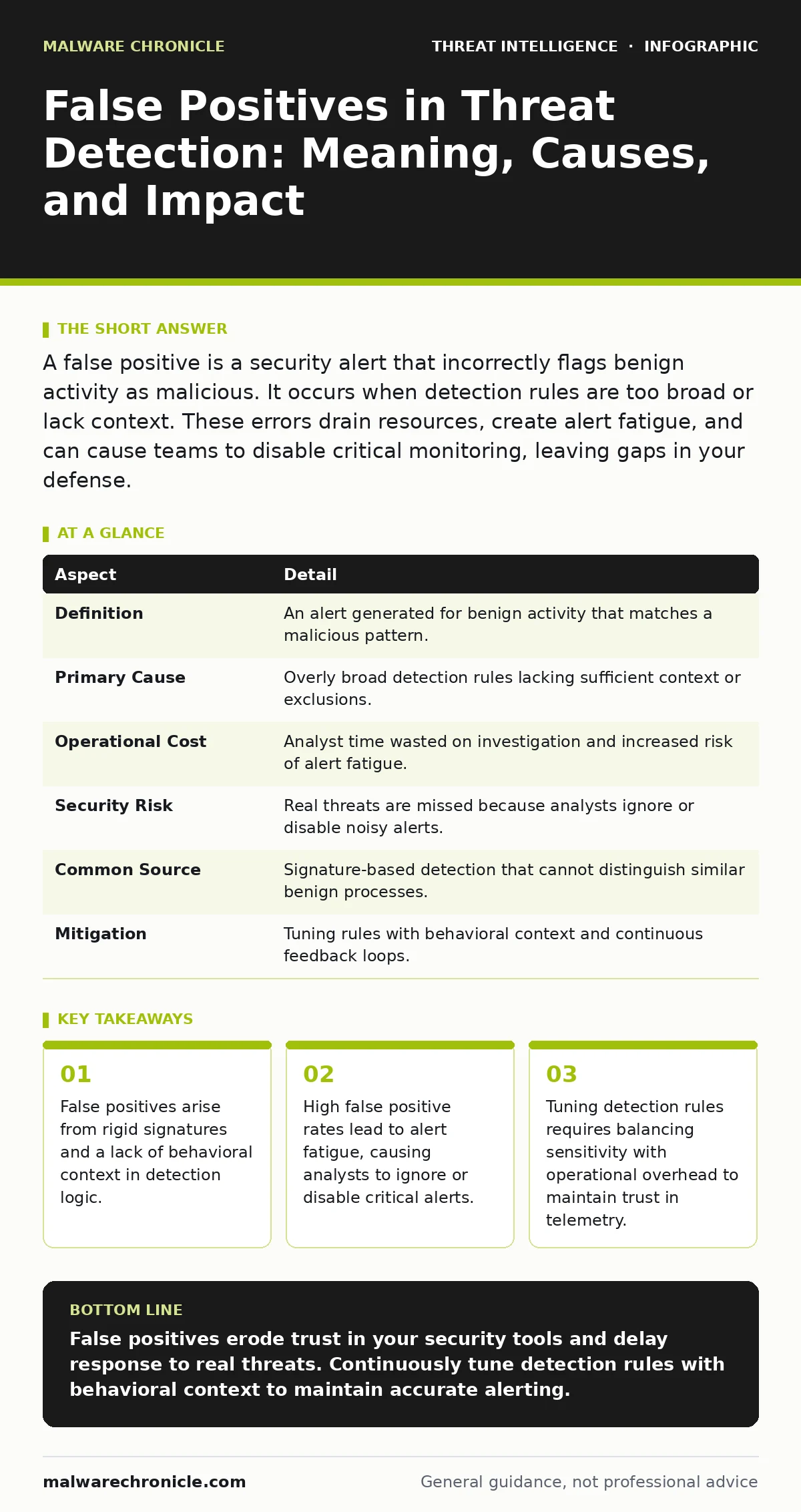
A false positive is a security alert that incorrectly flags benign activity as malicious. It occurs when detection rules are too broad or lack context. These errors drain resources, create alert fatigue, and can cause teams to disable critical monitoring, leaving gaps in your defense.
The Alarm That Never Rings for Burglars
Imagine a smoke detector that screams every time you toast bread. At first, you rush to the kitchen. After the tenth false alarm, you stop running. You might even remove the battery. When a real fire starts, the silence is deafening. This is the core mechanic of a false positive in cybersecurity. It is not just an annoyance; it is a systemic failure of trust between your tools and your team.
In threat detection, a false positive is a signal that indicates a threat where none exists. Your system reports an intrusion, but the activity was legitimate. The mechanism fails to distinguish between normal behavior and malicious intent. This error forces your defenders to investigate a ghost. Every minute spent on a false positive is a minute not spent on a real adversary.
Anatomy of a Detection Error
False positives do not appear randomly. They stem from specific design choices in how detection engines interpret data. Understanding the source helps you fix the root cause rather than just silencing the noise.
| Aspect | Detail |
|---|---|
| Definition | An alert generated for benign activity that matches a malicious pattern. |
| Primary Cause | Overly broad detection rules lacking sufficient context or exclusions. |
| Operational Cost | Analyst time wasted on investigation and increased risk of alert fatigue. |
| Security Risk | Real threats are missed because analysts ignore or disable noisy alerts. |
| Common Source | Signature-based detection that cannot distinguish similar benign processes. |
| Mitigation | Tuning rules with behavioral context and continuous feedback loops. |
The trade-off is always between sensitivity and precision. If you make your rules too sensitive, you catch everything, including harmless actions. If you make them too precise, you miss subtle attacks. Finding the balance is the daily work of security operations.
Where the Term Comes From in Practice
The concept originates from signal detection theory, which studies how humans decide if a signal is present in noise. In early radar systems, operators had to distinguish between enemy aircraft and weather patterns. A "false positive" was a blip on the screen that looked like an enemy but was just a cloud. Cybersecurity inherited this terminology because the problem is identical. You are looking for a needle in a haystack, but the haystack is made of needles that look exactly like the one you want.
In modern practice, the term applies to any automated system that classifies data. Whether it is an antivirus engine scanning a file or a network monitor inspecting traffic, the logic is binary: is this bad or good? When the logic errs on the side of caution, it flags the good as bad. This is the false positive. It is a byproduct of trying to automate human judgment without human context.
How Detection Logic Fails
Most detection systems rely on patterns. A signature-based antivirus looks for a specific sequence of bytes known to be malicious. If a legitimate program happens to contain that sequence, the antivirus flags it. This is a structural weakness. The tool cannot understand intent. It only sees structure.
Behavioral detection is smarter but still prone to error. It looks for unusual actions, like a process modifying system files. Suppose a developer runs a legitimate script that updates a configuration file. The detection engine sees a process modifying a system file and raises an alert. The action is real, but the context is benign. The system lacks the history to know that this developer usually runs this script at this time.
The hidden cost here is not just the investigation time. It is the erosion of confidence. When your tools are wrong often, you start to doubt them. You begin to tune down sensitivity to reduce noise. This creates blind spots. Attackers exploit these blind spots by mimicking normal behavior.
The Trap of Alert Fatigue
Alert fatigue is the psychological response to constant false alarms. When you receive hundreds of alerts a day, and most are false positives, your brain adapts. You start to skim rather than read. You develop heuristics to dismiss alerts quickly. "If it’s from Server X, ignore it." "If it’s this specific error code, close it."
This adaptation is dangerous. It creates a filter that blocks real threats. You are no longer analyzing; you are pattern-matching based on past errors. The adversary knows this. They craft attacks that look like the false positives you ignore. This is why understanding indicators of attack is more valuable than just counting alerts. You need to see the story, not just the signal.
The solution is not to work harder. It is to work smarter. You must reduce the volume of alerts by improving the quality of each one. This requires continuous tuning. You must review every false positive and ask why it happened. Was the rule too broad? Was there missing context? Use the feedback to refine the logic.
See also: Process Injection Mechanics: Step-by-Step Execution Flow · Sysmon Best Practices: Reduce Noise and Catch Hidden Threats
What People Usually Get Wrong
Many teams believe that more data equals better detection. They collect every log, every packet, every event. They assume that if they have enough information, they can filter out the noise. This is a mistake. More data often means more noise. Without strict filtering and correlation, additional telemetry just increases the burden on analysts.
Another common error is treating false positives as a tool problem. You blame the vendor for bad rules. But detection is a process, not a product. The tool provides the signal; you provide the context. If you do not maintain exclusions for known benign activities, the tool will always flag them. You must own the tuning process.
The hidden cost of poor tuning is drift. Over time, your environment changes. New software is installed. New processes are added. If you do not update your detection logic to reflect these changes, your false positive rate will creep up. What was a true positive last year might be a false positive today. You must treat detection rules as living code, not static settings.
Integrating Better Signals
To reduce false positives, you need richer context. This is where frameworks like Sigma rules help. They provide a standardized way to write detection logic that can be adapted to different platforms. By using a common language, you can share and refine rules more effectively. You can borrow logic that has been tested by others, reducing the chance of error.
Similarly, YARA rules allow for precise pattern matching in files and memory. They are more flexible than simple signatures because they allow for complex conditions. You can specify that a file must contain pattern A and pattern B, but not pattern C. This specificity reduces false positives. However, writing good YARA rules requires deep knowledge of the file structure and the malware behavior.
Another approach is to focus on the attacker's goals rather than their tools. This shifts the focus from specific indicators to broader behaviors. For example, instead of looking for a specific malware hash, look for the process that tries to hide its existence. This is the core of threat hunting. Proactively searching for threats allows you to find anomalies that automated tools miss. It also helps you understand what normal looks like, which improves your automated detection.
The Role of Telemetry Quality
Your detection is only as good as your data. If your security telemetry is incomplete or inaccurate, your alerts will be wrong. You must ensure that logs are collected consistently and contain the necessary fields. Missing fields force you to make assumptions, which leads to errors.
For instance, if your logs do not include the command-line arguments for a process, you cannot distinguish between a legitimate administrative task and a malicious script. You have to guess. Guessing leads to false positives. You must invest in collecting high-fidelity data. This means configuring agents correctly and ensuring that logs are not truncated or delayed.
Balancing Sensitivity and Precision
The goal is not to eliminate false positives. That is impossible. The goal is to manage them. You must accept a certain level of noise in exchange for catching real threats. The key is to keep the noise manageable.
Start by categorizing alerts by severity. Focus on high-severity alerts first. These are more likely to be true positives. Use automation to handle low-severity alerts. For example, you can automatically block known benign traffic after a certain number of occurrences. This reduces the manual workload.
Regularly review your detection rules. Ask your analysts which alerts they find useless. Disable or tune those rules. Engage with the development team to understand new processes. Add exclusions for legitimate activities. This continuous feedback loop is the only way to maintain a healthy detection system.
The Impact on Dwell Time
False positives directly impact attacker dwell time. Dwell time is the duration an adversary remains in your network before detection. If your team is bogged down by false positives, they cannot respond quickly to real incidents. The attacker has more time to move laterally, exfiltrate data, and establish persistence.
Every hour spent investigating a false positive is an hour the attacker is unchecked. This is the hidden cost of poor detection hygiene. It is not just about wasted time; it is about increased risk. You must prioritize accuracy to reduce dwell time. Accurate alerts allow for faster response, limiting the damage an attacker can cause.
Final Thoughts on Detection Hygiene
False positives are a symptom of a deeper issue: a lack of context. Your tools see the world in binary terms, but your environment is nuanced. You must bridge that gap. By understanding the mechanics of detection errors, you can build a more resilient defense.
Focus on quality over quantity. Tune your rules. Enrich your telemetry. Engage in continuous improvement. This is the only way to stay ahead of adversaries who are constantly evolving their techniques.
Key takeaways
- False positives arise from rigid signatures and a lack of behavioral context in detection logic.
- High false positive rates lead to alert fatigue, causing analysts to ignore or disable critical alerts.
- Tuning detection rules requires balancing sensitivity with operational overhead to maintain trust in telemetry.
False positives erode trust in your security tools and delay response to real threats. Continuously tune detection rules with behavioral context to maintain accurate alerting.
Frequently asked questions
How do I reduce false positives in my SIEM?
Start by reviewing your most common alerts and adding exclusions for known benign activities. Enrich your logs with more context, such as user roles and process trees, to help differentiate between normal and malicious behavior.
Is it better to have false positives or false negatives?
False negatives are worse because they mean a real threat was missed. However, too many false positives lead to alert fatigue, which can cause analysts to miss real threats. The goal is a balance that keeps the signal-to-noise ratio manageable.
What is the difference between a false positive and a false negative?
A false positive is an alert for benign activity. A false negative is a failure to alert on malicious activity. Both are errors, but they have different impacts on security operations.
Can AI eliminate false positives?
AI can help by identifying patterns that humans might miss, but it is not a silver bullet. AI models can also produce false positives, especially if they are trained on biased or incomplete data. Human oversight remains necessary.
How this guide was produced: written by the Malware Chronicle editorial team with AI assistance, checked against the public references listed below, and reviewed when the facts change. See our editorial policy or report an error.