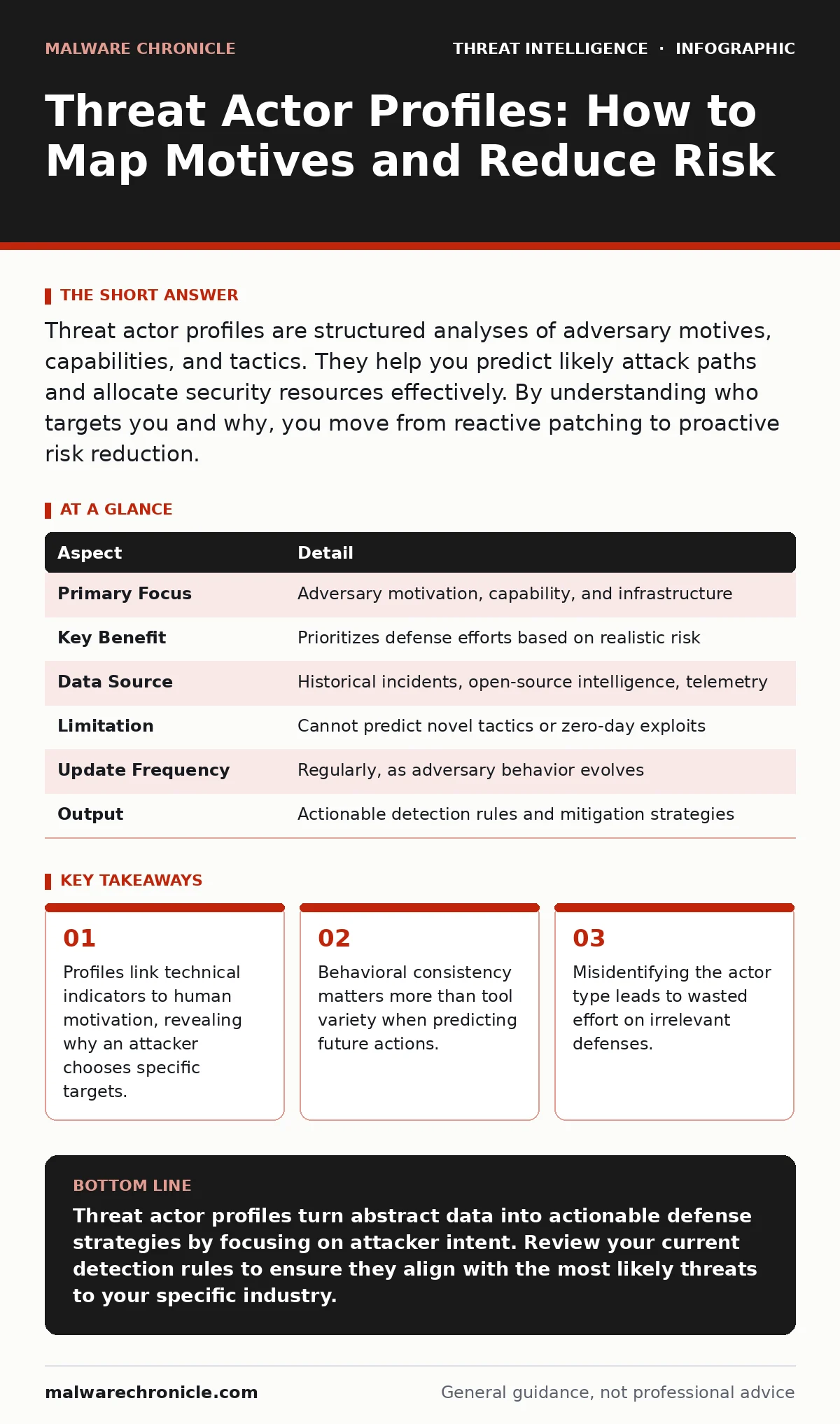
Threat actor profiles are structured analyses of adversary motives, capabilities, and tactics. They help you predict likely attack paths and allocate security resources effectively. By understanding who targets you and why, you move from reactive patching to proactive risk reduction.
Why Threat Actor Profiles Matter
Imagine a burglar who only targets houses with unlocked back doors because he cannot pick locks. You would secure the back door, not install a vault. Threat actor profiles work the same way. They categorize adversaries by their goals, resources, and methods. This classification helps you understand the "why" behind an attack, not just the "how." Without this context, you are defending against every possible threat equally, which is inefficient and expensive. Knowing the profile allows you to tailor your detection rules and response plans to the specific behaviors that actually matter to your organization.
| Aspect | Detail |
|---|---|
| Primary Focus | Adversary motivation, capability, and infrastructure |
| Key Benefit | Prioritizes defense efforts based on realistic risk |
| Data Source | Historical incidents, open-source intelligence, telemetry |
| Limitation | Cannot predict novel tactics or zero-day exploits |
| Update Frequency | Regularly, as adversary behavior evolves |
| Output | Actionable detection rules and mitigation strategies |
How Threat Actor Profiles Work
Creating a threat actor profile requires aggregating data from multiple sources. Analysts examine Indicators of Compromise, which are artifacts like file hashes or IP addresses left behind during an attack. They then map these indicators to Tactics, Techniques, and Procedures. These are the specific steps an attacker takes to achieve a goal, such as phishing for credentials or exploiting a software bug.
By linking technical data to human behavior, analysts can infer the attacker's identity or group affiliation. This process transforms raw logs into a narrative about who is attacking and what they want. The result is a living document that updates as new evidence emerges, helping you anticipate the next move in the Unified Kill Chain.
Who Is Targeted by Specific Actors
Not all attackers aim for the same prize. State-sponsored groups often target government infrastructure or intellectual property for long-term strategic advantage. They have deep resources and patience. Cybercriminals usually seek financial gain through ransomware or data theft. They move quickly and target weaknesses that pay off fast.
Hacktivists target organizations based on political or social beliefs, aiming to disrupt services or leak data for publicity. Understanding which category your organization falls into is critical. A small startup is unlikely to be a target for state espionage but might attract financially motivated criminals. Your industry, size, and data sensitivity determine your risk profile.
What People Usually Get Wrong
Many organizations focus too heavily on the tools an attacker uses. Tools are easy to copy or swap. An attacker might use a common cracking tool today and a custom script tomorrow. The underlying behavior remains consistent. If you build defenses only around specific tools, you will miss the next attack. Another common error is assuming all actors within a category behave identically.
Two ransomware groups may have different operational security practices or preferred entry points. Over-generalizing leads to blind spots. You must look at the specific patterns of the actors most likely to target you, not just broad categories. This nuance reduces false positives in threat detection by filtering out noise that does not match the expected behavior.
Building Your Own Profiles
You do not need to start from scratch. Public frameworks provide standardized ways to describe attacker behavior. You can adapt these frameworks to your specific environment. Start by identifying the data you already collect. Endpoint telemetry shows what happens on individual devices, while network scanning reveals external reconnaissance activity. Combine this data with public intelligence about active threats.
Look for patterns in your logs that match known tactics. For instance, if you see repeated failed login attempts followed by successful ones from unusual locations, this might indicate credential stuffing. Map these observations to a profile. This helps you create custom detection rules, such as Sigma rules, that alert you to suspicious activity before it causes damage.
See also: Difference Between Network Scanning and Port Scanning: How to Detect and Respond · Threat Hunting Explained: Proactive Security Beyond Alerts
Integrating Profiles Into Defense
A profile is useless if it sits in a report. You must integrate it into your daily operations. Use the profile to tune your security tools. Adjust thresholds for alerts based on the actor's known patience or speed. If an actor is known to dwell in a network for weeks, your detection should focus on long-term anomalies rather than immediate bursts.
Share the profile with your development team. They can write code that is resistant to the specific tactics used by your likely adversaries. This proactive approach strengthens your security posture from the inside out. Regularly review your profiles to ensure they reflect the current threat environment. Adversaries change, and your defenses must evolve with them.
Common Pitfalls to Avoid
One major pitfall is relying solely on external intelligence. External data may not reflect the specific vulnerabilities in your environment. You must combine external profiles with internal security telemetry. Another mistake is ignoring the human element. Social engineering remains a primary entry point for many actors.
Technical controls alone cannot stop a user from clicking a malicious link. Training and awareness are part of the profile implementation. Finally, avoid static profiles. An attacker who fails with one method may switch tactics. Your profile should be a hypothesis that you test and refine continuously. This dynamic approach ensures you are always prepared for the next variation of an attack.
The Role of Specialized Tools
Specialized tools can help automate parts of the profiling process. Sysmon provides detailed logging of system events, which is crucial for detecting post-exploitation behavior. It records process creations, network connections, and file changes. This data helps you reconstruct an attacker's path through your network. However, tools are only as good as the data they receive. Ensure your logging is comprehensive and consistent. Without high-quality data, even the best tools will miss subtle indicators. Use tools to augment your analysis, not replace it. Human judgment is still required to interpret the data and connect the dots into a coherent profile.
Key takeaways
- Profiles link technical indicators to human motivation, revealing why an attacker chooses specific targets.
- Behavioral consistency matters more than tool variety when predicting future actions.
- Misidentifying the actor type leads to wasted effort on irrelevant defenses.
Threat actor profiles turn abstract data into actionable defense strategies by focusing on attacker intent. Review your current detection rules to ensure they align with the most likely threats to your specific industry.
Frequently asked questions
How often should I update my threat actor profiles?
Update them whenever new intelligence emerges or after a significant incident in your sector. Quarterly reviews are a good baseline, but real-time adjustments are better for active threats.
Can threat actor profiles prevent zero-day attacks?
No profile can predict a completely unknown vulnerability. However, they help you detect the exploitation phase by recognizing the attacker's behavior, even if the initial exploit is new.
Do I need a dedicated team to maintain profiles?
Not necessarily. Small teams can use automated tools and public feeds to maintain basic profiles. Larger organizations may benefit from dedicated analysts to handle complex attribution.
How do profiles help with Kerberoasting attacks?
Profiles of internal threat actors or compromised credential groups often highlight lateral movement techniques. Recognizing Kerberoasting as a common tactic in these profiles helps you prioritize monitoring for service ticket requests.
How this guide was produced: written by the Malware Chronicle editorial team with AI assistance, checked against the public references listed below, and reviewed when the facts change. See our editorial policy or report an error.