Operational threat intelligence translates global attack data into specific defensive actions for your environment. Small businesses succeed by focusing on indicators relevant to their specific software stack and user behavior. This approach reduces alert fatigue and enables precise blocking of active threats without requiring a dedicated security operations center or expensive commercial tools.
The Context Gap in Small Business Defense
Small organizations often assume that more data equals better security. This assumption fails because raw threat data lacks context. Operational threat intelligence bridges the gap between raw data and defensive action. It answers the question of what to do with specific information about an attacker. Without this translation step, security teams drown in irrelevant alerts. You must filter global signals through the lens of your local environment. This process identifies which threats actually matter to your specific assets.
The cost of ignoring context is operational paralysis. Security staff spend time chasing ghosts instead of securing real assets. You need a mechanism that maps external indicators to internal assets. This mapping requires knowledge of your software versions, network topology, and user privileges. Without this inventory, you cannot determine relevance. Relevance determines priority. Priority determines action. Action determines security posture.
Filtering Noise from Signal
Raw threat feeds contain millions of indicators daily. Most of these indicators are irrelevant to your specific environment. An indicator of compromise, or IOC, is a recognizable artifact of malicious activity. Examples include IP addresses, domain names, or file hashes. You cannot block every known malicious IP address. Many malicious IPs are also used by legitimate services or are geographically distant from your user base.
You must prioritize indicators based on your attack surface. If you do not host a public-facing website, you can ignore threats targeting web application vulnerabilities. If your users do not use a specific legacy protocol, you can ignore exploits for that protocol. This filtering reduces the volume of alerts. It allows your team to focus on high-fidelity threats. High-fidelity threats are those with confirmed evidence of targeting your industry or technology.
This filtering process requires an accurate asset inventory. You must know what software you run and where it runs. Without this knowledge, you cannot filter effectively. You will either block too much, disrupting business, or too little, leaving gaps. The balance lies in precise mapping. Map each external threat to your internal asset list. If there is no match, discard the data. If there is a match, escalate for action.
Automating Defensive Actions
Manual analysis of every threat is impossible for small teams. You must automate the response to known threats. Automation means configuring your security tools to act on validated intelligence. This action typically involves blocking traffic or isolating endpoints. The goal is to stop the attack before it causes damage. This is known as automated containment.
You need a clear policy for automation. Define which indicators trigger automatic blocking. Define which indicators require human review. Automatic blocking should apply to high-confidence indicators. These are indicators with a long history of malicious activity and low risk of false positives. Low-confidence indicators require human review. Human review prevents blocking legitimate traffic that happens to share an attribute with a threat.
This automation reduces the burden on your staff. It allows them to focus on complex threats. Complex threats often involve social engineering or novel techniques. These techniques do not have known indicators. They require human judgment to detect. Automation handles the known. Humans handle the unknown. This division of labor is critical for small teams. It maximizes the efficiency of limited resources.
Validating Intelligence Sources
Not all threat intelligence is created equal. Some sources are reliable and timely. Others are outdated or inaccurate. You must validate your sources before trusting their data. Validation involves checking the source's methodology and history. You need to know how they collect data. You need to know how they verify it. Unverified data can lead to false positives. False positives disrupt business operations.
Ask your IT provider about their validation process. They should explain how they assess the credibility of each source. They should describe their procedure for testing indicators before deployment. This testing ensures that blocking an indicator does not break legitimate services. It also ensures that the indicator is still active. Old indicators may no longer be relevant. Using them wastes resources.
You should also consider the timeliness of the source. Threats evolve quickly. Old data is less useful. You need sources that provide real-time or near-real-time updates. This ensures that you are defending against current attacks. It also ensures that you are not relying on historical data that no longer applies. Timeliness is a key metric for source quality.
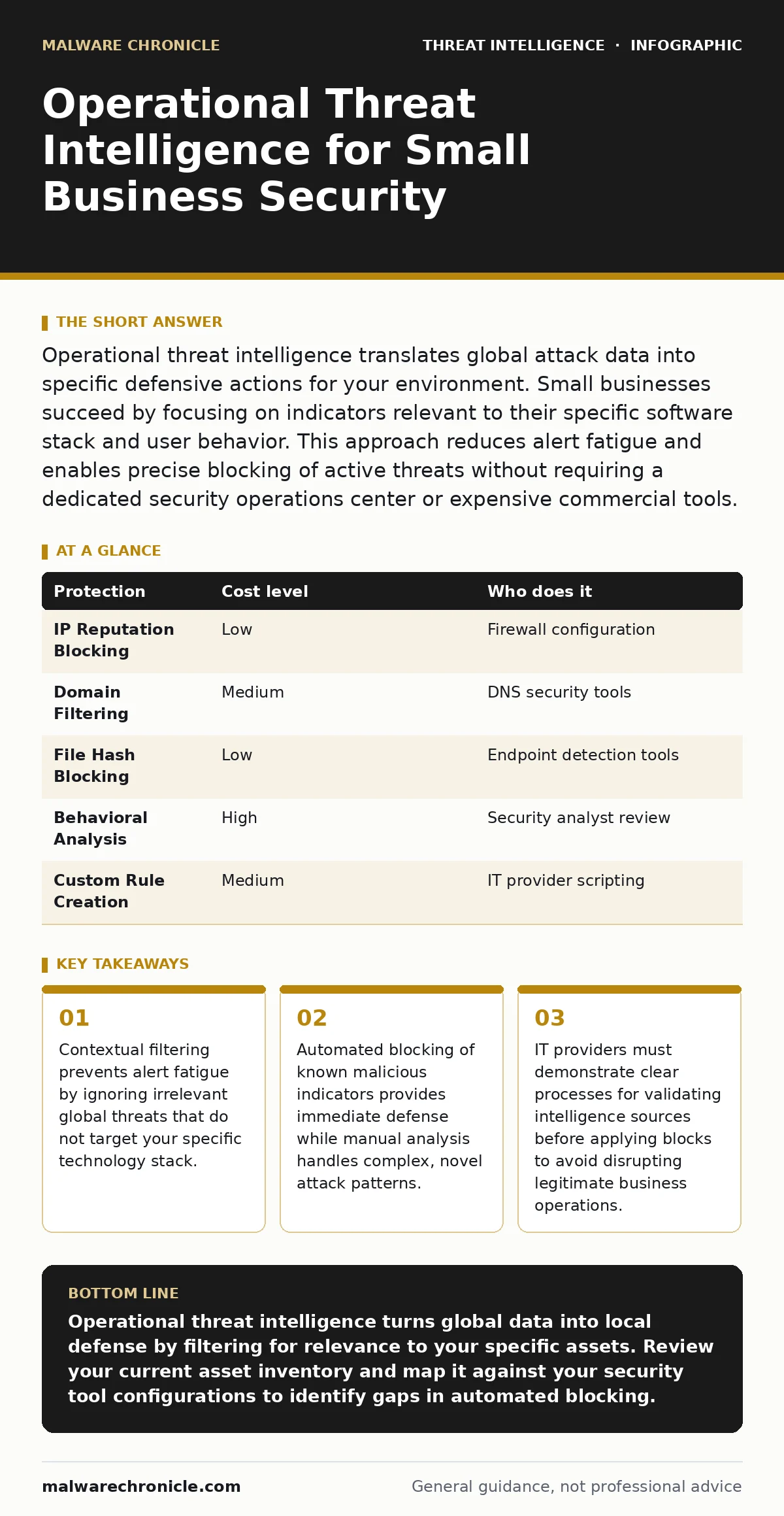
| Protection | Cost level | Who does it |
|---|---|---|
| IP Reputation Blocking | Low | Firewall configuration |
| Domain Filtering | Medium | DNS security tools |
| File Hash Blocking | Low | Endpoint detection tools |
| Behavioral Analysis | High | Security analyst review |
| Custom Rule Creation | Medium | IT provider scripting |
Integrating with Existing Tools
Operational threat intelligence must integrate with your existing security stack. It cannot exist in isolation. You need to feed intelligence into your firewalls, endpoint detection tools, and email filters. This integration allows for consistent enforcement. It ensures that a threat blocked at one layer is also blocked at others. Consistency reduces gaps in your defense.
Check your tools for supported formats. Most modern tools support standard formats for indicator sharing. These formats allow for easy import and export. You should use these standards to simplify integration. Avoid proprietary formats that lock you into specific vendors. Standards ensure flexibility. They allow you to switch tools without losing your intelligence data.
Integration also requires regular testing. You must verify that the intelligence is being applied correctly. This verification involves simulating attacks or using test indicators. You need to confirm that the blocks are working. You also need to confirm that they are not blocking legitimate traffic. Regular testing ensures that your automation remains effective. It also helps you identify configuration errors early.
See also: Difference Between Network Scanning and Port Scanning: How to Detect and Respond · Rate Limiting for Small Business: Stop Abuse Without Breaking the Bank
Questions for Your IT Provider
You rely on your IT provider to manage operational threat intelligence. You must ask specific questions to ensure they are doing their job. Do not accept vague answers. Demand details about their processes. This scrutiny ensures that your security is proactive. It also ensures that you are getting value for your investment.
- How do you validate the accuracy of threat indicators before blocking them?
- What is your process for testing blocks to prevent disruption of legitimate business traffic?
- How do you prioritize threats based on our specific asset inventory and software stack?
- What is the average time between receiving intelligence and implementing defensive actions?
- How do you report on the effectiveness of threat intelligence in reducing our risk?
Balancing Speed and Accuracy
Speed is critical in threat response. You must act quickly to stop active attacks. However, speed without accuracy causes problems. Blocking legitimate traffic can halt business operations. You must balance speed with accuracy. This balance requires a tiered approach. High-confidence threats get immediate action. Low-confidence threats get delayed action.
This tiered approach reduces risk. It ensures that you are not acting on bad data. It also ensures that you are not delaying response to real threats. You must define clear criteria for each tier. These criteria should be based on the severity of the threat and the confidence of the data. Regular review of these criteria ensures they remain appropriate. As threats evolve, your criteria must evolve too.
The Human Element in Defense
Automation handles known threats. Humans handle unknown threats. You must preserve the human element in your defense. This element involves threat hunting and incident response. Threat hunting involves proactively searching for signs of compromise. Incident response involves reacting to confirmed breaches. Both require human judgment and creativity.
You should train your staff to recognize suspicious activity. They are your first line of defense. They can spot anomalies that tools miss. This training should be ongoing. It should cover new tactics and techniques. It should also cover the specific risks to your organization. Empowered staff enhance your security posture. They provide a layer of defense that tools cannot replicate.
Key takeaways
- Contextual filtering prevents alert fatigue by ignoring irrelevant global threats that do not target your specific technology stack.
- Automated blocking of known malicious indicators provides immediate defense while manual analysis handles complex, novel attack patterns.
- IT providers must demonstrate clear processes for validating intelligence sources before applying blocks to avoid disrupting legitimate business operations.
Operational threat intelligence turns global data into local defense by filtering for relevance to your specific assets. Review your current asset inventory and map it against your security tool configurations to identify gaps in automated blocking.
Frequently asked questions
How does operational threat intelligence differ from strategic intelligence?
Operational intelligence provides actionable data like IP addresses to block immediate threats. Strategic intelligence provides high-level trends to inform long-term security planning and budgeting.
Can small businesses afford commercial threat intelligence platforms?
Many small businesses rely on open-source feeds and built-in features of existing security tools. Commercial platforms add value through curated data and integration support but may be unnecessary for simple environments.
What is the role of indicators of attack in this process?
Indicators of attack focus on attacker behavior rather than static artifacts. They help detect novel threats that do not have known signatures, complementing traditional indicators of compromise.
How often should I review my threat intelligence sources?
Review sources quarterly to assess their accuracy and relevance. Remove sources that provide high volumes of false positives or outdated data to maintain signal quality and reduce noise.
How this guide was produced: written by the Malware Chronicle editorial team with AI assistance, checked against the public references listed below, and reviewed when the facts change. See our editorial policy or report an error.