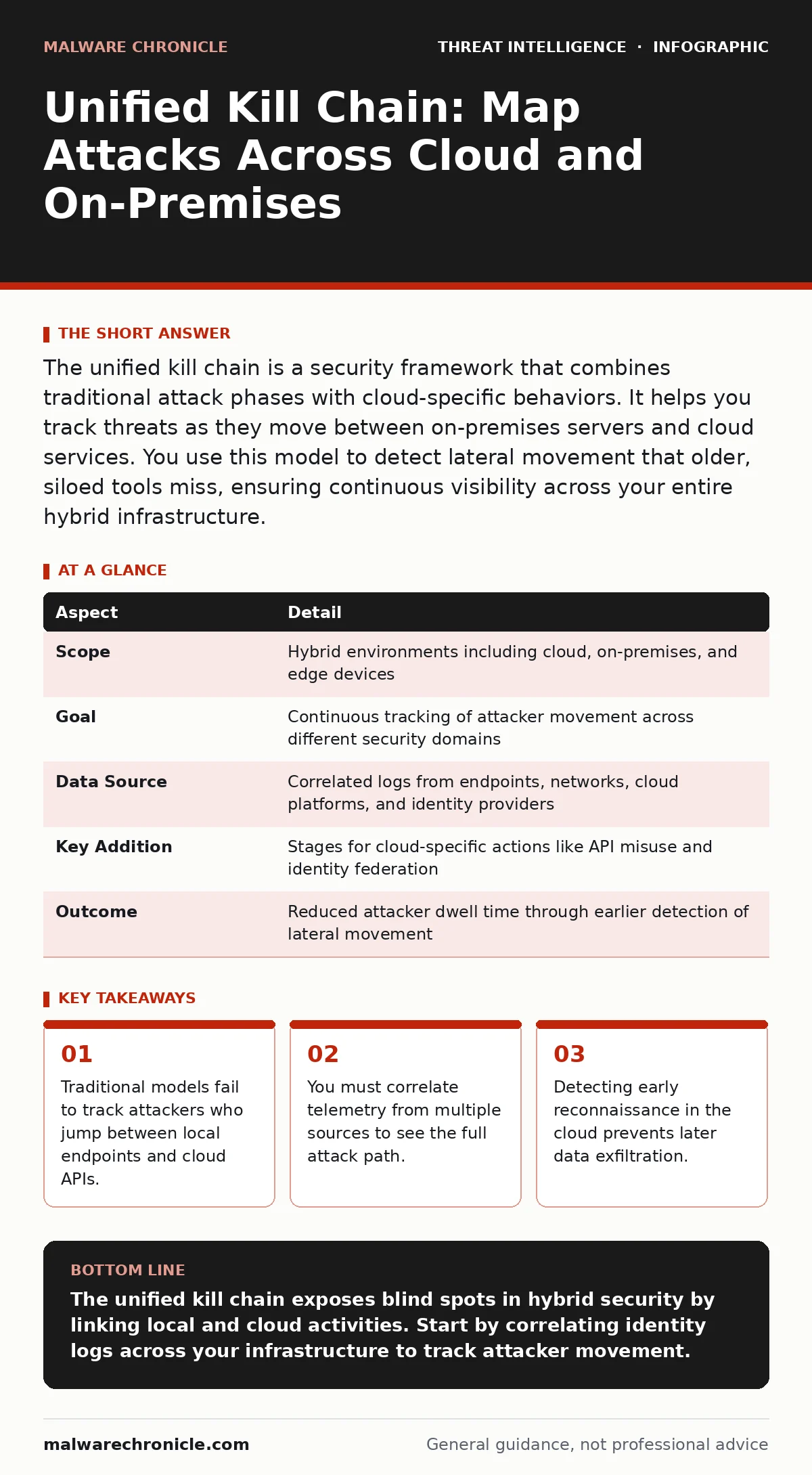
The unified kill chain is a security framework that combines traditional attack phases with cloud-specific behaviors. It helps you track threats as they move between on-premises servers and cloud services. You use this model to detect lateral movement that older, siloed tools miss, ensuring continuous visibility across your entire hybrid infrastructure.
The Unified Kill Chain Defined
Imagine a bank with separate security systems for the vault and the teller windows. A thief bypasses the vault cameras but walks openly through the lobby. If security only watches the vault, the theft goes unnoticed. The unified kill chain solves this by merging distinct security perspectives into a single, continuous timeline. It extends the classic attack lifecycle to include cloud-native actions and hybrid infrastructure movements.
This model recognizes that modern attacks rarely stay within one perimeter. Attackers move from local endpoints to cloud storage, then to external command servers. You need a framework that tracks these transitions without losing context. The unified kill chain provides that continuity. It does not replace existing tools; it reorganizes how you interpret their data. You stop looking at isolated alerts and start seeing the narrative of the intrusion.
How the Unified Kill Chain Works
The framework expands the standard six-stage model. It adds stages that reflect cloud computing realities and API interactions. You map attacker behavior across these expanded phases to identify gaps in your detection logic. The model forces you to look for indicators of compromise in places traditional models ignore, such as cloud configuration changes or identity token abuse.
| Aspect | Detail |
|---|---|
| Scope | Hybrid environments including cloud, on-premises, and edge devices |
| Goal | Continuous tracking of attacker movement across different security domains |
| Data Source | Correlated logs from endpoints, networks, cloud platforms, and identity providers |
| Key Addition | Stages for cloud-specific actions like API misuse and identity federation |
| Outcome | Reduced attacker dwell time through earlier detection of lateral movement |
You begin by ingesting telemetry from all relevant sources. Endpoint telemetry provides local activity, while cloud audit logs show account changes. You align these data streams by timestamp and user identity. This correlation reveals patterns that single-source analysis misses. For instance, a login from a new device followed immediately by a cloud storage permission change becomes visible only when both events are linked.
Who It Affects
Every organization using hybrid infrastructure faces this reality. You are affected if you run servers locally and services in the cloud. Attackers exploit the blind spots between these environments. They assume your security tools cannot talk to each other. This assumption allows them to operate for longer periods before detection.
The impact falls heavily on security operations teams. You must manage more complex data flows. Threat intelligence program maturity determines how well you can apply this model. Without structured intelligence, you drown in noise. The unified kill chain requires you to prioritize signals that indicate actual progression through the attack stages. You focus on behaviors that lead to data loss or system control, ignoring benign anomalies.
What People Usually Get Wrong
Many teams treat the unified kill chain as a software feature. It is not a product you install. It is an analytical framework you apply to your data. Expecting a single tool to provide this view leads to disappointment. You must integrate multiple data sources manually or through orchestrated platforms.
Another common error is focusing only on technical indicators. You might look for malicious file hashes or known bad IP addresses. These indicators change quickly. The unified kill chain emphasizes behavioral patterns. You look for unusual sequences of actions, such as automated script execution followed by data export. This approach remains effective even when attackers use new tools or custom malware.
Early Detection Strategies
You detect attacks earlier by monitoring the reconnaissance and weaponization stages. In cloud environments, reconnaissance often looks like API enumeration. Attackers query configuration endpoints to find exposed services. You set alerts for high-frequency API calls from unfamiliar clients. This behavior precedes exploitation.
Weaponization in hybrid environments often involves creating custom scripts that work across both local and cloud systems. You monitor for the creation of executable files or scripts that reference cloud SDKs. This combination is rare in legitimate operations. Identifying these artifacts allows you to block the attack before it reaches the delivery stage.
Process injection remains a common technique in the exploitation phase. Attackers inject malicious code into legitimate processes to hide their activity. You must monitor for parent-child process relationships that do not match expected behaviors. If a web server process spawns a command shell, that violates normal operational boundaries.
See also: Configuration Drift Mechanics: How Security Posture Decays Over Time
Responding to Lateral Movement
Lateral movement is where the unified kill chain adds the most value. Attackers use compromised credentials to move from local endpoints to cloud resources. You detect this by tracking identity usage patterns. A user account that accesses a local file server and then immediately queries a cloud database is suspicious.
Network scanning often precedes lateral movement. Attackers map internal networks to find high-value targets. You monitor for unusual internal traffic patterns, such as a single host contacting many other hosts on management ports. Combining this network data with endpoint logs confirms the intent. You isolate the compromised host and revoke associated credentials.
Attacker dwell time decreases when you detect this movement early. Each hour of undetected access increases the risk of data exfiltration. You automate response actions to cut off access paths. This includes disabling compromised accounts and blocking suspicious API tokens. Speed matters more than perfect analysis during this phase.
Building Your Implementation Plan
You implement this framework by starting with identity. Identity is the common thread across all environments. You ensure that every action, whether local or cloud, is tied to a unique identity. This allows you to trace the attacker's path regardless of the infrastructure component.
Next, you prioritize data collection. You do not need every log available. You focus on logs that show state changes and access decisions. Cloud audit logs, endpoint execution logs, and network connection logs provide the necessary coverage. You filter out low-value noise to reduce false positives in threat detection.
Finally, you train your analysts on the model. They must understand how attackers move between domains. You create playbooks that map specific alerts to kill chain stages. This structure helps analysts triage incidents faster. They know which data to pull and which questions to ask based on the current stage of the attack.
Key takeaways
- Traditional models fail to track attackers who jump between local endpoints and cloud APIs.
- You must correlate telemetry from multiple sources to see the full attack path.
- Detecting early reconnaissance in the cloud prevents later data exfiltration.
The unified kill chain exposes blind spots in hybrid security by linking local and cloud activities. Start by correlating identity logs across your infrastructure to track attacker movement.
Frequently asked questions
How does the unified kill chain differ from the standard cyber kill chain?
The standard model focuses on traditional network and endpoint attacks. The unified version adds stages for cloud-specific actions, API misuse, and identity federation, reflecting modern hybrid infrastructures.
Do I need new tools to implement the unified kill chain?
You do not necessarily need new tools. You need to integrate existing data sources and change how you analyze them. Correlation engines or SIEM platforms can support this model if configured correctly.
Can the unified kill chain prevent zero-day attacks?
No model prevents all attacks. The unified kill chain improves detection and response speed. It helps you identify unusual behavior associated with zero-day exploitation, allowing faster containment.
How do I handle data volume when correlating multiple sources?
Focus on high-fidelity signals related to identity and state changes. Filter out routine operational logs. Use automation to correlate events, reducing the manual burden on analysts.
How this guide was produced: written by the Malware Chronicle editorial team with AI assistance, checked against the public references listed below, and reviewed when the facts change. See our editorial policy or report an error.