
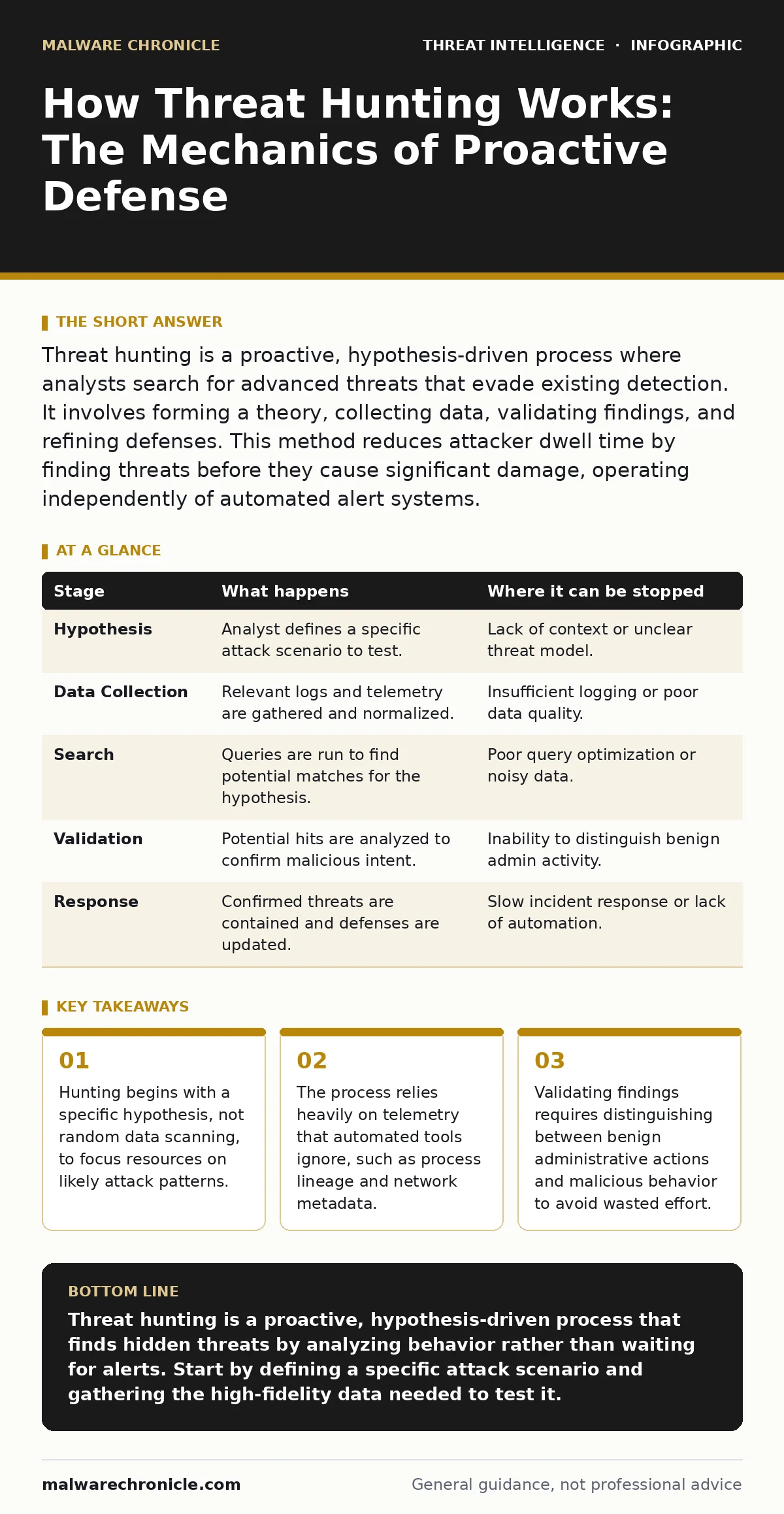
Threat hunting is a proactive, hypothesis-driven process where analysts search for advanced threats that evade existing detection. It involves forming a theory, collecting data, validating findings, and refining defenses. This method reduces attacker dwell time by finding threats before they cause significant damage, operating independently of automated alert systems.
The Hypothesis Drives the Hunt
Threat hunting is not a passive monitoring activity. It is an active investigation driven by a specific theory about how an adversary might operate within your environment. You do not start by looking at logs randomly. You start with a question. For example, you might suspect that an attacker is using legitimate administrative tools to move laterally across the network without triggering standard alerts.
This approach flips the traditional security model. Instead of waiting for a signature match or an anomaly score to spike, you assume the breach has already happened. This mindset is necessary because modern attackers often blend in with normal traffic. They use low-and-slow techniques that fall below the threshold of automated detection.
Your hypothesis must be testable. If you cannot define what success looks like, you cannot hunt. A vague hypothesis like "look for bad things" leads to noise. A specific hypothesis like "check for PowerShell scripts downloading files from non-standard ports" gives you a clear path forward. This specificity is what separates hunting from general log review.
Data Collection and Telemetry
Once you have a hypothesis, you need the right data to test it. Most organizations collect vast amounts of telemetry, but much of it is unusable for hunting. You need high-fidelity data that shows the context of an action. Process creation logs, network connection records, and registry changes are valuable. Simple firewall logs are often not.
The challenge is that this data is often scattered across different systems. You might need to correlate a process start on a workstation with a DNS query and a subsequent network connection. Without a centralized platform that normalizes this data, hunting becomes a manual nightmare. You spend more time joining tables than analyzing behavior.
You must also consider the cost of data retention. Keeping detailed logs for years is expensive and slow. Keeping them for too short a period means you miss slow-moving threats. You need a balance that allows you to reconstruct events from weeks or months ago. This is where the concept of attacker dwell time becomes critical. The longer an attacker stays hidden, the more data you need to look back through to find them.
Searching for Indicators of Attack
Traditional detection relies on indicators of compromise (IOCs). These are static artifacts like a malicious IP address or a file hash. They are easy to search for but easy to change. Threat hunters focus on indicators of attack (IOAs). These are behaviors that suggest malicious intent, regardless of the specific tool used.
For example, instead of looking for a specific malware hash, you look for a process that injects code into another process. This behavior is common across many malware families. It is also harder for an attacker to disguise without breaking their tool. You use query languages to search for these behaviors across your dataset.
This stage often involves using frameworks like Sigma rules. These are generic detection rules that can be translated into different log analysis platforms. They provide a starting point for your search, but you must adapt them to your environment. A rule that works in one company might generate hundreds of false positives in another due to different software configurations.
| Stage | What happens | Where it can be stopped |
|---|---|---|
| Hypothesis | Analyst defines a specific attack scenario to test. | Lack of context or unclear threat model. |
| Data Collection | Relevant logs and telemetry are gathered and normalized. | Insufficient logging or poor data quality. |
| Search | Queries are run to find potential matches for the hypothesis. | Poor query optimization or noisy data. |
| Validation | Potential hits are analyzed to confirm malicious intent. | Inability to distinguish benign admin activity. |
| Response | Confirmed threats are contained and defenses are updated. | Slow incident response or lack of automation. |
Validating the Findings
When your search returns results, you are not done. You have a list of potential hits, most of which will be benign. This is the triage phase. You must determine if the activity is truly malicious or just normal user behavior. This is where the skill of the hunter matters most.
You look for context. Did the process run at an unusual time? Was it launched by a user who does not normally use that tool? Did it connect to a server that is not part of the standard application stack? These clues help you separate signal from noise.
False positives in threat detection are a major risk here. If you flag too many benign events as malicious, you waste time and risk alert fatigue. If you miss a true positive, the attacker continues their work. You must validate each finding manually before escalating it. Automation can help filter obvious noise, but human judgment is required for complex scenarios.
Refining Defenses and Closing the Loop
The goal of threat hunting is not just to find one attacker. It is to improve your overall security posture. When you find a gap that allowed an attacker to hide, you must close it. This might mean adding a new detection rule, improving logging on a specific system, or changing a configuration.
You should also update your detection logic. If you found an attacker using a specific technique, you need to ensure your automated systems can detect that technique in the future. This turns a manual hunt into an automated defense. It reduces the likelihood that the same attack will succeed again.
This stage also involves sharing your findings with other teams. Developers might need to patch a vulnerability. Network engineers might need to segment a subnet. Threat hunting is a team sport. The insights you gain should flow into the broader security program.
See also: False Positives in Threat Detection: Meaning, Causes, and Impact · Security Misconfigurations: Response and Recovery Steps
The Limits of Human Hunting
Threat hunting is resource-intensive. It requires skilled analysts who understand both the technology and the tactics of adversaries. You cannot scale hunting linearly. Adding more hunters does not necessarily mean you find more threats if the data is not ready or the hypotheses are not well-formed.
There is also a hidden cost in time. Analysts spend a significant portion of their day gathering data and writing queries. Only a fraction of their time is spent on actual analysis. If your data infrastructure is poor, hunting becomes impossible. You cannot hunt what you cannot see.
Finally, hunting is reactive to a degree. You can only hunt for what you suspect. If an attacker uses a completely novel technique that you have not hypothesized, you will miss it. This is why hunting must be continuous and adaptive. You must constantly update your hypotheses based on new threat intelligence and internal findings.
Integrating with Existing Tools
You do not hunt in a vacuum. Your hunting efforts should integrate with your existing security tools. You might use Sysmon to generate detailed process logs that are not available in standard Windows Event Logs. You might use YARA rules to scan memory for specific patterns of malware.
These tools provide the data you need, but they do not do the hunting for you. You still need to define the hypotheses and interpret the results. The tools are enablers, not replacements for human analysis.
Integrating hunting with your incident response process is also vital. When you find a threat, you need a clear path to containment and remediation. If your hunting process is disconnected from your response team, you risk losing the attacker while you debate the findings.
Key takeaways
- Hunting begins with a specific hypothesis, not random data scanning, to focus resources on likely attack patterns.
- The process relies heavily on telemetry that automated tools ignore, such as process lineage and network metadata.
- Validating findings requires distinguishing between benign administrative actions and malicious behavior to avoid wasted effort.
Threat hunting is a proactive, hypothesis-driven process that finds hidden threats by analyzing behavior rather than waiting for alerts. Start by defining a specific attack scenario and gathering the high-fidelity data needed to test it.
Frequently asked questions
How is threat hunting different from SOC monitoring?
SOC monitoring is reactive, relying on automated alerts to notify analysts of potential incidents. Threat hunting is proactive, where analysts actively search for threats that have evaded detection, based on specific hypotheses.
Do I need expensive tools to start threat hunting?
No, but you do need high-quality data. You can start with basic log analysis tools if you have good visibility into process creation and network connections. Expensive platforms help with scale and automation, but are not strictly necessary for initial hunts.
How often should I conduct threat hunts?
Threat hunting should be a continuous activity. However, formal hunts with specific hypotheses might occur weekly or monthly, depending on your resources and risk profile. Daily activities might include reviewing anomalous patterns identified during formal hunts.
What is the most common mistake in threat hunting?
The most common mistake is starting without a clear hypothesis. This leads to data overload and an inability to distinguish between noise and signal. Always define what you are looking for and why before you start searching.
How this guide was produced: written by the Malware Chronicle editorial team with AI assistance, checked against the public references listed below, and reviewed when the facts change. See our editorial policy or report an error.