
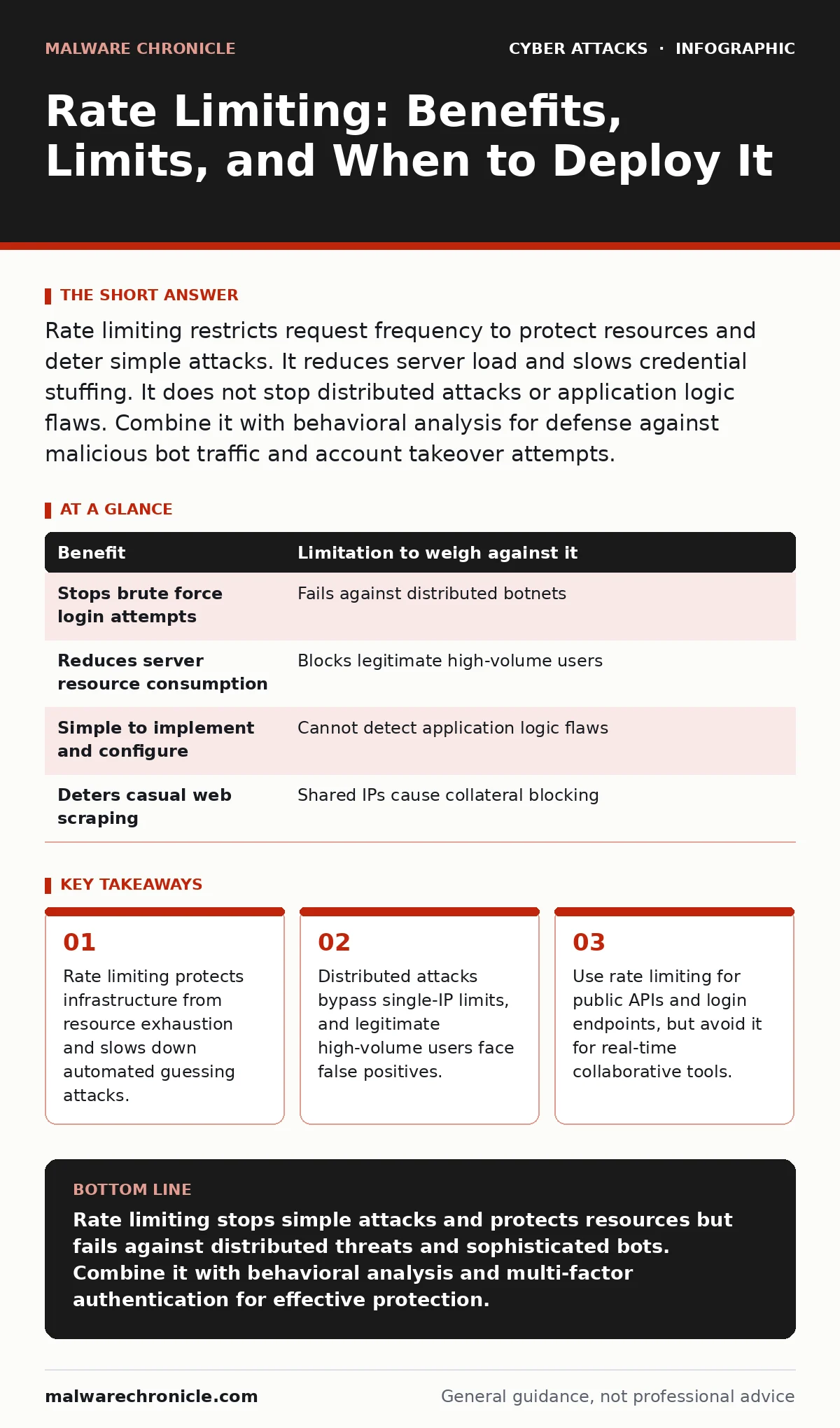
Rate limiting restricts request frequency to protect resources and deter simple attacks. It reduces server load and slows credential stuffing. It does not stop distributed attacks or application logic flaws. Combine it with behavioral analysis for defense against malicious bot traffic and account takeover attempts.
How Rate Limiting Protects Your Infrastructure
Rate limiting controls the number of requests a client can send to your server within a specific time window. This mechanism prevents any single source from consuming disproportionate resources. You configure thresholds based on expected normal behavior. When a client exceeds the threshold, the server rejects further requests until the window resets. This simple gatekeeper stops resource exhaustion attacks. It also slows down automated scripts that attempt to guess passwords or scrape data. The server remains responsive for legitimate users during these spikes. You maintain control over your service availability without complex infrastructure changes.
The Hidden Cost of False Positives
Blocking bad actors often inadvertently blocks good users. This is the primary trade-off of rate limiting. A user with a slow connection may retry requests, triggering the limit. A developer testing an API might exceed thresholds during debugging. Corporate users behind a shared proxy appear as one IP address. If that office hits the limit, every employee loses access. You must balance security with usability. Aggressive limits frustrate users and increase support tickets. Lenient limits fail to stop determined attackers. You need a feedback loop to adjust thresholds based on real-world impact.
Distributed Attacks Bypass Single-IP Limits
Most basic rate limiting tracks requests by source IP address. This approach fails against distributed denial-of-service attacks and coordinated credential stuffing. Attackers use botnets to spread requests across thousands of IP addresses. Each IP stays under the limit, but the aggregate volume overwhelms the system. You face a choice between blocking everyone or nothing. Simple IP-based rules cannot distinguish between a legitimate user and a bot using a residential proxy. You must move beyond IP tracking to identify malicious behavior. This requires analyzing request patterns and user agents.
| Benefit | Limitation to weigh against it |
|---|---|
| Stops brute force login attempts | Fails against distributed botnets |
| Reduces server resource consumption | Blocks legitimate high-volume users |
| Simple to implement and configure | Cannot detect application logic flaws |
| Deters casual web scraping | Shared IPs cause collateral blocking |
When It Is Worth It
Rate limiting provides immediate value for public-facing endpoints. Login pages are prime targets for credential stuffing. Limiting attempts per username or IP slows attackers significantly. It buys time for detection and response. Public APIs benefit from preventing abuse by unauthorized clients. You protect your backend from unexpected traffic spikes. Search endpoints can be limited to prevent expensive database queries. These measures reduce noise and highlight anomalous behavior. You gain visibility into attack patterns. This data informs broader security strategies. Rate limiting acts as a first line of defense. It filters out low-effort attacks before they reach core systems.
When It Is Not Worth It
Rate limiting adds friction to real-time applications. Collaborative tools require instant updates from multiple users. Limiting request frequency breaks the user experience. Financial trading platforms need high-frequency data feeds. Blocking rapid requests causes financial loss. Internal administrative tools used by few staff members rarely face volume attacks.
Adding limits here complicates administration without significant security gain. Systems with stateless, idempotent operations may not need strict limits. If your architecture handles load gracefully, rate limiting adds unnecessary complexity. Evaluate the risk versus the usability cost. Do not apply a blanket policy to every endpoint.
See also: Least Privilege Access Control: How to Limit Damage and Stop Lateral Movement · Authorization Bypass Myths: Why Common Security Beliefs Fail
Advanced Techniques for Better Accuracy
IP-based limiting is the simplest but least accurate method. You can improve precision by tracking user accounts. Limit login attempts per username rather than per IP. This prevents shared IP issues. Behavioral analysis adds another layer. You can detect patterns typical of bots, like rapid mouse movements or consistent timing. Fingerprinting browsers helps identify unique clients despite IP changes. Challenge-response mechanisms, such as CAPTCHAs, engage suspicious clients. These methods increase accuracy but add complexity. You must manage the trade-off between security and user convenience. Advanced techniques require more development effort and maintenance.
Integrating With Broader Security Strategies
Rate limiting works best as part of a layered defense. It complements other security measures rather than replacing them. Combine it with email filtering to reduce phishing-induced attacks. Use security awareness training to educate users on recognizing threats. Monitor for brand impersonation attempts that drive traffic to malicious sites. Integrate logs with your security information and event management system. This allows correlation of rate limit events with other alerts. You can detect coordinated campaigns that span multiple vectors. A holistic approach reduces blind spots. Rate limiting handles volume, while other controls handle intent.
Key takeaways
- Rate limiting protects infrastructure from resource exhaustion and slows down automated guessing attacks.
- Distributed attacks bypass single-IP limits, and legitimate high-volume users face false positives.
- Use rate limiting for public APIs and login endpoints, but avoid it for real-time collaborative tools.
Rate limiting stops simple attacks and protects resources but fails against distributed threats and sophisticated bots. Combine it with behavioral analysis and multi-factor authentication for effective protection.
Frequently asked questions
Does rate limiting stop DDoS attacks?
Basic rate limiting stops low-volume DDoS attacks but fails against high-volume distributed attacks. You need specialized DDoS mitigation services for large-scale attacks.
How do I set the right rate limit?
Analyze your normal traffic patterns and set limits slightly above peak usage. Monitor for false positives and adjust thresholds based on real-world impact.
Can attackers bypass rate limiting?
Yes, attackers can bypass IP-based limits using botnets or proxies. They can also bypass account-based limits by using multiple compromised accounts.
Should I rate limit internal APIs?
Internal APIs face lower risk but can still be abused. Apply limits based on service dependencies and expected usage patterns to prevent cascading failures.
How this guide was produced: written by the Malware Chronicle editorial team with AI assistance, checked against the public references listed below, and reviewed when the facts change. See our editorial policy or report an error.