
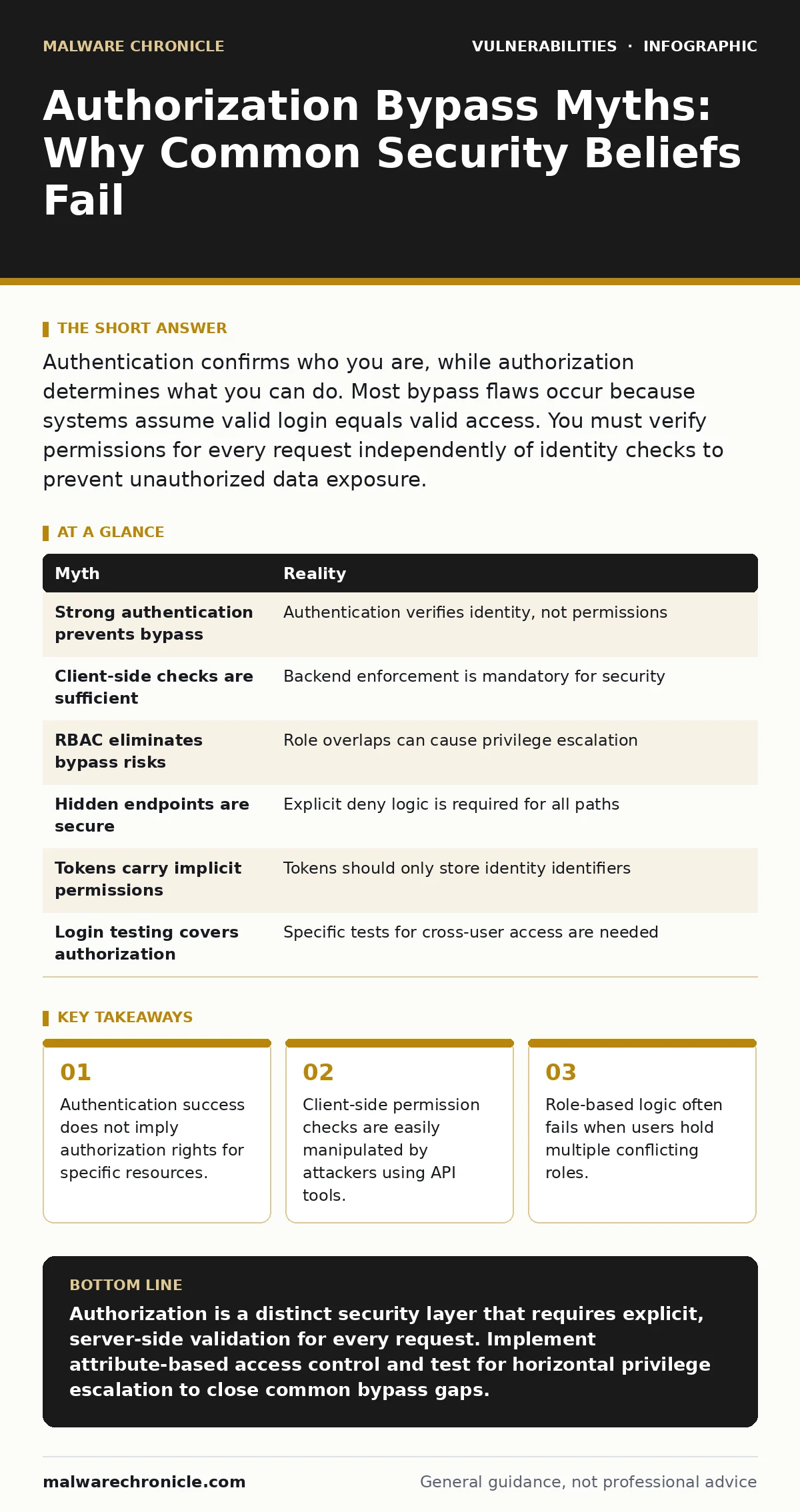
Authentication confirms who you are, while authorization determines what you can do. Most bypass flaws occur because systems assume valid login equals valid access. You must verify permissions for every request independently of identity checks to prevent unauthorized data exposure.
Myth: Strong Authentication Prevents Authorization Bypass
Reality: Authentication and authorization serve distinct purposes in system security. Authentication verifies the identity of a user, confirming they are who they claim to be. Authorization determines what actions that identity is permitted to perform. A system can correctly identify a user while still granting them access to resources they should not see.
Imagine a scenario where a user logs in with valid credentials. The system issues a session token. If the application relies solely on this token to grant access to all endpoints, it creates a critical flaw. An attacker who obtains or predicts a valid token gains the same access as the legitimate user.
This misconception leads developers to invest heavily in multi-factor authentication while neglecting permission logic. Multi-factor authentication stops impersonation, but it does not stop an authorized user from accessing data outside their scope. You must treat authorization as a separate security layer that operates independently of the login process.
Myth: Client-Side Checks Are Sufficient for Access Control
Reality: Client-side authorization checks are visible to the user and can be bypassed with standard development tools. When a web application hides buttons or disables links based on user role, it improves user experience but provides zero security. An attacker can send direct HTTP requests to the backend API, ignoring the interface entirely.
The backend server must enforce every permission check. If the server trusts the client to filter data or actions, it introduces a bypass vector. Attackers use browser developer tools or command-line utilities to craft requests that mimic authorized actions. These requests bypass the graphical interface restrictions completely.
This error is common in single-page applications where the frontend handles significant logic. Developers may believe that removing a "Delete" button from the UI prevents deletion. In reality, the API endpoint that performs the deletion remains accessible. You must implement server-side validation for every state-changing operation and data retrieval request.
Myth: Role-Based Access Control Eliminates Bypass Risks
Reality: Role-based access control simplifies permission management but introduces complexity when users hold multiple roles. If a user belongs to both an "Editor" role and an "Admin" role, the system must define which permissions take precedence. Ambiguous role hierarchies often result in the most permissive access being granted by default.
Consider a user who is both a standard customer and a support agent. The support role grants access to ticket details. The customer role grants access to their own order history. If the system fails to isolate these contexts, the user might access other customers' tickets. This is known as privilege escalation through role overlap.
Static roles do not account for dynamic contexts. A user might have permission to view a document in one project but not another. Role-based systems often lack the granularity to handle these specific constraints. You need attribute-based access control to evaluate permissions based on object attributes, user attributes, and environmental conditions simultaneously.
Myth: Hidden Endpoints Are Secure Without Explicit Denial
Reality: Security by obscurity is not a valid defense strategy. Hiding API endpoints or database fields does not prevent determined attackers from discovering them. Automated scanning tools can map out application structure by probing common paths and analyzing response codes. If an endpoint exists and lacks explicit authorization logic, it is accessible.
Developers sometimes remove endpoints from documentation or disable them in the user interface, believing this makes them secure. This approach fails because the backend code still processes requests to these paths. If the code does not explicitly check for authorization, it returns the requested data.
You must implement explicit deny logic for all sensitive operations. The default behavior for any unverified request should be rejection. Relying on the absence of a known path is insufficient. Attackers use fuzzing techniques to discover hidden functionality. Each discovered endpoint represents a potential entry point for data exfiltration or system compromise.
Myth: Session Tokens Carry Implicit Permission Context
Reality: Session tokens typically store identity information, not permission sets. Embedding complex authorization data in tokens increases their size and exposes sensitive logic to the client. If a token contains permission flags, an attacker can modify them. Even if signed, the server must validate these flags against the current authorization policy.
Storing permissions in the token creates a synchronization problem. If a user's role changes, the token must be invalidated or refreshed. Failure to do so allows the user to retain old permissions until the token expires. This window of opportunity enables authorization bypass during the validity period.
You should store only a unique identifier in the token. The server must retrieve the current permissions from the database or authorization service for every request. This approach ensures that permission changes take effect immediately. It also reduces the risk of token tampering, as the token itself contains no actionable privilege data.
See also: What Causes Data Breaches: The Hidden Mechanics Behind Every Leak · Pen Testing vs Vulnerability Scanning: The Real Difference
Myth: Testing Login Flows Covers Authorization Security
Reality: Standard functional testing often verifies that users can log in and access their own resources. It rarely tests whether users can access resources belonging to others. This gap allows horizontal privilege escalation, where a user accesses data at the same privilege level but belonging to a different account.
Automated tests may check that a user sees their own profile. They often fail to check that the same user cannot see another user's profile by changing an ID parameter. This is known as Insecure Direct Object Reference. It is a common form of authorization bypass that persists because it requires specific test cases to detect.
You must implement property-based testing for authorization. Generate random combinations of user identities and resource IDs to verify that access is denied when ownership or permission is lacking. Manual review of access control logic is also necessary. Automated scans often miss logical flaws that require understanding business rules.
| Myth | Reality |
|---|---|
| Strong authentication prevents bypass | Authentication verifies identity, not permissions |
| Client-side checks are sufficient | Backend enforcement is mandatory for security |
| RBAC eliminates bypass risks | Role overlaps can cause privilege escalation |
| Hidden endpoints are secure | Explicit deny logic is required for all paths |
| Tokens carry implicit permissions | Tokens should only store identity identifiers |
| Login testing covers authorization | Specific tests for cross-user access are needed |
Key takeaways
- Authentication success does not imply authorization rights for specific resources.
- Client-side permission checks are easily manipulated by attackers using API tools.
- Role-based logic often fails when users hold multiple conflicting roles.
Authorization is a distinct security layer that requires explicit, server-side validation for every request. Implement attribute-based access control and test for horizontal privilege escalation to close common bypass gaps.
Frequently asked questions
How do I fix horizontal privilege escalation in my API?
Enforce ownership checks on the server side by verifying that the authenticated user owns the requested resource before returning data.
What is the difference between authentication and authorization?
Authentication confirms user identity, while authorization determines what actions that identity is permitted to perform on specific resources.
Can I use role-based access control for complex systems?
Role-based access control works for simple hierarchies, but complex systems require attribute-based access control to handle dynamic permissions.
How often should I review authorization logic?
Review authorization logic whenever business rules change, new roles are added, or new data types are introduced to the system.
How this guide was produced: written by the Malware Chronicle editorial team with AI assistance, checked against the public references listed below, and reviewed when the facts change. See our editorial policy or report an error.