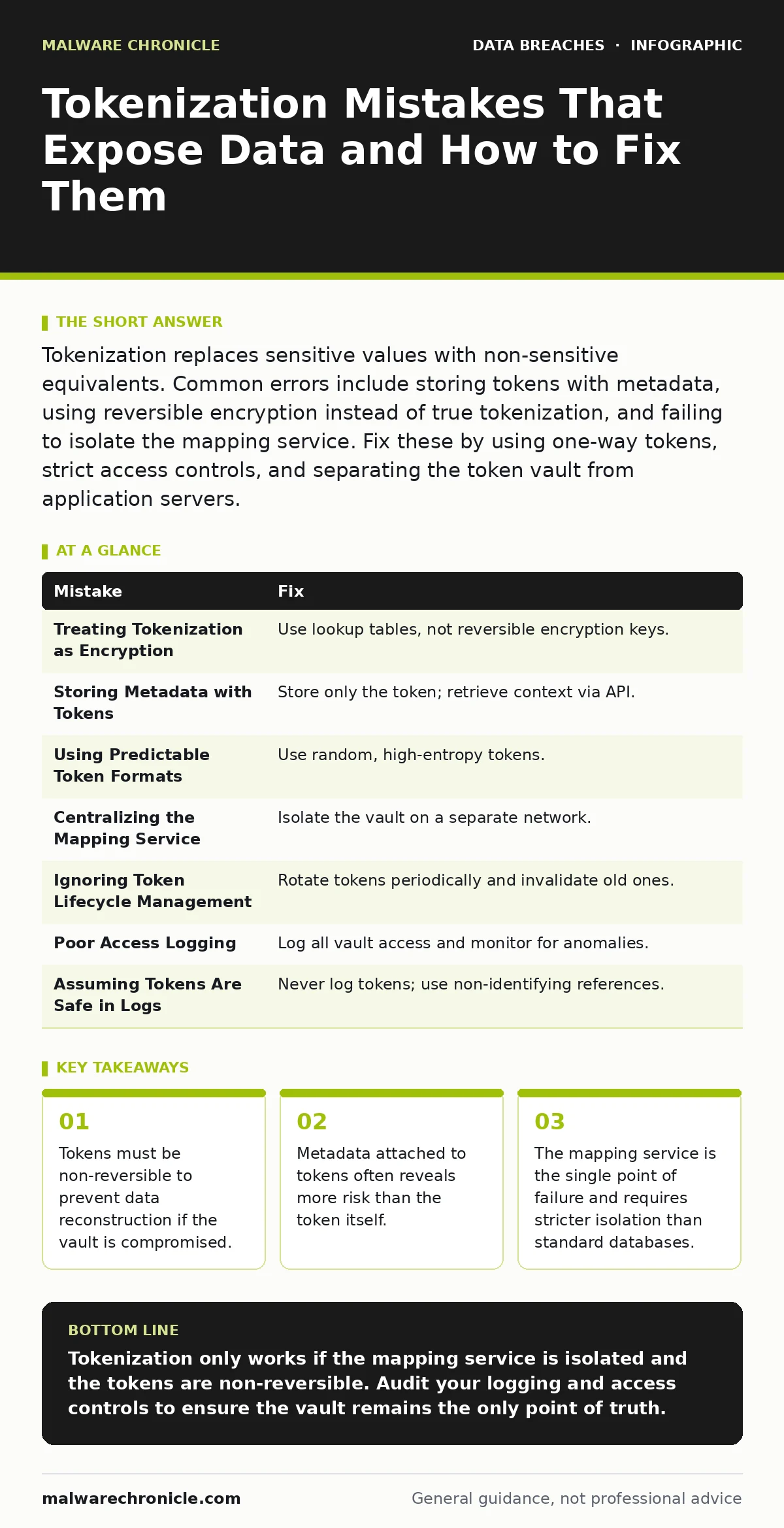
Tokenization replaces sensitive values with non-sensitive equivalents. Common errors include storing tokens with metadata, using reversible encryption instead of true tokenization, and failing to isolate the mapping service. Fix these by using one-way tokens, strict access controls, and separating the token vault from application servers.
Mistake 1: Treating Tokenization as Encryption
Many developers assume tokenization and encryption are interchangeable security controls. They are not. Encryption is reversible with a key; tokenization maps a value to a surrogate that holds no mathematical relationship to the original. When you use encryption where tokenization is required, you keep the computational power needed to reverse the data in your application layer. This increases the attack surface significantly.
Why it hurts:
If an attacker gains access to your application server, they can decrypt the data using keys stored in memory or configuration files. True tokenization removes the original data from the application environment entirely. The application only holds the token, which is useless without access to the mapping service. Using encryption leaves the sensitive data present and decryptable on systems that should never handle it.
The fix:
Replace reversible encryption with a tokenization service that uses a lookup table or mapping. Ensure the application never holds the decryption key or the original data. The token should be a random string generated by the service, not a transformed version of the input. This separation ensures that compromising the application does not yield the sensitive data.
Mistake 2: Storing Metadata with Tokens
It is tempting to store additional context alongside the token to make debugging easier. You might store the last four digits of a card number or the creation date next to the token. This metadata often contains enough information to re-identify the data owner or narrow down the value of the token. It defeats the purpose of removing sensitive context from the application layer.
Why it hurts:
Metadata creates a secondary attack vector. If an attacker steals the token database, they do not just have random strings. They have strings paired with identifying fragments. This allows them to correlate tokens with external breaches or guess the original values. For example, knowing the month and year of a transaction reduces the possible values for a token significantly. This linkage can lead to customer data exposure even if the token itself is secure.
The fix:
Store only the token and the minimum technical identifiers required for system operation. Never store partial original values, dates, or user identifiers in the same table as the token. If you need to display partial data to a user, retrieve it from the tokenization service via a secure API call at the moment of display. Keep the application database free of any data that could link a token to a person.
Mistake 3: Using Predictable Token Formats
Some systems generate tokens that look like the original data format. A credit card token might look like a valid card number, and a social security token might look like a valid ID. This is known as format-preserving tokenization. While it helps with legacy system compatibility, it introduces significant risk. Attackers can use the format to validate tokens or launch brute-force attacks.
Why it hurts:
Predictable formats allow attackers to distinguish valid tokens from noise. If a token looks like a valid card number, an attacker can use it in a payment gateway to test if it is active. This turns the token into a usable credential. Format-preserving tokens also make it easier for attackers to guess the original data if they have partial knowledge. The structural similarity reduces the entropy of the token space.
The fix:
Use random, high-entropy tokens that do not resemble the original data format. If legacy systems require specific formats, use a separate mapping layer that translates the random token to the formatted value only at the point of use. Ensure the stored token is a long, random string. This prevents attackers from validating tokens outside of your controlled environment and reduces the risk of format-based attacks.
Mistake 4: Centralizing the Mapping Service
The mapping service, or token vault, holds the link between tokens and original data. Many organizations place this service on the same network as other internal tools. They treat it as just another database. This centralization creates a single point of failure. If the network is compromised, the attacker can pivot to the mapping service and reverse all tokens.
Why it hurts:
A centralized mapping service becomes a high-value target. Attackers know that compromising this service gives them access to all sensitive data protected by tokenization. If the service shares credentials or network access with other systems, a breach in one area can cascade into a total failure. This concentration of risk is dangerous. It negates the isolation benefits of tokenization.
The fix:
Isolate the mapping service on a separate network segment with strict access controls. Use dedicated hardware or virtual machines for the vault. Implement multi-factor authentication for any administrative access. Ensure that the application servers can only communicate with the vault via specific, monitored APIs. This containment limits the blast radius of a breach.
Mistake 5: Ignoring Token Lifecycle Management
Tokens are often created and never rotated or deleted. Developers assume that once a token is generated, it is secure forever. This is incorrect. Tokens can be leaked through logs, backups, or memory dumps. Over time, the risk of exposure increases. A token that is years old may have been exposed in a credential leaks incident without anyone noticing.
Why it hurts:
Stale tokens provide a long window for attackers to exploit. If a token is leaked, it remains valid indefinitely. This allows attackers to use the token long after the initial breach. It also complicates forensic analysis. You cannot determine when a token was compromised if it is never rotated. This lack of visibility makes it hard to respond to dark web monitoring alerts effectively.
The fix:
Implement a token rotation policy. Rotate tokens periodically or when a user changes their sensitive data. Ensure that old tokens are invalidated immediately. Monitor for token usage anomalies. If a token is used in an unexpected context, invalidate it and alert the user. This limits the damage of a leak.
See also: Cloud Encryption Checklist: Protect Data in Transit and at Rest · Customer Data Exposure: Risks and Protection for Small Businesses
Mistake 6: Poor Access Logging
Many systems do not log access to the tokenization service adequately. They log who accessed the application, but not who accessed the mapping service. This creates a blind spot. If an attacker gains access to the vault, you may not know until they have reversed significant amounts of data. Lack of logging hinders detection and response.
Why it hurts:
Without detailed logs, you cannot detect unauthorized access to the mapping service. Attackers can operate silently, reversing tokens and exfiltrating data. You lose the ability to trace the breach back to its source. This makes incident response difficult. You cannot determine the scope of the breach or who was affected.
The fix:
Log all access to the mapping service, including successful and failed requests. Include user identities, timestamps, and IP addresses. Store these logs in a secure, immutable location. Monitor the logs for unusual patterns, such as bulk lookups or access from unusual locations. This visibility allows you to detect and respond to attacks quickly.
Mistake 7: Assuming Tokens Are Safe in Logs
Developers often log tokens for debugging purposes. They assume that because the token is not the original data, it is safe to log. This is a dangerous assumption. Tokens can be used to reconstruct data if the mapping service is compromised. Logging tokens increases the risk of exposure. They can be extracted from logs and used in attacks.
Why it hurts:
Logs are often less secure than application databases. They are shared among many tools and personnel. If tokens are in logs, they are exposed to anyone with access to the logging system. This bypasses the security controls of the application. Attackers can harvest tokens from logs and use them to access sensitive data. This leads to sensitive personal data being exposed unnecessarily.
The fix:
Never log tokens. Use non-identifying references in logs instead. If you need to trace a transaction, use a transaction ID that is not linked to the token. Ensure that logging frameworks are configured to mask or remove any sensitive data. This reduces the risk of accidental exposure.
| Mistake | Fix |
|---|---|
| Treating Tokenization as Encryption | Use lookup tables, not reversible encryption keys. |
| Storing Metadata with Tokens | Store only the token; retrieve context via API. |
| Using Predictable Token Formats | Use random, high-entropy tokens. |
| Centralizing the Mapping Service | Isolate the vault on a separate network. |
| Ignoring Token Lifecycle Management | Rotate tokens periodically and invalidate old ones. |
| Poor Access Logging | Log all vault access and monitor for anomalies. |
| Assuming Tokens Are Safe in Logs | Never log tokens; use non-identifying references. |
Key takeaways
- Tokens must be non-reversible to prevent data reconstruction if the vault is compromised.
- Metadata attached to tokens often reveals more risk than the token itself.
- The mapping service is the single point of failure and requires stricter isolation than standard databases.
Tokenization only works if the mapping service is isolated and the tokens are non-reversible. Audit your logging and access controls to ensure the vault remains the only point of truth.
Frequently asked questions
Is tokenization better than encryption for credit card data?
Tokenization is often better for compliance because it removes card data from the application environment. Encryption keeps the data present but scrambled. Tokenization reduces the scope of compliance audits.
Can I use tokenization for passwords?
No. Tokenization is not suitable for passwords. Passwords should be hashed with a strong algorithm like Argon2. Tokenization preserves the ability to retrieve the original value, which is dangerous for credentials.
How do I handle token rotation for existing users?
Rotate tokens when users update their data or periodically. Notify users if the rotation affects their experience. Ensure that old tokens are invalidated immediately to prevent confusion or security gaps.
What if my legacy system requires formatted tokens?
Use a gateway that translates random tokens to formatted values only at the point of use. Keep the stored tokens random. This maintains security while supporting legacy requirements.
How this guide was produced: written by the Malware Chronicle editorial team with AI assistance, checked against the public references listed below, and reviewed when the facts change. See our editorial policy or report an error.