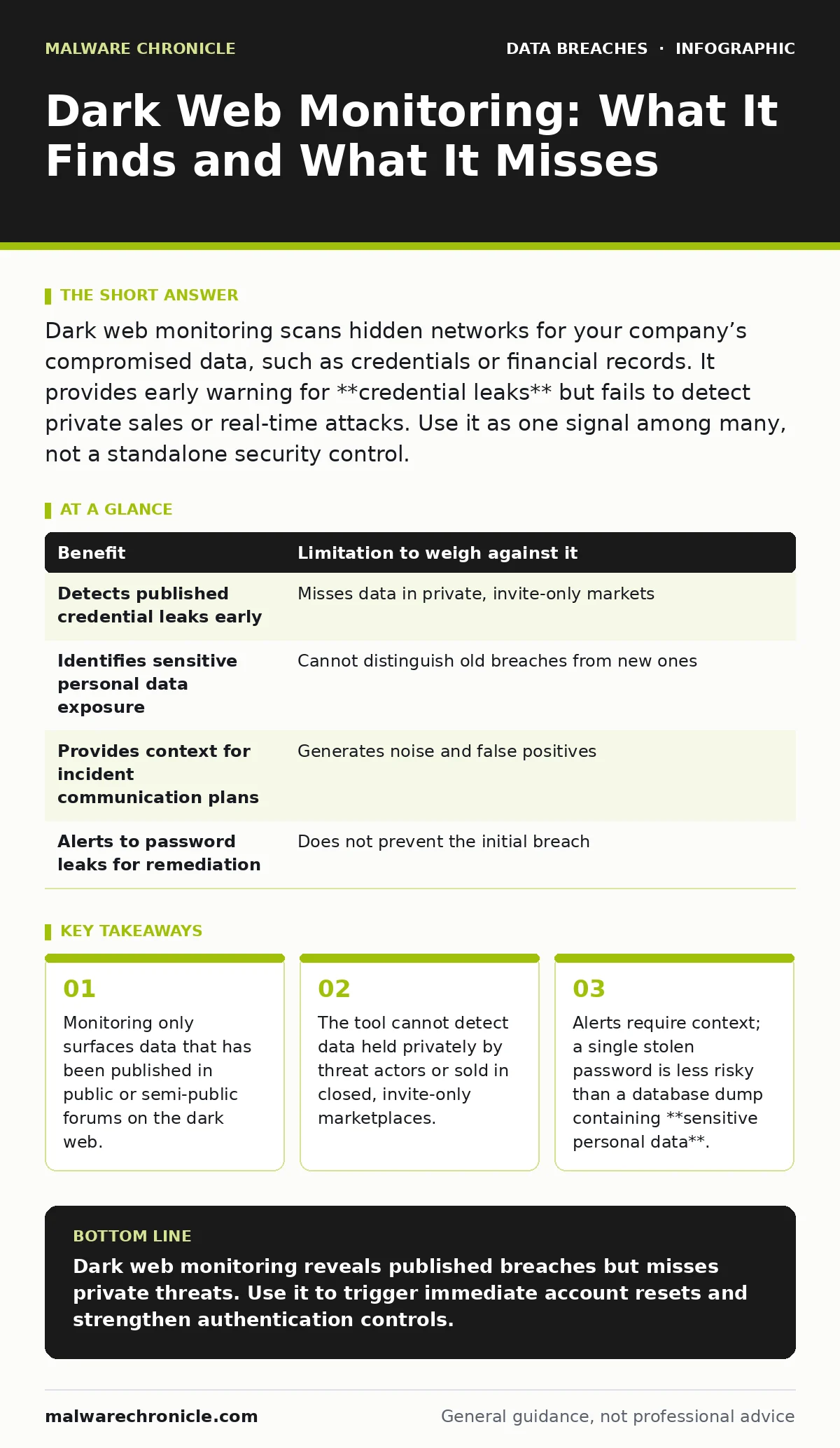
Dark web monitoring scans hidden networks for your company’s compromised data, such as credentials or financial records. It provides early warning for **credential leaks** but fails to detect private sales or real-time attacks. Use it as one signal among many, not a standalone security control.
The Illusion of Visibility
Dark web monitoring services crawl hidden services, typically those running on the Tor network, to find data associated with your organization. These services search for email addresses, domain names, and other identifiers in forums, paste sites, and marketplaces. The promise is early detection of a breach before it impacts your customers.
However, the dark web is not a single searchable index. It is a fragmented ecosystem of changing URLs and encrypted connections. Many markets require invitations or specific credentials to enter. If your data is held in a private channel or a closed auction, monitoring tools cannot see it. You are only looking at what threat actors choose to publish openly.
This creates a dangerous blind spot. A sophisticated actor may keep stolen data private to maximize its value or to avoid detection. They might sell the data in batches over time, keeping the source hidden. Your monitoring tool remains silent while the threat grows.
Concrete Benefits of Monitoring
The primary benefit is the detection of password leaks and credential leaks. When threat actors dump harvested passwords from other breaches, they often list them on public forums. Monitoring can alert you to these exposures before the attacker uses them against your systems.
This allows you to force password resets or block compromised accounts. It turns a passive risk into an active remediation step. You can also detect the sale of personal data sold on the dark web, such as credit card numbers or identity documents. This helps you assess the scope of a potential incident and prepare your incident communication plans.
Another benefit is threat intelligence gathering. By analyzing the language, tools, and targets discussed in forums, you can identify emerging tactics. You might see a new exploit kit being promoted or a specific industry being targeted. This context helps you prioritize your defensive efforts.
Honest Limitations to Accept
The most significant limitation is the inability to see private transactions. The dark web is largely unstructured. There is no central database. Monitoring services rely on known URLs and keywords. If a threat actor changes the URL or uses code words, the tool misses the data.
False positives are also common. A match might be an old breach from years ago that you have already addressed. Or it might be a similar domain name or a generic email pattern. Investigating every alert consumes time and resources. You need a process to validate findings quickly.
Monitoring does not prevent data exfiltration. It only finds data that has already left your environment. It cannot stop an attacker from copying files or accessing your database in real time. It is a reactive measure, not a preventive one. Relying on it as a primary defense is a strategic error.
| Benefit | Limitation to weigh against it |
|---|---|
| Detects published credential leaks early | Misses data in private, invite-only markets |
| Identifies sensitive personal data exposure | Cannot distinguish old breaches from new ones |
| Provides context for incident communication plans | Generates noise and false positives |
| Alerts to password leaks for remediation | Does not prevent the initial breach |
When It Is Worth It
Dark web monitoring is worth the investment when you handle high-value data that is frequently targeted. This includes financial institutions, healthcare providers, and large technology firms. For these organizations, the cost of a single customer data exposure event can be devastating.
It is also valuable when you have many employees using personal email addresses for business. Threat actors often harvest these addresses from public sources. Monitoring helps you track whether these accounts have been compromised in third-party breaches. This allows you to push for stronger authentication methods, such as multi-factor authentication, before an attack occurs.
If you have a mature security operations center, monitoring adds another data stream. Your analysts can correlate dark web alerts with internal logs. This helps them spot credential leaks being used in real-time attacks. The value comes from integration, not just the alerts themselves.
When It Is Not Worth It
For small organizations with limited data exposure, monitoring may be a waste of resources. If you do not store sensitive personal data or financial records, the incentive for attackers to target you is lower. The alerts you receive are likely to be generic or irrelevant.
It is not worth it if you lack the staff to respond. An alert without action is noise. If you do not have a process to reset passwords, block accounts, or investigate findings, the tool provides no value. You are paying for anxiety, not security.
Avoid it if you believe it replaces other controls. Monitoring does not fix weak passwords, unpatched software, or poor access controls. If you are not addressing these foundational issues, monitoring will not save you. It is a supplement, not a substitute.
See also: Data Classification FAQ: Protect Assets Without Slowing Development · Encryption at Rest vs In Transit: Core Differences and Selection Criteria
The Hidden Cost of Alerts
Every alert requires investigation. Analysts must determine if the data is real, if it is new, and if it is relevant. This takes time. In a busy security team, this time is taken from other tasks, such as patching or testing backup testing procedures.
The psychological cost is also real. Constant alerts can lead to alert fatigue. Teams may start ignoring warnings, assuming they are false positives. This increases the risk that a real threat will be missed. You need clear criteria for what constitutes a high-priority alert.
Imagine receiving an alert for a CEO’s email address. The team spends hours investigating, only to find it is from a breach two years ago. The time spent could have been used to secure a critical server. Measure the effort required to verify each alert against the actual risk.
Integrating Into Your Strategy
To make monitoring useful, integrate it into your broader security workflow. Connect it to your identity provider so you can automatically block compromised accounts. Use it to trigger password resets for affected users. This reduces the manual effort required.
Combine it with other data sources. Look for patterns in your internal logs that match the timing of dark web alerts. If you see a spike in login failures at the same time as a credential leak alert, the connection is likely real. This correlation improves accuracy.
Do not rely on a single vendor. Different services crawl different parts of the dark web. Using multiple sources can reduce blind spots. However, this also increases noise. You need a platform that can aggregate and deduplicate alerts from multiple providers.
Moving Beyond Detection
The goal is not just to find stolen data, but to reduce the impact of a breach. This requires strong authentication. Even if passwords are stolen, multi-factor authentication can block unauthorized access. This is more effective than trying to find every leak.
Implement least privilege access. Limit what each user can do within your systems. This reduces the value of stolen credentials. An attacker with a single password cannot do much if they cannot access critical systems.
Regularly test your incident response plans. Ensure your team knows how to handle a customer data exposure event. Practice communicating with stakeholders and customers. The speed of your response matters more than the speed of your detection.
Key takeaways
- Monitoring only surfaces data that has been published in public or semi-public forums on the dark web.
- The tool cannot detect data held privately by threat actors or sold in closed, invite-only marketplaces.
- Alerts require context; a single stolen password is less risky than a database dump containing **sensitive personal data**.
Dark web monitoring reveals published breaches but misses private threats. Use it to trigger immediate account resets and strengthen authentication controls.
Frequently asked questions
Can dark web monitoring detect ransomware groups?
It can detect their communications if they post publicly, but most ransomware groups operate in private channels. It is not a reliable tool for tracking ransomware activity.
How often should I run a dark web scan?
Continuous monitoring is best. Data can appear and disappear quickly. Weekly or monthly scans may miss short-lived posts or auctions.
Is dark web monitoring legal?
Yes, monitoring publicly accessible forums is legal. However, accessing private markets or using illegal tools to browse the dark web is not. Ensure your vendor operates within legal boundaries.
What data should I monitor for?
Monitor for employee email addresses, domain names, and any unique identifiers. Do not monitor for generic terms that could match unrelated breaches.
How this guide was produced: written by the Malware Chronicle editorial team with AI assistance, checked against the public references listed below, and reviewed when the facts change. See our editorial policy or report an error.