
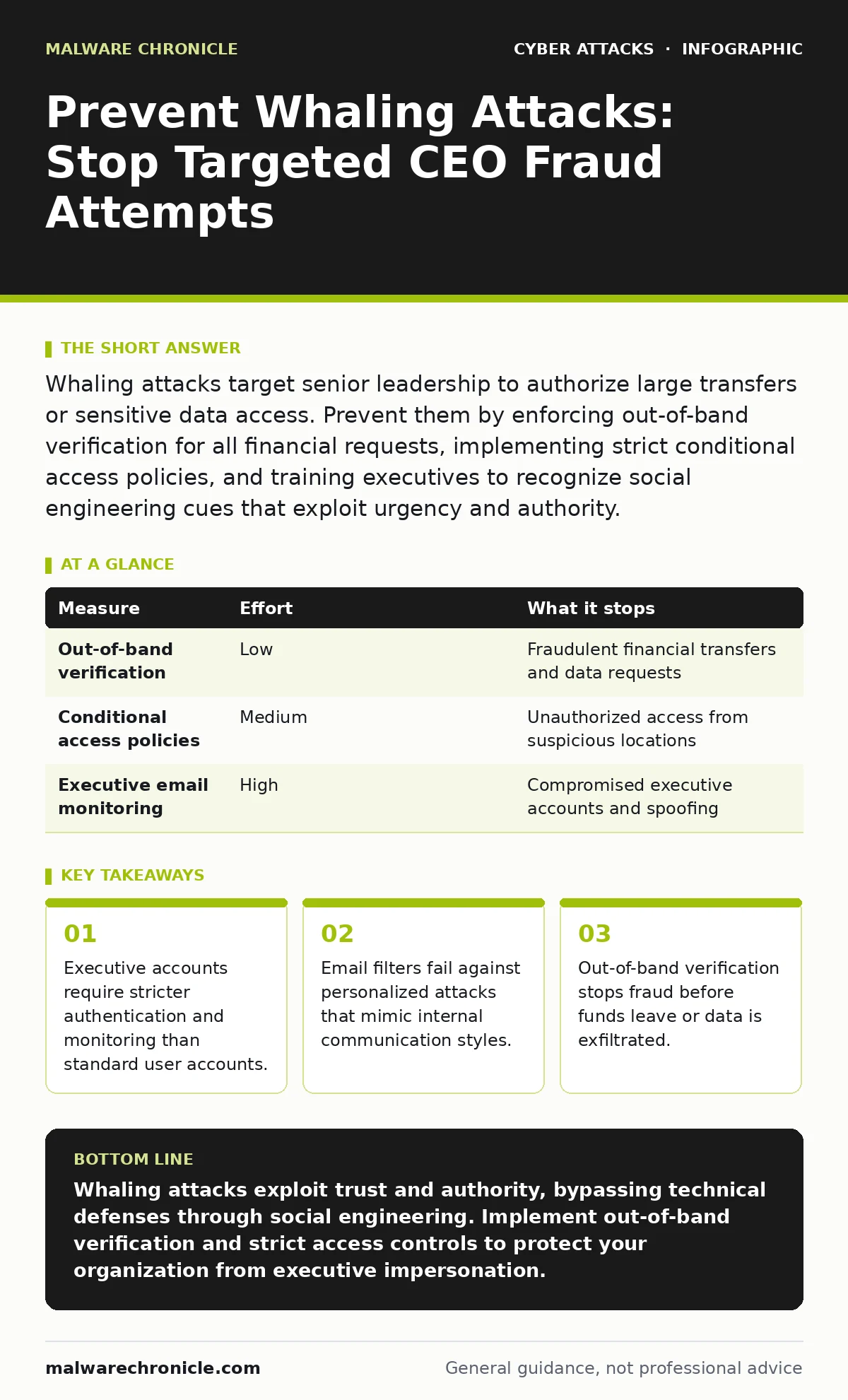
Whaling attacks target senior leadership to authorize large transfers or sensitive data access. Prevent them by enforcing out-of-band verification for all financial requests, implementing strict conditional access policies, and training executives to recognize social engineering cues that exploit urgency and authority.
Understanding the Whaling Attack Vector
Whaling is a specific type of spear phishing that targets high-profile executives. Attackers research the target extensively to craft messages that appear to come from trusted colleagues, partners, or legal counsel. The goal is usually financial gain through payroll diversion fraud or data theft through business email compromise.
Standard security measures often miss these attacks. The messages do not contain malicious links or attachments. They rely entirely on social engineering. The attacker exploits the executive’s authority and the recipient’s desire to comply with urgent requests.
Imagine a message from the CEO asking for immediate invoice payments to a new vendor. The tone is authoritative. The deadline is tight. The recipient assumes the request is legitimate because it aligns with the executive’s known communication style.
Why Standard Defenses Fail Against Whaling
Traditional spam filters look for known malicious signatures or suspicious domains. Whaling attacks use clean domains or compromised legitimate accounts. The content is grammatically correct and contextually appropriate.
Attackers often compromise a real executive’s account first. This makes the message appear to come from a trusted source. Even advanced threat protection struggles to flag legitimate-looking content from a verified sender.
The human element is the primary vulnerability. Employees hesitate to question authority. This hesitation creates a window for the attacker to execute the transfer or data exfiltration before anyone raises an alarm.
Priority One: Out-of-Band Verification
The most effective defense against whaling is out-of-band verification. This means confirming any request for money or sensitive data through a different communication channel. If an email requests a wire transfer, call the executive on a known phone number.
Do not use the phone number provided in the suspicious email. Attackers often spoof contact details. Use your internal directory or a previously established contact method. This simple step breaks the attacker’s chain of deception.
This measure removes the risk of acting on a fraudulent instruction. It adds friction to the process, which may slow down legitimate urgent requests. However, the trade-off is worth the security benefit. No amount of urgency justifies bypassing verification protocols.
| Measure | Effort | What it stops |
|---|---|---|
| Out-of-band verification | Low | Fraudulent financial transfers and data requests |
| Conditional access policies | Medium | Unauthorized access from suspicious locations |
| Executive email monitoring | High | Compromised executive accounts and spoofing |
Priority Two: Conditional Access Policies
Implement strict conditional access policies for executive accounts. These policies define when and where users can access resources. For example, block access to email from countries where the executive does not travel.
Require multi-factor authentication for all administrative actions. This adds a layer of security that attackers cannot bypass with stolen passwords alone. If an attacker compromises credentials, they cannot log in without the second factor.
Conditional access policies also help detect anomalies. If an executive logs in at 3 AM from a new device, the system can block the attempt or require additional verification. This reduces the window of opportunity for attackers who have stolen credentials.
Priority Three: Executive Email Monitoring
Monitor executive email accounts for unusual activity. Look for spikes in sending volume, new recipients, or changes in signing patterns. An intrusion detection systems can alert security teams to these anomalies in real-time.
Attackers often use compromised executive accounts to launch further attacks. They may send phishing emails to other employees or partners. Early detection of account compromise limits the damage.
Regularly review email forwarding rules. Attackers often set up forwarding rules to keep copies of emails sent from the compromised account. This allows them to monitor responses and adjust their tactics. Blocking unauthorized forwarding rules is a critical control.
See also: Phishing Simulations: 8 Practices That Actually Work · Payroll Diversion Fraud: How Attackers Steal Your Money
The Hidden Cost of Executive Awareness Training
Training executives on security awareness is necessary but insufficient. Executives are busy and often delegate security tasks to assistants. This creates a gap in defense. Assistants may not recognize the subtle cues of a whaling attack.
Training must include the entire support chain. Executive assistants, legal counsel, and finance teams must understand the risks. They are often the ones who execute the requests. If they do not know what to look for, the defense fails.
Regular phishing simulations can help reinforce training. These tests expose employees to realistic attack scenarios. However, simulations must be tailored to the executive context. Generic phishing tests do not prepare teams for sophisticated whaling attempts.
What Does Not Work: Technical Fixes Alone
Many organizations believe that upgrading email security software will stop whaling. This is a misconception. Whaling attacks exploit human psychology, not software vulnerabilities. No amount of filtering can replace human judgment.
Another common mistake is assuming that multi-factor authentication is a silver bullet. MFA protects against credential theft but not against social engineering. If an executive is tricked into approving a transfer, MFA does not stop the fraud.
Integrating with Incident Response
A whaling attack is a security incident. Your cyber incident response team should have a specific plan for executive compromise. This plan should include immediate account lockdown, forensic analysis, and communication strategies.
Speed is critical. The longer an attacker has access to an executive’s account, the more damage they can cause. The response plan must define clear roles and responsibilities. Everyone involved must know their part in the process.
Post-incident analysis is vital. Review what went wrong and how the attack was detected. Use these insights to improve defenses. Continuous improvement is the only way to stay ahead of evolving attack techniques.
Closing Checklist for Immediate Action
Review your current email security settings today. Ensure that executive accounts have the highest level of protection. Implement conditional access policies if they are not already in place.
Update your financial verification procedures. Ensure that all large transfers require out-of-band confirmation. Train your staff on the new process. Make sure everyone understands the importance of verification.
Test your incident response plan. Conduct a tabletop exercise focused on executive account compromise. Identify gaps in your response and address them immediately. Preparation reduces the impact of an actual attack.
- Enable conditional access policies for executive accounts.
- Establish out-of-band verification for all financial requests.
- Review and update incident response procedures for executive compromise.
Key takeaways
- Executive accounts require stricter authentication and monitoring than standard user accounts.
- Email filters fail against personalized attacks that mimic internal communication styles.
- Out-of-band verification stops fraud before funds leave or data is exfiltrated.
Whaling attacks exploit trust and authority, bypassing technical defenses through social engineering. Implement out-of-band verification and strict access controls to protect your organization from executive impersonation.
Frequently asked questions
How do I know if an executive account is compromised?
Look for unusual login locations, times, or devices. Check for spikes in email volume or new forwarding rules. Monitor for changes in communication style or tone.
Can AI detect whaling attacks?
AI can analyze patterns and flag anomalies. However, it cannot replace human judgment. AI should support verification processes, not replace them.
What is the difference between whaling and phishing?
Phishing targets many users with generic messages. Whaling targets specific high-value individuals with personalized, researched attacks. The sophistication and personalization level are much higher in whaling.
Should I block external emails for executives?
Blocking all external emails is impractical. It disrupts business operations. Instead, use conditional access and monitoring to manage risk while maintaining productivity.
How this guide was produced: written by the Malware Chronicle editorial team with AI assistance, checked against the public references listed below, and reviewed when the facts change. See our editorial policy or report an error.