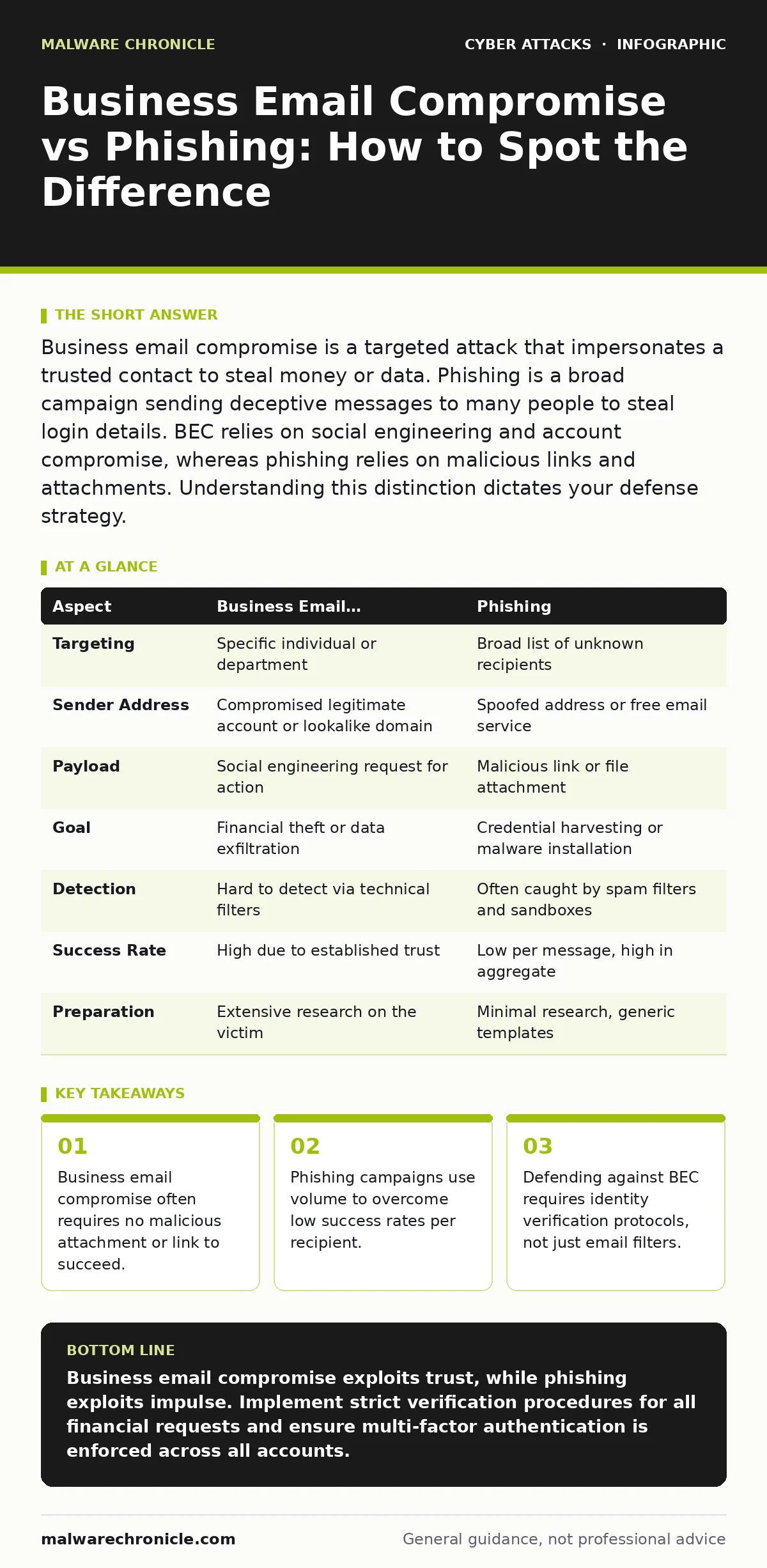
Business email compromise is a targeted attack that impersonates a trusted contact to steal money or data. Phishing is a broad campaign sending deceptive messages to many people to steal login details. BEC relies on social engineering and account compromise, whereas phishing relies on malicious links and attachments. Understanding this distinction dictates your defense strategy.
Business Email Compromise vs Phishing: The Core Distinction
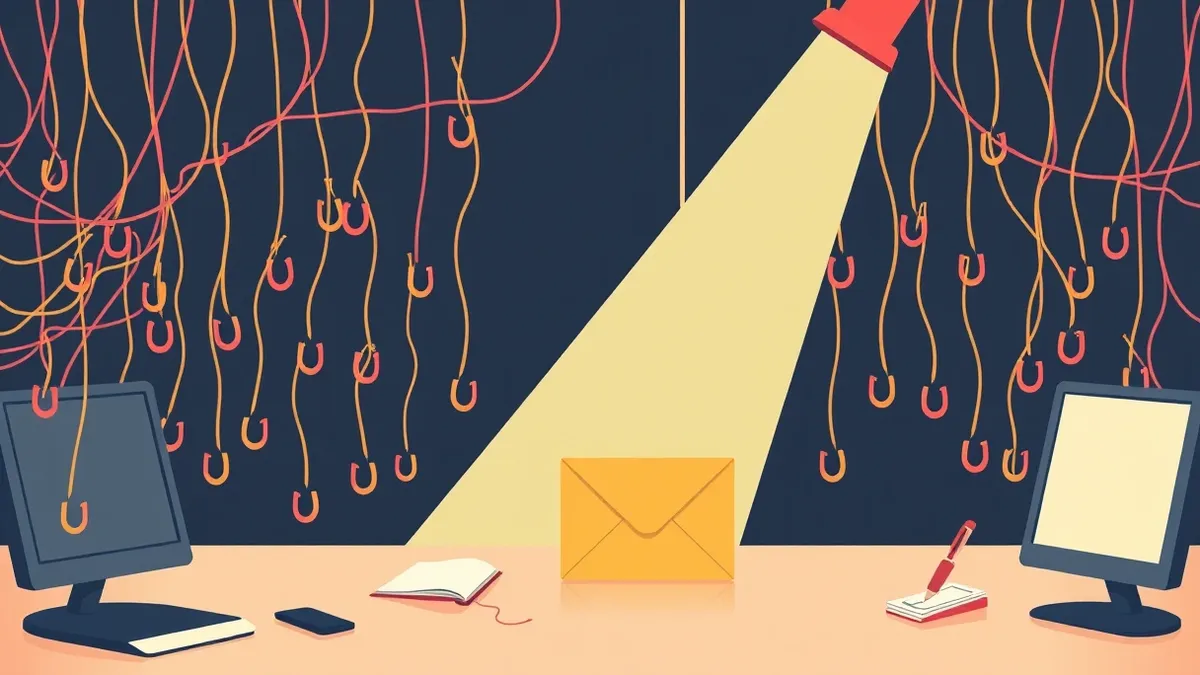
Business email compromise and phishing share a common goal: unauthorized access to sensitive information or funds. The fundamental difference lies in scope and method. Business email compromise is a surgical strike against a specific individual or organization, often leveraging compromised legitimate accounts. Phishing is a scattergun approach, sending identical deceptive messages to thousands of recipients in hopes that a small fraction will interact with the payload. One relies on trust and context; the other relies on urgency and deception.
What Is Business Email Compromise?
Business email compromise is a fraud scheme where an attacker compromises a legitimate email account or registers a domain that looks nearly identical to a known vendor. The attacker then sends requests for wire transfers or sensitive data from that trusted address. Because the message originates from a recognized source, recipients rarely suspect foul play. The attacker uses social engineering to mimic the tone, style, and urgency of the actual owner. This method bypasses traditional spam filters because the content appears to be a routine business request rather than a suspicious solicitation.
What Is Phishing?
Phishing is the practice of sending fraudulent communications that appear to come from a reputable source. The goal is to trick the recipient into revealing personal information, such as passwords or credit card numbers, or to install malware. These messages often contain links to fake login pages or malicious attachments. The attacker does not know who will click; they rely on statistical probability. If one in a thousand recipients falls for the scam, the attacker gains valuable credentials. This method exploits human error and urgency, urging the victim to act quickly without verifying the sender's identity.
Point-by-Point Comparison
| Aspect | Business Email Compromise | Phishing |
|---|---|---|
| Targeting | Specific individual or department | Broad list of unknown recipients |
| Sender Address | Compromised legitimate account or lookalike domain | Spoofed address or free email service |
| Payload | Social engineering request for action | Malicious link or file attachment |
| Goal | Financial theft or data exfiltration | Credential harvesting or malware installation |
| Detection | Hard to detect via technical filters | Often caught by spam filters and sandboxes |
| Success Rate | High due to established trust | Low per message, high in aggregate |
| Preparation | Extensive research on the victim | Minimal research, generic templates |
When to Choose Which Defense Strategy
You must tailor your defenses to the specific threat model. A single security posture cannot address both threats equally because they exploit different vulnerabilities. BEC exploits trust and process gaps, while phishing exploits technical weaknesses and human impulse. Recognizing which attack vector is most likely to succeed against your organization allows you to allocate resources effectively. Ignoring the distinction leads to wasted effort on tools that do not address the actual risk.
See also: Phishing Simulations: 8 Practices That Actually Work · How Secure Email Gateways Filter Threats Before Inbox Delivery
Choose Business Email Compromise Defenses When
- You handle high-value wire transfers or financial transactions regularly.
- Your organization has public executive profiles that attackers can research.
- You rely on email for critical business decisions without secondary verification.
- You have experienced previous account takeover incidents.
- Your vendors use similar domain names that are easy to spoof.
Choose Phishing Defenses When
- You have a large workforce with varying levels of security awareness.
- Your users frequently download files or click links in emails.
- You use cloud services where credential theft leads to immediate account takeover.
- Your organization lacks strict conditional access policies for login attempts.
- You want to reduce the volume of malicious bot traffic reaching your inbox.
Where the Strategies Overlap
Both threats require strong identity management. Implementing multi-factor authentication stops many phishing attempts but does not stop BEC if the attacker has already bypassed it via a compromised session. Email authentication protocols like SPF, DKIM, and DMARC help prevent domain spoofing for both types of attacks. User training is vital for both, but the content differs. For phishing, train users to spot bad URLs. For BEC, train users to question unexpected requests for money or data, even from known contacts.
Advanced Detection and Mitigation
Intrusion detection systems can alert on unusual login patterns, such as access from a new country at an odd hour. This is particularly useful for spotting account takeover before a BEC request is sent. For phishing, DNS spoofing protections ensure that users are redirected to legitimate sites even if they click a bad link. Rate limiting on authentication endpoints prevents attackers from brute-forcing passwords after a phishing campaign succeeds. Whaling attacks, a subset of BEC targeting executives, require specific monitoring of executive accounts for unusual activity.
Integrating Security Frameworks
Payroll diversion fraud is a common outcome of successful BEC. Ensuring that payroll changes require dual approval prevents a single compromised account from altering bank details. Malicious bot traffic can be filtered to reduce the noise in your security alerts, allowing analysts to focus on high-value threats. Combining technical controls with procedural safeguards creates a layered defense. No single tool stops all attacks, but a combination of identity verification, email authentication, and user awareness significantly reduces risk.
Key takeaways
- Business email compromise often requires no malicious attachment or link to succeed.
- Phishing campaigns use volume to overcome low success rates per recipient.
- Defending against BEC requires identity verification protocols, not just email filters.
Business email compromise exploits trust, while phishing exploits impulse. Implement strict verification procedures for all financial requests and ensure multi-factor authentication is enforced across all accounts.
Frequently asked questions
Can antivirus software stop business email compromise?
No, because BEC typically does not involve malware. The attack relies on social engineering and legitimate email channels, bypassing traditional antivirus protections.
Is phishing more dangerous than business email compromise?
It depends on the target. Phishing affects more people, but BEC often results in higher financial losses per incident due to the targeted nature of the attack.
How do I verify a suspicious email from a known contact?
Contact the person using a pre-established phone number or messaging platform. Do not reply to the email or use contact details provided within the suspicious message.
What is the role of DMARC in preventing these attacks?
DMARC prevents attackers from spoofing your domain name, making it harder for them to send emails that appear to come from your organization.
How this guide was produced: written by the Malware Chronicle editorial team with AI assistance, checked against the public references listed below, and reviewed when the facts change. See our editorial policy or report an error.