
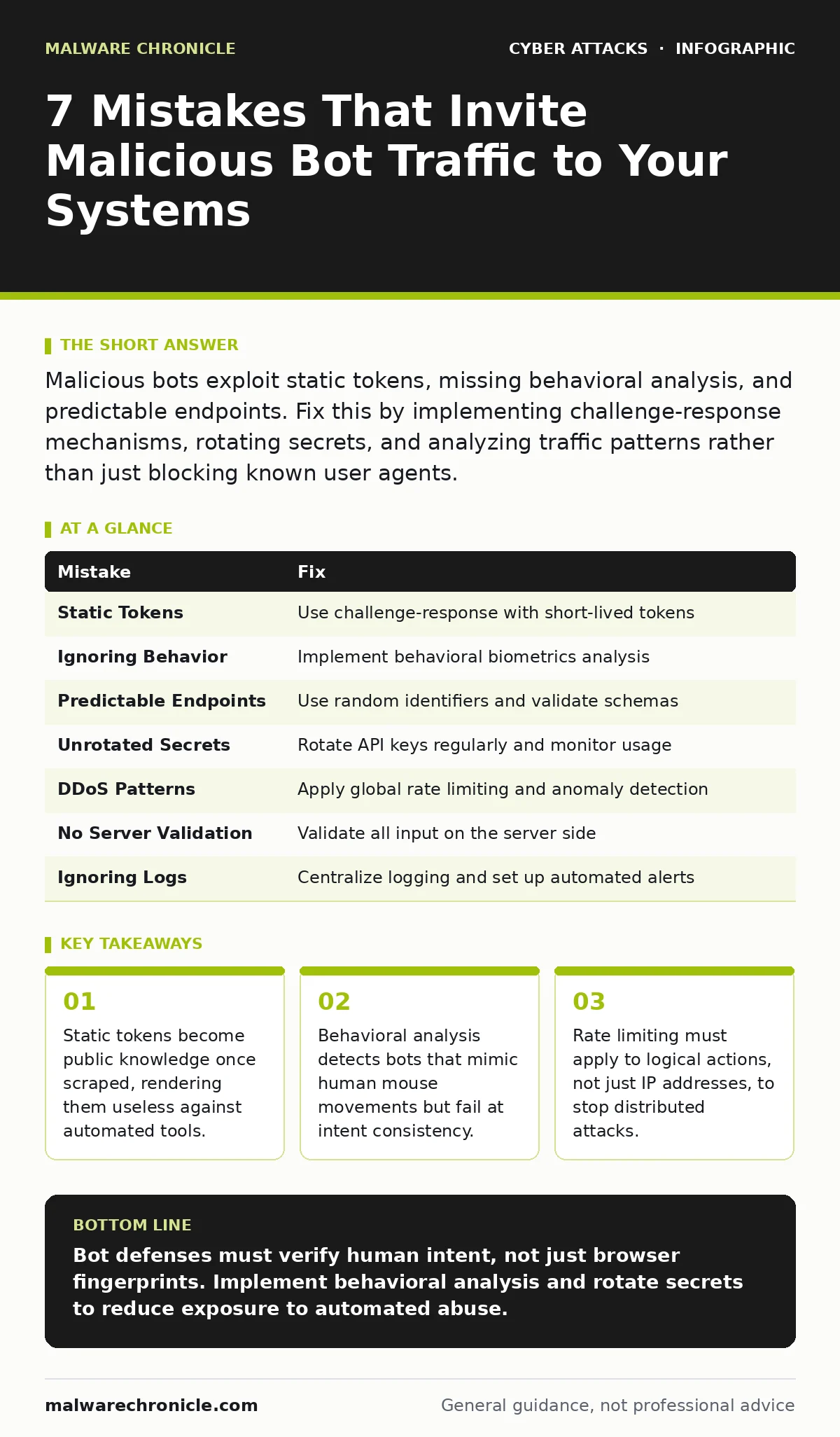
Malicious bots exploit static tokens, missing behavioral analysis, and predictable endpoints. Fix this by implementing challenge-response mechanisms, rotating secrets, and analyzing traffic patterns rather than just blocking known user agents.
Mistake 1: Relying on Static Tokens for Authentication
Many developers embed fixed tokens in JavaScript files to prove a request comes from a legitimate browser. Attackers scrape these tokens and reuse them in their own scripts. The token becomes a shared secret that loses its value the moment a bot reads it.
Why it hurts:
Static tokens do not expire or change per session. A single scrape gives an attacker permanent access to bypass basic bot checks. This creates a false sense of security while your systems process thousands of fraudulent requests.
The fix:
Implement challenge-response mechanisms that generate unique, short-lived tokens for each interaction. Use protocols like reCAPTCHA or similar open standards that require a fresh cryptographic proof for every action. This ensures that stolen tokens cannot be reused by automated scripts.
Mistake 2: Ignoring Behavioral Biometrics
Blocking requests based on IP address or user agent string is a common first line of defense. Modern bots use residential IP proxies and rotate user agent strings to mimic real browsers. These static checks fail to distinguish between a human and a sophisticated automation framework.
Why it hurts:
You waste resources blocking legitimate users who share IP ranges with attackers, such as those on mobile networks. Meanwhile, sophisticated bots slip through because they technically look like real browsers. This leads to account takeover attempts and data scraping without detection.
The fix:
Analyze behavioral signals like mouse movement, typing cadence, and touch interactions. Humans exhibit natural variations and imperfections that scripts struggle to replicate perfectly. Integrate behavioral analysis into your conditional access policies to verify human presence without friction for legitimate users.
Mistake 3: Exposing Predictable API Endpoints
Developers often create API endpoints with predictable naming conventions or sequential IDs. Bots scan for these patterns to enumerate data or brute-force access. Predictable structures make it easy for attackers to map your application logic and target specific resources.
Why it hurts:
Attackers can automate requests to guess valid resource IDs or parameter values. This leads to data leakage and increased server load as your backend processes invalid queries. The lack of randomness allows bots to scale their attacks efficiently across your infrastructure.
The fix:
Use random, non-sequential identifiers for resources and endpoints. Implement API gateways that validate request schemas and reject malformed inputs early. This adds a layer of obscurity and validation that forces bots to expend more resources to find valid targets.
Mistake 4: Failing to Rotate Secrets Regularly
API keys and secret tokens often remain unchanged for months or years. If an attacker gains access to these secrets, they can impersonate your services indefinitely. Long-lived secrets increase the window of opportunity for unauthorized access and abuse.
Why it hurts:
Compromised secrets allow bots to authenticate as legitimate services. This bypasses many security controls that trust internal traffic. The longer a secret remains active, the higher the chance it will be leaked through code repositories or configuration errors.
The fix:
Establish a strict rotation schedule for all API keys and secrets. Use automated tools to generate and deploy new credentials without downtime. Monitor for unusual usage patterns that might indicate a compromised secret, and revoke access immediately if anomalies are detected.
Mistake 5: Overlooking Distributed Denial of Service Patterns
Bots often operate in distributed networks, sending low-volume requests from many sources. Traditional rate limiting based on single IP addresses fails to detect this coordinated behavior. The aggregate traffic may appear normal, but the intent is malicious.
Why it hurts:
Your systems become overwhelmed by the sheer volume of requests, degrading performance for legitimate users. This type of attack is difficult to mitigate because each individual source looks benign. The cumulative effect disrupts service availability and increases operational costs.
The fix:
Implement global rate limiting that tracks requests across multiple dimensions, such as user accounts or session tokens. Analyze traffic patterns to identify coordinated bursts that deviate from normal usage. Use machine learning models to detect anomalies in request frequency and source distribution.
See also: What Is the Purpose of Security Awareness Training? · Email Filtering FAQ: 8 Answers for Secure Inbox Management
Mistake 6: Neglecting Server-Side Validation
Many applications rely on client-side validation to filter out malicious input. Bots bypass client-side checks by sending requests directly to the server. This leaves your backend vulnerable to injection attacks and other exploits that client-side scripts were meant to prevent.
Why it hurts:
Server-side validation is the last line of defense. If it is missing or weak, bots can inject malicious payloads that compromise your database or application logic. This leads to data corruption, unauthorized access, and potential system takeover.
The fix:
Validate all input on the server side, regardless of client-side checks. Use allowlists for expected input formats and reject anything that does not match. This ensures that even if bots bypass front-end controls, your backend remains secure against malformed or malicious data.
Mistake 7: Ignoring Log Analysis for Bot Activity
Logs contain valuable information about bot behavior, but many teams fail to analyze them effectively. Without proper monitoring, bot traffic goes unnoticed until it causes significant damage. This reactive approach allows attacks to persist and escalate.
Why it hurts:
Delayed detection means prolonged exposure to malicious activity. Bots can scrape data, brute-force logins, or disrupt services for extended periods. The lack of visibility prevents timely intervention and allows attackers to refine their techniques.
The fix:
Implement centralized logging and monitoring solutions that aggregate data from all sources. Use automated alerts to notify teams of suspicious patterns, such as high error rates or unusual request volumes. Regularly review logs to identify new bot behaviors and update your defenses accordingly.
| Mistake | Fix |
|---|---|
| Static Tokens | Use challenge-response with short-lived tokens |
| Ignoring Behavior | Implement behavioral biometrics analysis |
| Predictable Endpoints | Use random identifiers and validate schemas |
| Unrotated Secrets | Rotate API keys regularly and monitor usage |
| DDoS Patterns | Apply global rate limiting and anomaly detection |
| No Server Validation | Validate all input on the server side |
| Ignoring Logs | Centralize logging and set up automated alerts |
Key takeaways
- Static tokens become public knowledge once scraped, rendering them useless against automated tools.
- Behavioral analysis detects bots that mimic human mouse movements but fail at intent consistency.
- Rate limiting must apply to logical actions, not just IP addresses, to stop distributed attacks.
Bot defenses must verify human intent, not just browser fingerprints. Implement behavioral analysis and rotate secrets to reduce exposure to automated abuse.
Frequently asked questions
How do I distinguish between good and bad bots?
Good bots identify themselves via standard headers and follow robots.txt rules. Bad bots often hide their identity, ignore rules, and exhibit aggressive scraping patterns.
Can CAPTCHAs stop all bot traffic?
No. CAPTCHAs add friction and can be bypassed by sophisticated services. They are one layer of defense, not a complete solution.
What is the best way to hide API endpoints?
Use random, non-sequential IDs and require authentication for all access. Obscurity helps but should not replace proper security controls.
How often should I rotate API keys?
Rotate keys regularly, such as every 90 days, or immediately if suspicious activity is detected. Automation helps manage this process without disruption.
How this guide was produced: written by the Malware Chronicle editorial team with AI assistance, checked against the public references listed below, and reviewed when the facts change. See our editorial policy or report an error.