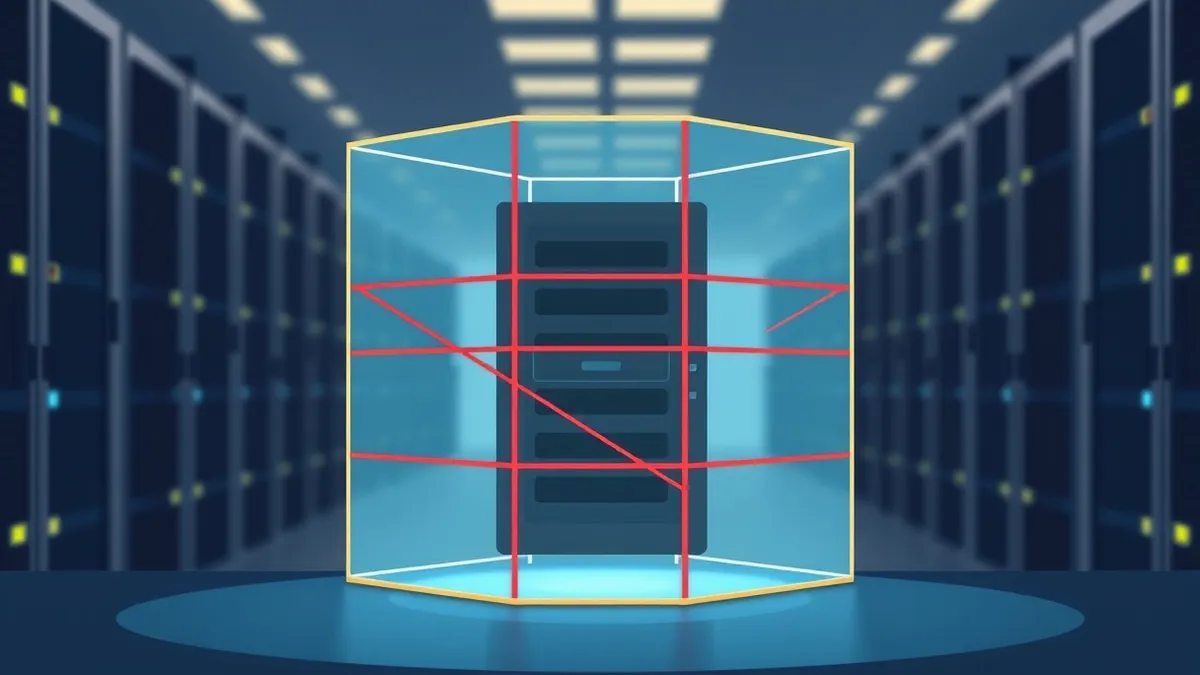
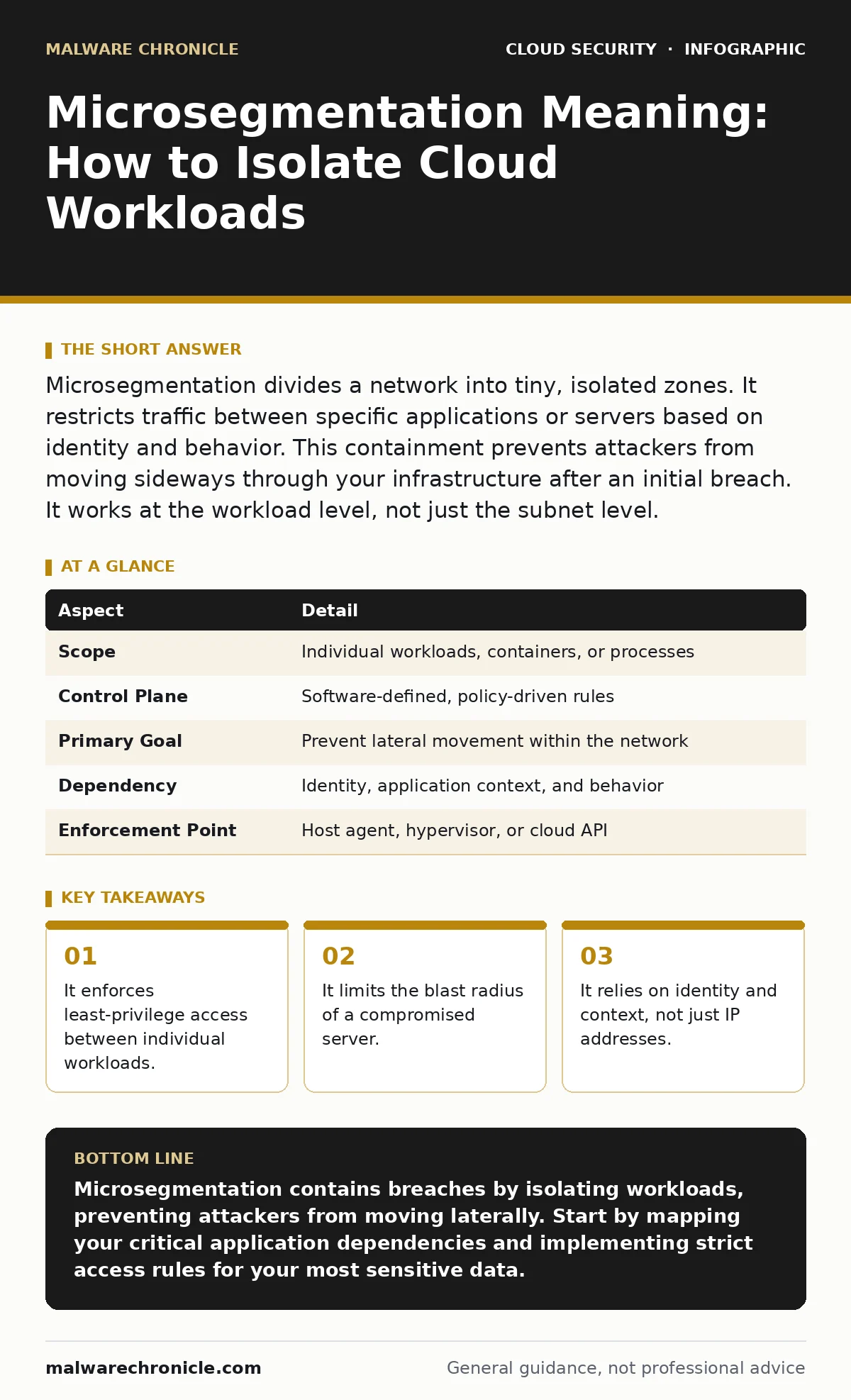
Microsegmentation divides a network into tiny, isolated zones. It restricts traffic between specific applications or servers based on identity and behavior. This containment prevents attackers from moving sideways through your infrastructure after an initial breach. It works at the workload level, not just the subnet level.
The Library Analogy
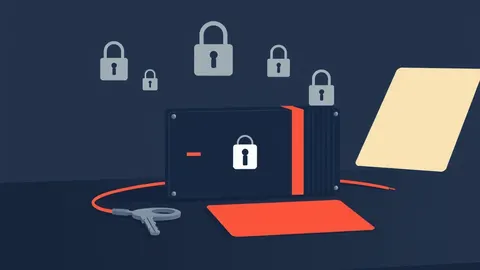
Imagine a library where every book is on a single, massive shelf. If someone steals one book, they can easily grab the next one. Now imagine each book is in its own locked glass case. A thief might crack one case, but they cannot reach the others without breaking each separate lock.
Traditional network security acts like the open shelf. It protects the building’s entrance but leaves the interior wide open. Microsegmentation acts like the individual cases. It isolates every workload, ensuring that access to one component does not grant access to another.
This approach shifts the focus from protecting the perimeter to protecting the data and applications themselves. It assumes that the outer walls will eventually fail.
At a Glance
| Aspect | Detail |
|---|---|
| Scope | Individual workloads, containers, or processes |
| Control Plane | Software-defined, policy-driven rules |
| Primary Goal | Prevent lateral movement within the network |
| Dependency | Identity, application context, and behavior |
| Enforcement Point | Host agent, hypervisor, or cloud API |
Origin in Practice
The term emerged from the need to secure virtualized environments. Early cloud architectures allowed any virtual machine to talk to any other machine on the same subnet. This flat structure made it easy for malware to spread rapidly once it entered the network.
Organizations realized that traditional firewalls were too coarse. They could block traffic from the outside, but they struggled to manage the internal chatter between thousands of virtual machines. Microsegmentation provided a way to apply firewall rules at the operating system or hypervisor level.
It treats every workload as a distinct entity. This granularity allows security teams to define exactly which services can communicate with each other. It moves beyond static IP addresses to dynamic identities.
Daily Usage in Development
You use microsegmentation when you define which services can talk to your database. Instead of allowing all internal traffic, you create a rule that only the application server can connect to the database port. Any other attempt is blocked, even if it comes from another server in the same cloud account.
This process integrates with your development workflow. You define these access patterns in your infrastructure-as-code scanning pipelines. This ensures that security policies are deployed alongside the application code. It prevents misconfigurations before they reach production.
You also monitor traffic flows to verify that the rules work as expected. If a new service needs access, you explicitly grant it. This explicit allowance prevents accidental exposure of sensitive data.
What People Usually Get Wrong
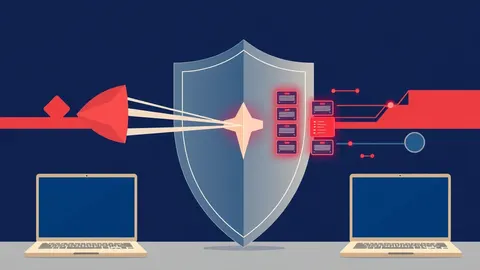
Many teams believe that microsegmentation replaces traditional firewalls. It does not. It complements them by adding a layer of defense deep inside the network. You still need perimeter defenses to stop the initial attack.
Another common mistake is assuming that microsegmentation is set and forget. Applications change. New services are added. Dependencies shift. If you do not update your policies, you will either block legitimate traffic or leave gaps. Continuous validation is required.
Some teams also confuse microsegmentation with simple VLANs. VLANs separate traffic at the network layer. Microsegmentation operates at the application layer. It understands the context of the traffic, not just the destination IP.
See also: Configuration Drift Mechanics: How Security Posture Decays Over Time
The Hidden Cost of Complexity
The main trade-off is management overhead. Every rule you create adds complexity. If you have hundreds of microservices, you may have thousands of rules. Maintaining this matrix is difficult.
You need a way to visualize these connections. Without a clear map, you will not know which services depend on which others. This is where a cloud asset inventory becomes critical. It helps you understand the relationships between your workloads.
If you get the rules wrong, you break your application. This leads to operational incidents. Your team will spend time debugging connectivity issues rather than fixing security flaws. Balance is key. Start with the most critical assets.
Identity Over IP Addresses
IP addresses change. Virtual machines are deleted and recreated. Containers are ephemeral. Relying on IP addresses for security rules is fragile. Microsegmentation uses identity.
This identity can be based on the workload name, the application tag, or the user account running the process. It stays consistent even if the underlying infrastructure changes. This makes your policies more resilient.
It also allows for more precise control. You can restrict access based on who is running the code, not just where it is located. This adds a layer of defense against insider threats.
Integrating with Broader Security
Microsegmentation works best when combined with other security practices. For example, you can use policy as code to define your segmentation rules. This allows you to version control your security policies. You can review changes and roll back if something goes wrong.
It also supports confidential computing by ensuring that even if an attacker gains access to a host, they cannot access data in other isolated zones. The isolation prevents the spread of compromise.
When you move to the cloud, consider cloud landing zones that include microsegmentation by default. This ensures that new environments are secure from the start. It reduces the risk of misconfiguration during cloud migration security efforts.
Key takeaways
- It enforces least-privilege access between individual workloads.
- It limits the blast radius of a compromised server.
- It relies on identity and context, not just IP addresses.
- It requires continuous monitoring of application dependencies.
Microsegmentation contains breaches by isolating workloads, preventing attackers from moving laterally. Start by mapping your critical application dependencies and implementing strict access rules for your most sensitive data.
Frequently asked questions
Does microsegmentation slow down network performance?
Modern implementations use kernel-level filtering or cloud APIs, adding negligible latency. The overhead is typically less than one millisecond per packet.
Is microsegmentation the same as zero trust?
Microsegmentation is a key component of zero trust. It enforces the principle of least privilege at the network level, supporting the broader zero trust architecture.
How this guide was produced: written by the Malware Chronicle editorial team with AI assistance, checked against the public references listed below, and reviewed when the facts change. See our editorial policy or report an error.