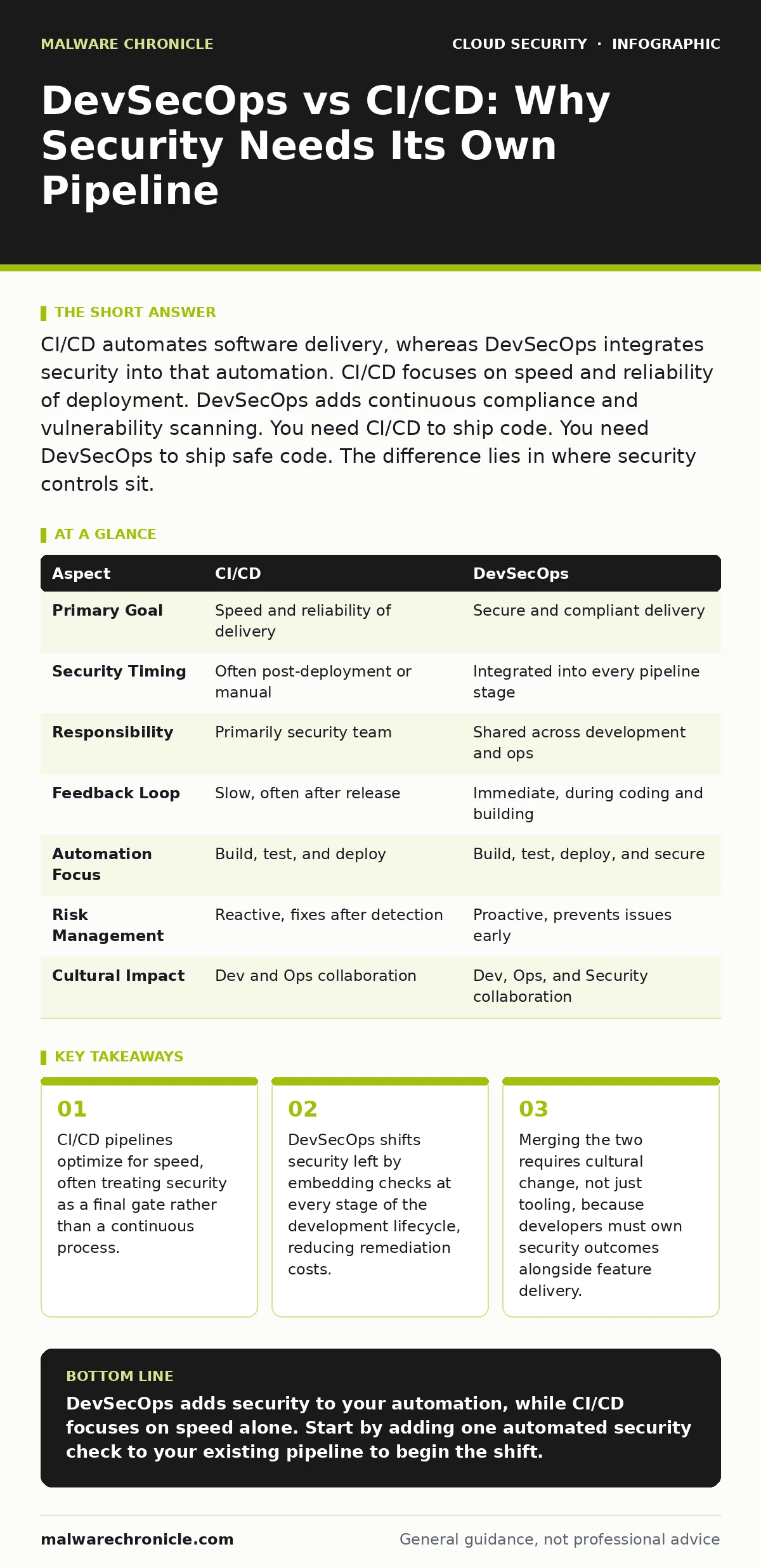
CI/CD automates software delivery, whereas DevSecOps integrates security into that automation. CI/CD focuses on speed and reliability of deployment. DevSecOps adds continuous compliance and vulnerability scanning. You need CI/CD to ship code. You need DevSecOps to ship safe code. The difference lies in where security controls sit.
The Difference Between DevSecOps and CI/CD
CI/CD stands for Continuous Integration and Continuous Deployment. It is an automation framework that builds, tests, and releases software rapidly. DevSecOps extends this model by integrating security practices into every stage of the pipeline. The core difference is intent. CI/CD seeks to remove friction from delivery. DevSecOps seeks to remove risk from delivery without adding friction. CI/CD assumes code is safe if it passes functional tests. DevSecOps assumes code is unsafe until proven otherwise.
CI/CD pipelines often treat security as a final checkpoint. Developers write code, merge it, and wait for a manual audit or a post-deployment scan. This approach creates a bottleneck. If a vulnerability is found late, the team must stop deployment, fix the code, and restart the cycle. DevSecOps inserts automated security checks earlier. Static analysis runs during coding. Dynamic testing runs during staging. This prevents broken builds from reaching production.
What Is CI/CD?
CI/CD is a set of practices that automate the software delivery process. Continuous Integration requires developers to merge code changes into a central repository frequently. Each merge triggers an automated build and test suite. Continuous Deployment takes this further by automatically releasing successful builds to production. The goal is to reduce the time between writing code and making it available to users.
This model relies on automation to ensure consistency. Human intervention is minimized to reduce error. However, traditional CI/CD focuses on functionality and performance. Security checks are often manual or outsourced to a separate team. This separation creates a blind spot. Developers may prioritize features over security, assuming someone else will fix vulnerabilities later.
What Is DevSecOps?
DevSecOps integrates security into the DevOps culture. It treats security as a shared responsibility among developers, operations, and security teams. Security controls are automated and embedded into the CI/CD pipeline. This means security checks run automatically whenever code changes. The goal is to identify and fix vulnerabilities before they reach production.
This approach shifts security left. Instead of waiting for a final audit, security checks happen during coding, building, and testing. Developers receive immediate feedback on security issues. This reduces the cost of remediation. Fixing a bug in development is cheaper and faster than fixing it in production. DevSecOps also includes continuous monitoring and compliance checks.
DevSecOps vs CI/CD: A Point-by-Point Comparison
| Aspect | CI/CD | DevSecOps |
|---|---|---|
| Primary Goal | Speed and reliability of delivery | Secure and compliant delivery |
| Security Timing | Often post-deployment or manual | Integrated into every pipeline stage |
| Responsibility | Primarily security team | Shared across development and ops |
| Feedback Loop | Slow, often after release | Immediate, during coding and building |
| Automation Focus | Build, test, and deploy | Build, test, deploy, and secure |
| Risk Management | Reactive, fixes after detection | Proactive, prevents issues early |
| Cultural Impact | Dev and Ops collaboration | Dev, Ops, and Security collaboration |
When to Choose CI/CD
Choose CI/CD when your primary goal is rapid iteration and frequent releases. This model works well for internal tools or low-risk applications. You need a stable pipeline that automates builds and tests. Manual security reviews may suffice if the application does not handle sensitive data.
- Your team lacks security expertise and needs to focus on feature development.
- The application has minimal attack surface and low compliance requirements.
- You need to establish a baseline automation before adding complex security checks.
When to Choose DevSecOps
Choose DevSecOps when security is a business requirement. This model is necessary for applications handling sensitive data or subject to compliance standards. You need to ensure that every code change is secure. The overhead of integrating security checks is justified by the reduction in risk.
- Your application processes personal, financial, or health data.
- You operate in a regulated industry with strict compliance mandates.
- You want to reduce the cost and time of fixing vulnerabilities post-release.
Where They Overlap and Integrate
DevSecOps does not replace CI/CD; it enhances it. You cannot have DevSecOps without a functioning CI/CD pipeline. The automation of builds and tests is the foundation. Security checks are added as additional steps in the pipeline. This integration requires careful planning to avoid slowing down delivery.
Imagine a pipeline that runs static analysis on every commit. If a vulnerability is found, the build fails. The developer must fix the issue before merging. This is DevSecOps in action. It uses the CI/CD infrastructure to enforce security. The key is to balance security with speed. Too many checks can slow down development. Too few checks can lead to breaches.
Consider how infrastructure-as-code scanning fits into this model. As you automate infrastructure, you must also automate security checks for that infrastructure. This extends the DevSecOps model beyond application code. It ensures that the environment is as secure as the code running on it.
Bottom Line for Implementation
Implementing DevSecOps requires more than tools. It requires a cultural shift. Developers must accept security as part of their job. Security teams must enable developers with automated tools. Operations must ensure the pipeline is reliable and fast. This collaboration is the heart of DevSecOps.
The next step is to audit your current CI/CD pipeline. Identify where security checks are missing. Add automated scanning for dependencies and code quality. Gradually expand to include dynamic testing and compliance checks. Measure the impact on delivery speed and security posture. Adjust as needed.
Key takeaways
- CI/CD pipelines optimize for speed, often treating security as a final gate rather than a continuous process.
- DevSecOps shifts security left by embedding checks at every stage of the development lifecycle, reducing remediation costs.
- Merging the two requires cultural change, not just tooling, because developers must own security outcomes alongside feature delivery.
DevSecOps adds security to your automation, while CI/CD focuses on speed alone. Start by adding one automated security check to your existing pipeline to begin the shift.
Frequently asked questions
Can I run DevSecOps without CI/CD?
No. DevSecOps relies on the automation provided by CI/CD pipelines to integrate security checks effectively. Without automation, security becomes a manual bottleneck.
Does DevSecOps slow down development?
Initially, it may add slight overhead. However, it reduces the time spent fixing critical vulnerabilities later. In the long run, it speeds up the overall release process by preventing last-minute blockers.
How do I measure the success of DevSecOps?
Track metrics like the time to detect vulnerabilities, the number of vulnerabilities in production, and the mean time to remediate. A successful program reduces these numbers over time.
Is DevSecOps only for large enterprises?
No. Small teams benefit most from DevSecOps because they lack the resources to handle security incidents. Automating security early prevents costly breaches that could shut down a small business.
How this guide was produced: written by the Malware Chronicle editorial team with AI assistance, checked against the public references listed below, and reviewed when the facts change. See our editorial policy or report an error.