Policy as code treats security rules like software. You write constraints in a readable format, version control them, and run them automatically. This ensures every cloud resource meets standards before it launches, preventing drift and human error.
The Kitchen Inspectors
Imagine a busy commercial kitchen. The health inspector does not stand by the stove watching every chef. Instead, the inspector writes a rulebook. The rules state that raw meat must stay below a certain temperature and that surfaces must be sanitized hourly. In cloud security, policy as code replaces the human inspector with automated scripts.
These scripts check your infrastructure against the rules you have written. If a chef tries to serve undercooked meat, the system stops the process. In the cloud, if a server tries to launch with an open port, the policy blocks it. This analogy carries through every aspect of the technology. The rulebook is your code. The inspector is the automation engine. The kitchen is your cloud environment.
Defining the Language
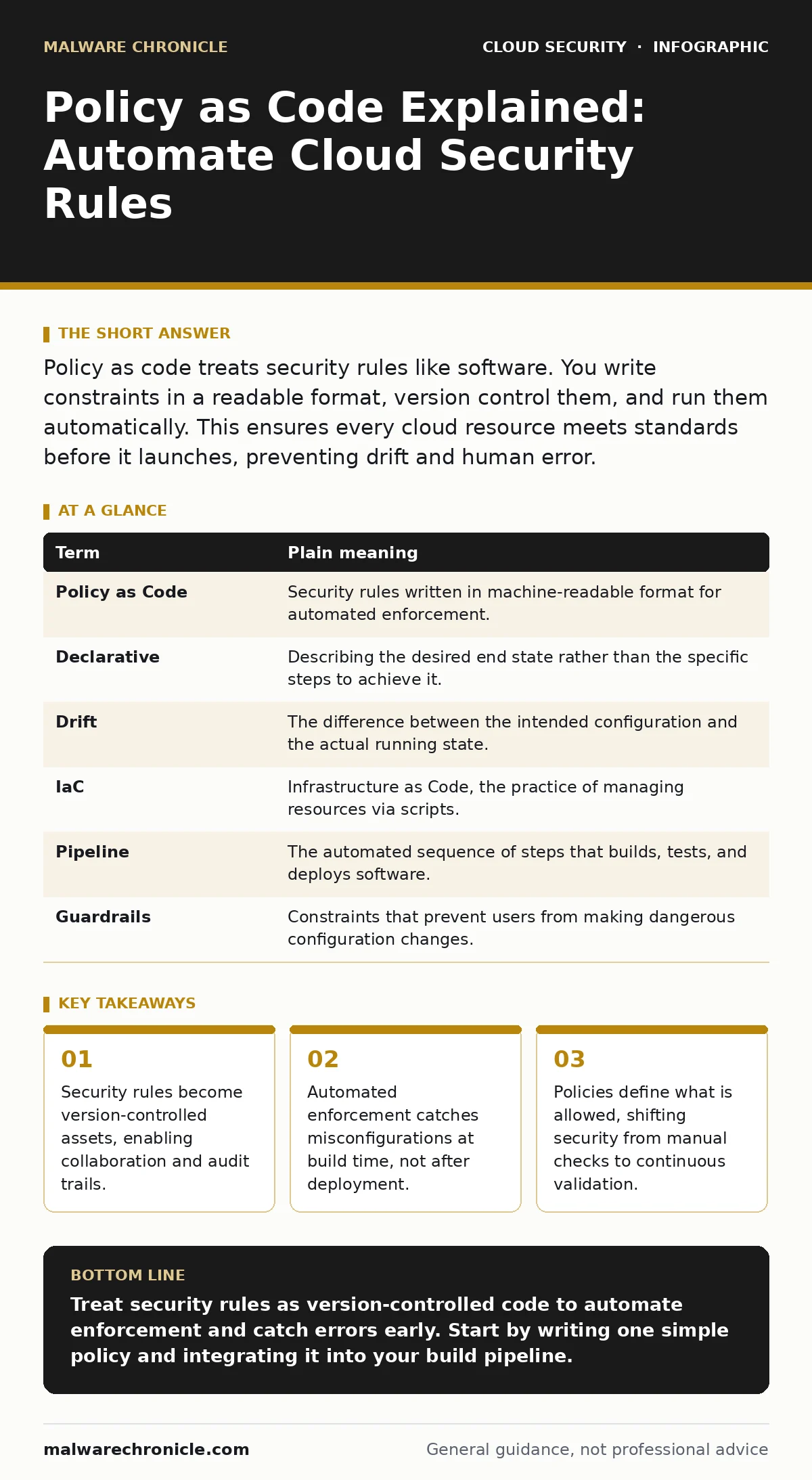
You cannot automate what you cannot define. Policy as code requires you to translate security requirements into a machine-readable format. This format is usually a declarative language. Declarative means you describe the desired state, not the steps to get there.
You say "this bucket must be private," not "go to the console and click private." This distinction matters because it allows the system to verify the state repeatedly. If someone changes the bucket back to public, the policy detects the drift. Drift is when the actual configuration diverges from the intended configuration. Without code, drift happens silently. With code, the system flags the deviation immediately.
| Term | Plain meaning |
|---|---|
| Policy as Code | Security rules written in machine-readable format for automated enforcement. |
| Declarative | Describing the desired end state rather than the specific steps to achieve it. |
| Drift | The difference between the intended configuration and the actual running state. |
| IaC | Infrastructure as Code, the practice of managing resources via scripts. |
| Pipeline | The automated sequence of steps that builds, tests, and deploys software. |
| Guardrails | Constraints that prevent users from making dangerous configuration changes. |
The Developer Workflow
You write code to build applications. You also write code to secure them. This integration changes how you work. Instead of asking security teams to review every change, you embed checks into your development pipeline. The pipeline is the automated path your code takes from your computer to production. At specific gates, the policy engine runs. It checks your infrastructure definitions against the security rules. If the check fails, the build stops. You see the error message in your terminal. You fix the code locally. This feedback loop is fast. It prevents bad configurations from ever reaching the live environment. You do not need to wait for a security audit months later.
Hidden Costs of Automation
There is a trade-off to this approach. Writing policies requires upfront effort. You must understand the cloud provider’s API and the specific resources you use. A poorly written policy can block legitimate work. This is called a false positive. If a developer needs a temporary exception, a rigid policy creates friction. You must design an exception process.
This process should be temporary and require approval. Without a clear exception path, developers will find ways to bypass the policy. They might move their work to a different environment where no policies exist. This creates shadow IT. Shadow IT is infrastructure that operates outside of security oversight. It is often more dangerous than the original problem.
Version Control and Collaboration
Security policies are now code. This means they live in your version control system. You use the same tools for security as you do for application code. This brings transparency. Anyone can see who changed a rule and why. You can review policy changes just like you review application changes. This prevents silent changes. In the past, a security admin might change a firewall rule without telling anyone. Now, the change is a pull request. Peers review it. History is preserved. This audit trail is vital for compliance. It proves that you have reviewed and approved your security controls. It also allows you to roll back changes if a new policy breaks production.
See also: DevSecOps vs CI/CD: Why Security Needs Its Own Pipeline
The First Practical Step
You do not need to rewrite your entire infrastructure to start. Begin with one simple rule. Choose a high-risk configuration that is easy to define. For example, require that all new storage buckets are private. Write this rule in your policy language. Integrate it into your build process. Run it against your next infrastructure change. See if it catches the error. If it does, you have a working prototype. Expand from there. Add more rules as you gain confidence. This incremental approach reduces risk. It allows you to learn the mechanics without disrupting operations. You build muscle memory for secure configuration.
- Identify one critical security requirement for your cloud resources.
- Write this requirement as a declarative policy rule.
- Run the policy against a test infrastructure definition to verify it works.
Beyond the Basics
As you mature, you will find that policies can do more than block. They can also remediate. Remediation means the system fixes the problem automatically. If a bucket becomes public, the policy engine can change it back to private. This is powerful but risky. Automatic remediation can cause outages if the policy is wrong. You must test remediation thoroughly. Start with passive checks. Only enable automatic fixes when you are certain of the outcome. This balance between speed and safety is key. You want to move fast, but not at the cost of stability.
Key takeaways
- Security rules become version-controlled assets, enabling collaboration and audit trails.
- Automated enforcement catches misconfigurations at build time, not after deployment.
- Policies define what is allowed, shifting security from manual checks to continuous validation.
Treat security rules as version-controlled code to automate enforcement and catch errors early. Start by writing one simple policy and integrating it into your build pipeline.
Frequently asked questions
Do I need to learn a new programming language?
Most policy tools use domain-specific languages or standard formats like YAML. You do not need general-purpose coding skills, but you must learn the syntax for the specific tool.
Can policy as code replace security teams?
No. It automates repetitive checks. Security teams still define the rules, handle exceptions, and investigate complex threats that code cannot detect.
What if my cloud provider changes its API?
Policy engines usually update to support new APIs. You may need to adjust your policies to match new resource types or parameters, but the core logic remains similar.
Is this only for large enterprises?
No. Small teams benefit most because they lack the bandwidth for manual reviews. Automation ensures security scales with your growth without adding headcount.
How this guide was produced: written by the Malware Chronicle editorial team with AI assistance, checked against the public references listed below, and reviewed when the facts change. See our editorial policy or report an error.