
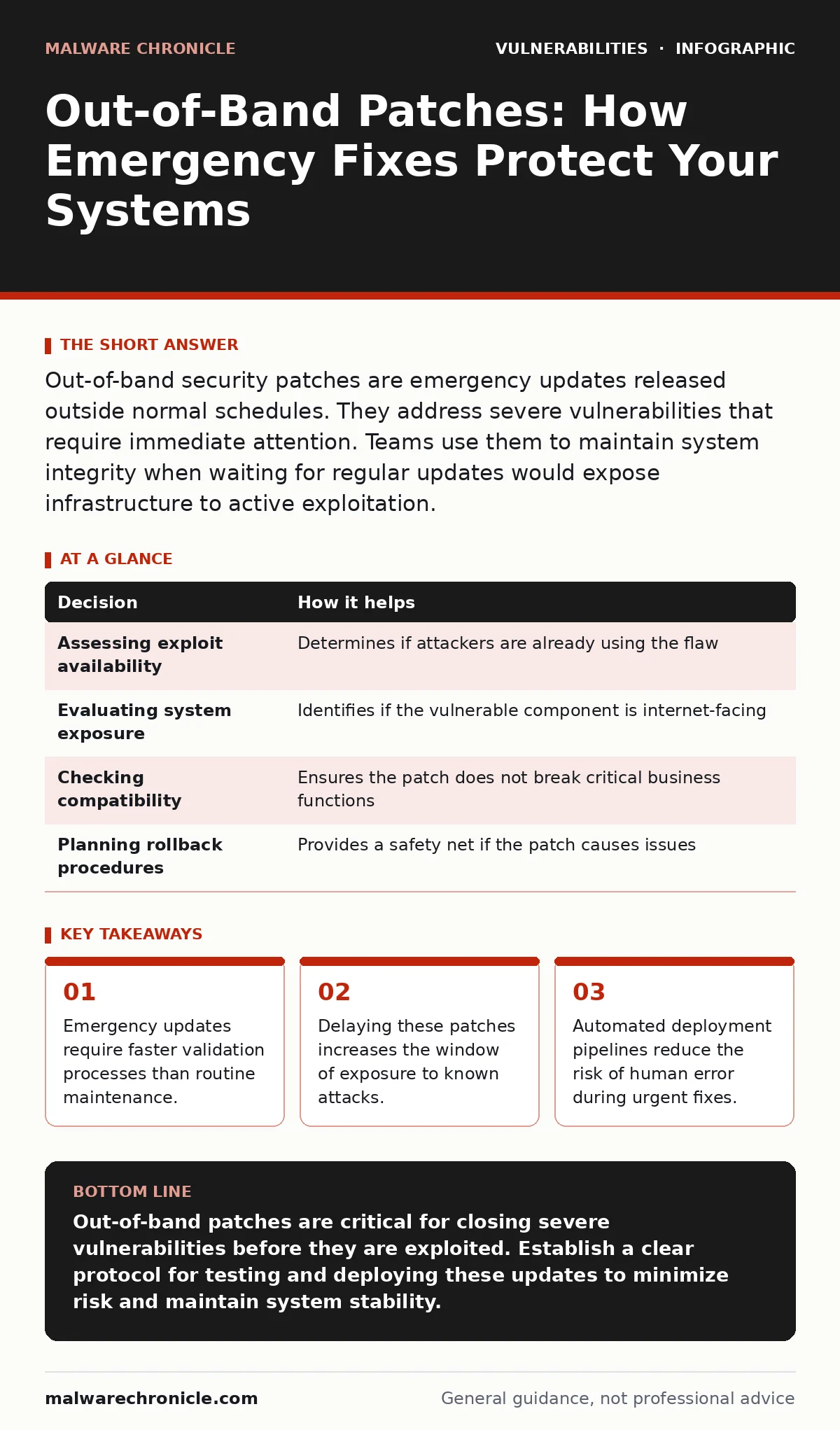
Out-of-band security patches are emergency updates released outside normal schedules. They address severe vulnerabilities that require immediate attention. Teams use them to maintain system integrity when waiting for regular updates would expose infrastructure to active exploitation.
Understanding the Urgency of Emergency Updates
Out-of-band security patches are software updates released outside the standard maintenance window. They address vulnerabilities that pose an immediate threat to system integrity. Regular updates follow a predictable schedule, allowing teams to plan testing and deployment. Emergency updates break this rhythm because the risk of inaction outweighs the risk of disruption. You must treat these patches as high-priority tasks that require immediate attention. The goal is to minimize the time between the discovery of a flaw and the application of the fix. This approach reduces the window of opportunity for attackers to exploit the weakness.
The Hidden Cost of Waiting
Waiting for the next scheduled update cycle creates a dangerous gap. Attackers often discover vulnerabilities shortly after they are disclosed publicly. They scan for unpatched systems and attempt exploitation within days or even hours. Your infrastructure remains vulnerable during this period. The cost of a breach far exceeds the operational friction of applying an emergency patch.
Suppose a critical flaw allows remote code execution. Leaving the system exposed for weeks invites intrusion. The hidden cost includes not only the direct damage but also the loss of trust and compliance violations. You cannot afford to treat every update with the same urgency, but you must recognize when a patch demands immediate action.
How Teams Handle Emergency Fixes
Teams use out-of-band patches to maintain security posture during crises. The process involves identifying the affected systems, testing the patch for compatibility, and deploying it rapidly. Automation plays a significant role in this workflow. Scripts can detect vulnerable versions and push updates without manual intervention.
Human oversight remains necessary to verify that the patch does not break critical functions. You need a clear chain of command to approve these changes. Without a predefined protocol, teams may hesitate or make errors under pressure. A structured approach ensures that the patch is applied correctly and consistently across all affected assets. This discipline prevents partial coverage that leaves some systems exposed.
Decisions Informed by Patch Prioritization
Not all patches require immediate deployment. You must decide which updates qualify as out-of-band based on severity and exploitability. The decision matrix considers the criticality of the affected component and the availability of public exploits. High-severity flaws in internet-facing services demand immediate attention. Low-severity issues in internal tools can wait for the next cycle. This prioritization helps allocate resources effectively. You cannot patch everything at once, so you must choose wisely. The table below outlines how specific decisions impact your security posture.
| Decision | How it helps |
|---|---|
| Assessing exploit availability | Determines if attackers are already using the flaw |
| Evaluating system exposure | Identifies if the vulnerable component is internet-facing |
| Checking compatibility | Ensures the patch does not break critical business functions |
| Planning rollback procedures | Provides a safety net if the patch causes issues |
What Goes Wrong Without a Process
Lacking a formal process for out-of-band patches leads to chaos. Teams may apply patches randomly, causing compatibility issues or service outages. Some systems may be missed, creating blind spots in your defense. Others may receive patches that are not yet tested, introducing new bugs. This inconsistency weakens your overall security posture. You need a documented procedure that outlines who approves the patch, who tests it, and who deploys it. Without this clarity, panic sets in during a crisis. Decisions become reactive rather than proactive. The result is a fragile environment that struggles to maintain stability under pressure.
See also: Linux Kernel Privilege Escalation Warning Signs · Speculative Execution Vulnerabilities: Definition, Mechanics, and Mitigation
Integrating with Other Security Practices
Out-of-band patches work best when integrated with broader security practices. Configuration hardening reduces the attack surface, making some vulnerabilities less relevant. Vulnerability scanning helps identify systems that need immediate attention. Security advisories provide early warnings about emerging threats.
You should also consider the impact of silent security patches, which may fix issues without explicit notification. Understanding how these elements interact allows you to build a resilient defense. For instance, strong authorization controls can mitigate the impact of certain vulnerabilities, buying you time to apply patches. This layered approach ensures that a single failure does not lead to a catastrophic breach.
Managing the Trade-Offs of Speed
Speed is necessary, but it comes with trade-offs. Rapid deployment increases the risk of introducing bugs or breaking dependencies. You must balance the urgency of the patch with the need for stability. Thorough testing is ideal, but it may not be feasible in an emergency. In such cases, you can limit the scope of the deployment. Apply the patch to a small subset of systems first to monitor for issues.
If no problems arise, expand the deployment to the rest of the infrastructure. This phased approach reduces the impact of potential failures. You also need to ensure that rollback procedures are ready. If the patch causes critical issues, you must be able to revert to the previous state quickly. This preparedness allows you to act decisively without fear of irreversible damage.
Key takeaways
- Emergency updates require faster validation processes than routine maintenance.
- Delaying these patches increases the window of exposure to known attacks.
- Automated deployment pipelines reduce the risk of human error during urgent fixes.
Out-of-band patches are critical for closing severe vulnerabilities before they are exploited. Establish a clear protocol for testing and deploying these updates to minimize risk and maintain system stability.
Frequently asked questions
How do I know if a patch is out-of-band?
Check the vendor's security advisory for severity ratings and exploit status. Critical flaws with public exploits usually require immediate attention.
Can automated updates handle emergency patches?
Yes, but you should configure them to require manual approval for critical updates to prevent unintended disruptions.
What if the patch breaks my application?
Roll back to the previous version immediately. Investigate the issue in a non-production environment before reapplying the patch.
Do out-of-band patches cover all vulnerabilities?
No, they focus on severe, imminent threats. Other vulnerabilities should be addressed through regular maintenance cycles.
How this guide was produced: written by the Malware Chronicle editorial team with AI assistance, checked against the public references listed below, and reviewed when the facts change. See our editorial policy or report an error.