
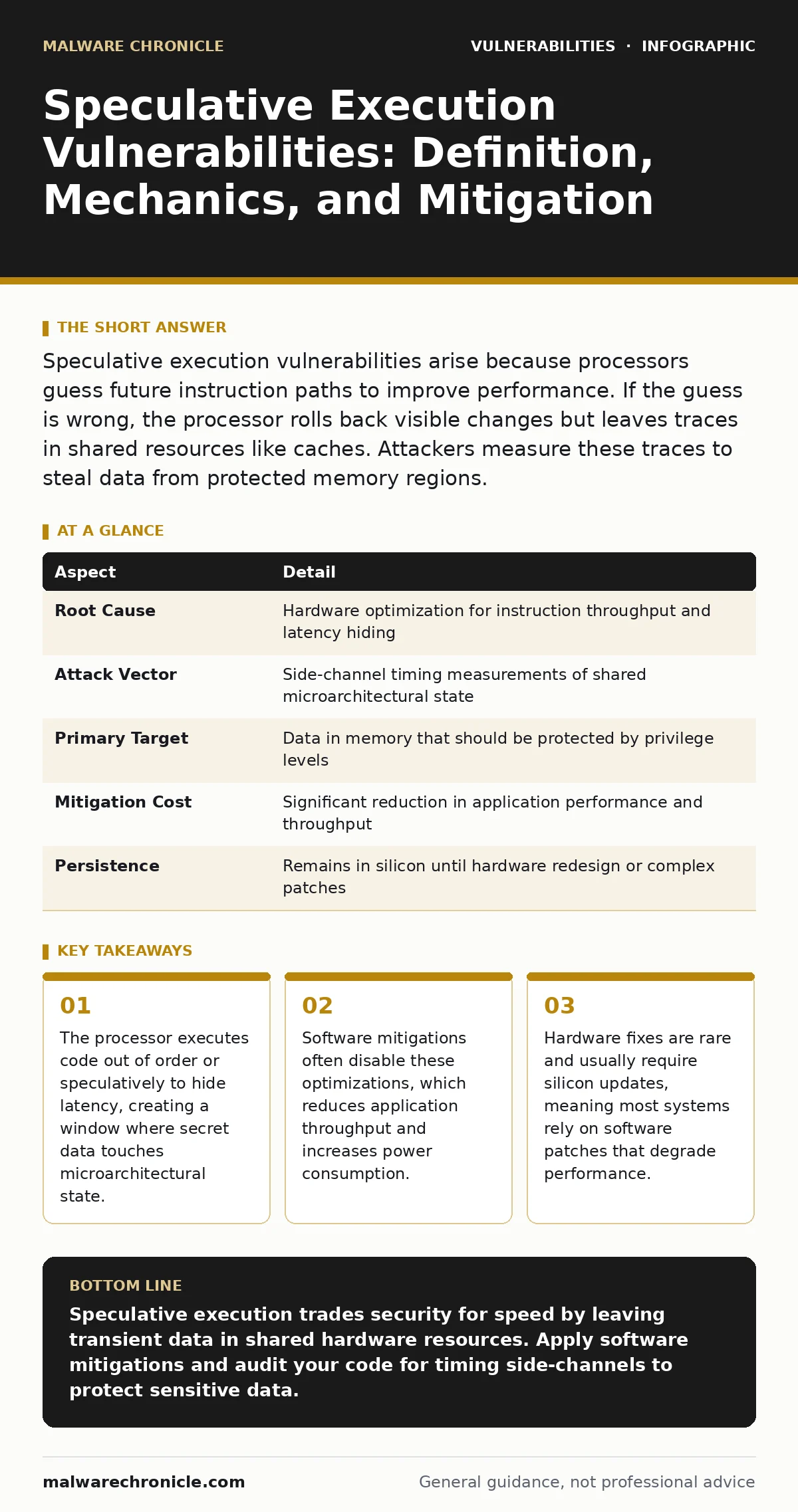
Speculative execution vulnerabilities arise because processors guess future instruction paths to improve performance. If the guess is wrong, the processor rolls back visible changes but leaves traces in shared resources like caches. Attackers measure these traces to steal data from protected memory regions.
How Processors Gain Speed Through Guessing
Modern processors do not wait for every instruction to finish before starting the next one. They use speculative execution to predict which path a program will take. If the processor guesses correctly, it saves time. If it guesses incorrectly, it discards the results of the wrong path. The system state appears unchanged to the operating system.
The physical hardware, however, has already touched memory and registers during the guess. This transient state remains in shared resources like cache lines. An attacker can measure how long it takes to access specific memory addresses. These timing differences reveal whether the processor accessed secret data during the speculative phase. The mechanism turns a performance feature into a data leakage channel.
The Mechanism Behind the Leak
The vulnerability exists in the gap between logical state and physical state. Logical state is what the software sees. Physical state is what the silicon actually does. When a branch prediction fails, the processor squashes the speculative results. It does not clean the cache. The cache still holds the data fetched during the wrong guess.
An attacker runs a malicious program on the same core. This program accesses the cache repeatedly. If the cache hit is fast, the attacker knows the data was there. If the cache miss is slow, the data was not there. By repeating this process thousands of times, the attacker reconstructs the secret data. The leak happens because the hardware optimizes for speed, not isolation.
| Aspect | Detail |
|---|---|
| Root Cause | Hardware optimization for instruction throughput and latency hiding |
| Attack Vector | Side-channel timing measurements of shared microarchitectural state |
| Primary Target | Data in memory that should be protected by privilege levels |
| Mitigation Cost | Significant reduction in application performance and throughput |
| Persistence | Remains in silicon until hardware redesign or complex patches |
Common Forms of Speculative Attacks
Several distinct classes of speculative execution vulnerabilities have emerged. Branch Target Injection tricks the processor into jumping to a malicious instruction address. The processor executes code from an attacker-controlled location speculatively. Spectre variants exploit bounds checks and type confusion in software. The software allows an out-of-bounds access to happen speculatively.
The access fails logically, but the data enters the cache. Meltdown breaks the isolation between user space and kernel space. The processor loads kernel data speculatively before checking permissions. The permission check fails, but the data remains in the cache. These forms all rely on the same core flaw: the hardware does not scrub transient state. They differ in how they trigger the speculation.
Who Faces the Greatest Risk
Any system using modern processors is potentially affected. Servers hosting sensitive data face the highest risk. They process many requests from untrusted users. The noise from concurrent operations makes timing attacks harder, but not impossible. Cloud environments are particularly vulnerable. Tenants share physical hardware. A malicious tenant can target other tenants on the same core.
Mobile devices are also at risk, but the attack surface is smaller. The device is often isolated from direct network access. Laptops and desktops face moderate risk. Local malware can exploit the vulnerability more easily than remote attackers. The risk depends on the ability to run code on the target machine. If you can execute code, you can likely perform a side-channel attack.
How to Reduce the Risk
You cannot eliminate the risk without changing the silicon. You can reduce the impact through software mitigations. These mitigations insert barriers that force the processor to commit state before continuing. They also flush caches or disable speculative execution entirely. Operating system vendors provide patches that apply these barriers. You must apply these patches to your kernel and critical libraries.
Application developers must also write code that is resistant to speculation. Use constant-time algorithms for cryptographic operations. Ensure memory accesses do not depend on secret data. This prevents the processor from speculating on secret-dependent paths. Review your software for these patterns. The goal is to remove the secret data from the speculative path.
See also: Out-of-Band Patches: How Emergency Fixes Protect Your Systems · Linux Kernel Privilege Escalation Warning Signs
The Hidden Cost of Mitigation
Software mitigations come with a performance penalty. Disabling speculative execution removes a major optimization. Applications run slower. Latency increases. Power consumption may rise because the processor works less efficiently. The penalty varies by workload. Database servers often see the largest drops in throughput. Web servers see moderate impacts.
Some applications rely heavily on speculative execution for their logic. These applications may become unusable with strict mitigations. You must balance security against performance. Disabling mitigations entirely exposes you to data theft. Keeping them enabled slows your service. There is no free lunch here. You must accept the trade-off.
What People Usually Get Wrong
Many believe that these vulnerabilities allow remote code execution. They do not. They allow data theft. The attacker cannot change the code or take control of the machine directly. They can only read memory. Another common error is thinking that encryption solves the problem. Encryption protects data at rest and in transit. It does not protect data while it is in the CPU cache.
The cache holds plaintext data temporarily. The attacker reads the cache, not the encrypted storage. Finally, some think that moving to a new processor solves the issue. Older processors still have the flaw. Newer processors have mitigations built in, but they are not immune. The threat evolves as attackers find new ways to measure side channels.
The Future of Secure Execution
Hardware vendors are designing new features to prevent speculation on secret data. These features add hardware-enforced barriers. They allow speculation without leaking data. Until these features become universal, software mitigations remain the primary defense. You must stay updated with patches. You must audit your code for timing side-channels. You must accept the performance cost. Security is no longer just about logic. It is about physics. The speed of electrons in the cache matters as much as the correctness of your code. Plan your infrastructure to handle the overhead of secure execution.
Key takeaways
- The processor executes code out of order or speculatively to hide latency, creating a window where secret data touches microarchitectural state.
- Software mitigations often disable these optimizations, which reduces application throughput and increases power consumption.
- Hardware fixes are rare and usually require silicon updates, meaning most systems rely on software patches that degrade performance.
Speculative execution trades security for speed by leaving transient data in shared hardware resources. Apply software mitigations and audit your code for timing side-channels to protect sensitive data.
Frequently asked questions
Do speculative execution vulnerabilities allow remote code execution?
No, they primarily enable data theft through side-channel attacks. Attackers can read memory contents but cannot directly execute arbitrary code or take control of the system.
How do I know if my specific hardware is vulnerable?
Consult hardware vendor documentation and VEX documents. These resources map specific vulnerability identifiers to processor models and revisions, indicating which mitigations are required for your system.
Can encryption prevent data leakage from speculative execution?
Encryption protects data at rest and in transit, but not data in CPU cache. Speculative execution attacks read plaintext data from the cache while it is being processed, bypassing encryption layers.
Should I disable speculative execution entirely for maximum security?
Disabling it provides strong protection but causes significant performance degradation. It is usually better to enable targeted mitigations that block specific attack vectors while preserving some performance benefits.
How this guide was produced: written by the Malware Chronicle editorial team with AI assistance, checked against the public references listed below, and reviewed when the facts change. See our editorial policy or report an error.