
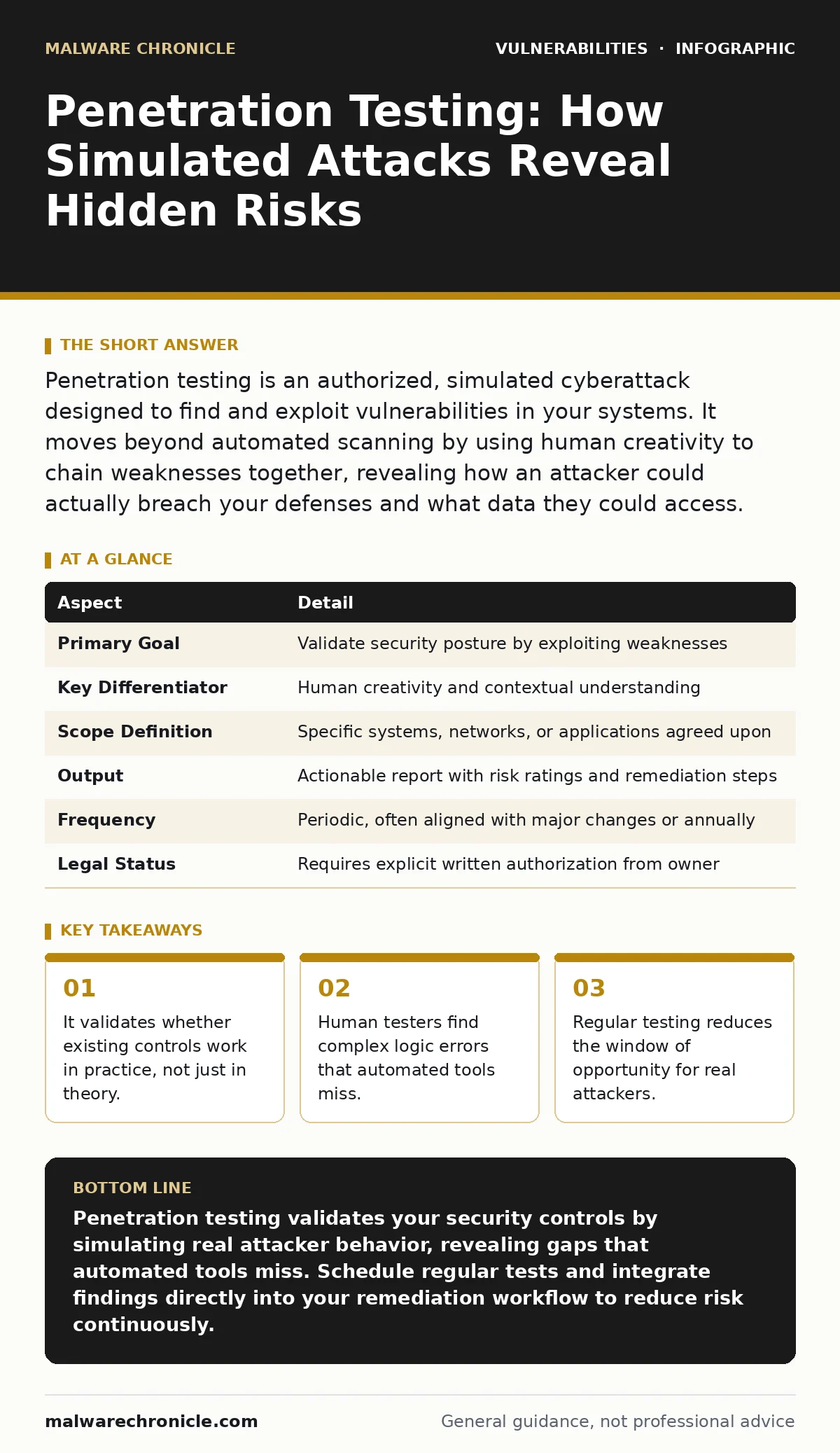
Penetration testing is an authorized, simulated cyberattack designed to find and exploit vulnerabilities in your systems. It moves beyond automated scanning by using human creativity to chain weaknesses together, revealing how an attacker could actually breach your defenses and what data they could access.
The Locksmith’s Audit
Imagine you hire a locksmith to test your home’s security. They do not just check if the deadbolt is engaged. They try to jimmy the window latch, slide a card under the door, or pick the lock. They look for the path of least resistance. Penetration testing works the same way. It is an authorized simulation of a cyberattack. The goal is not to break in for malicious reasons. The goal is to prove whether your defenses hold up under pressure.
Most organizations rely on automated scanners to find known issues. These tools are fast and consistent. They check for missing patches or default passwords. But they follow scripts. They cannot understand context. A penetration tester acts like a human adversary. They look for creative ways to bypass controls. They chain small, seemingly harmless issues into a major breach. This human element is what separates a test from a scan.
At a Glance: Penetration Testing Basics
| Aspect | Detail |
|---|---|
| Primary Goal | Validate security posture by exploiting weaknesses |
| Key Differentiator | Human creativity and contextual understanding |
| Scope Definition | Specific systems, networks, or applications agreed upon |
| Output | Actionable report with risk ratings and remediation steps |
| Frequency | Periodic, often aligned with major changes or annually |
| Legal Status | Requires explicit written authorization from owner |
Why Scanners Are Not Enough
Automated tools are excellent at finding known signatures. They check against a database of Common Vulnerabilities and Exposures. If a system has a known flaw, the scanner flags it. But real attackers do not wait for known flaws. They look for misconfigurations. They exploit business logic flaws that make sense to a developer but break security rules. For instance, a shopping cart might allow a user to apply a coupon code to another user’s order if the validation logic is weak. An automated tool sees valid data. A human tester sees a theft vector.
You cannot rely on web application firewalls to catch these logical errors. These firewalls filter traffic based on patterns. They block obvious attacks like SQL injection strings. But they often let through sophisticated requests that look normal but execute malicious logic. Penetration testing reveals these blind spots. It shows you where your automated defenses fail to understand intent.
The Testing Lifecycle
A proper engagement follows a strict structure. This ensures you get accurate results without disrupting operations. The process usually starts with reconnaissance. The tester gathers information about your public-facing assets. They map out the attack surface. This phase mimics what an attacker would do in the wild. It relies on open-source intelligence and passive scanning.
Next comes the vulnerability analysis. The tester identifies potential entry points. They prioritize targets based on likelihood and impact. Then comes the exploitation phase. This is where the actual testing happens. The tester attempts to gain access. They escalate privileges. They move laterally through the network. Every step is documented. The final phase is reporting. The tester provides a detailed account of what they found. They explain the risk. They suggest remediation steps. This report is your roadmap for improvement.
White Box vs Black Box Approaches
The level of information you give the tester changes the outcome. In a black box test, the tester knows nothing about your system. They act like an external attacker with no insider knowledge. This tests your perimeter defenses. It reveals how well your monitoring detects unknown activity. It is realistic but can miss internal weaknesses.
In a white box test, you provide full access. Source code, network diagrams, and credentials are shared. The tester acts like an insider with malicious intent. This allows for deep code review and configuration analysis. It finds issues that external attackers might never see. A gray box test sits in the middle. The tester has limited credentials, like a standard user account. This simulates an attacker who has already breached the perimeter and is trying to move deeper. Each approach has trade-offs. Black box is faster and cheaper but less thorough. White box is comprehensive but expensive and time-consuming.
Common Misconceptions About Testing
Many organizations treat penetration testing as a checkbox exercise. They schedule it once a year and file the report. This is a mistake. Security is dynamic. New vulnerabilities emerge daily. New services are deployed constantly. A test from six months ago is already outdated. You need continuous validation. Integrate testing into your development lifecycle. Test before you deploy. Test after major changes.
Another misconception is that a clean report means you are secure. It only means the tester did not find a way in. It does not mean no path exists. Attackers have more time and resources than a tester. They can wait for a moment of weakness. They can use social engineering. They can target third-party vendors. Penetration testing reduces risk. It does not eliminate it. You must combine it with other defenses.
Integrating With Your Defense Strategy
Penetration testing does not exist in a vacuum. It must connect with your broader security program. The findings should feed into your IT asset inventory. If the tester finds a vulnerable device that was not in your inventory, that is a critical gap. You cannot secure what you do not know you have. The report should also inform your configuration hardening efforts. If a service was left open due to default settings, update your baseline images.
Consider how testing fits with responsible disclosure. If you have a bug bounty program, external researchers may find issues before your internal team. Penetration testing validates the effectiveness of your triage and response process. It ensures you can handle real-world reports efficiently. It also helps you prioritize which vulnerabilities to fix first. Not all flaws are equal. Some allow remote code execution. Others only leak minor data. Testing helps you rank them by actual risk.
Measuring Real Improvement
How do you know if testing is working? Look at the trend. Are you finding fewer critical issues over time? Are you patching known issues faster? Are testers taking longer to breach your defenses? These are signs of improvement. But do not stop at metrics. Look at the quality of your response. Did you detect the tester’s activity? Did you alert the right team? Did you contain the breach?
Penetration testing reveals the truth about your security posture. It shows you where your assumptions fail. It forces you to confront uncomfortable realities. Use that truth to build better defenses. Do not ignore the findings. Do not delay the fixes. Every day you wait is a day an attacker could exploit the same gap.
Key takeaways
- It validates whether existing controls work in practice, not just in theory.
- Human testers find complex logic errors that automated tools miss.
- Regular testing reduces the window of opportunity for real attackers.
- It integrates with broader security programs like responsible disclosure.
Penetration testing validates your security controls by simulating real attacker behavior, revealing gaps that automated tools miss. Schedule regular tests and integrate findings directly into your remediation workflow to reduce risk continuously.
Frequently asked questions
How often should we perform penetration testing?
Conduct tests annually as a baseline, but perform additional tests after major infrastructure changes, new application deployments, or significant security incidents.
What is the difference between penetration testing and vulnerability scanning?
Scanning uses automated tools to find known issues, while penetration testing uses human experts to exploit vulnerabilities and demonstrate actual impact.
Can we do penetration testing on our own?
Internal teams can perform tests, but external testers provide an unbiased perspective and may find issues that insiders overlook due to familiarity.
Does penetration testing guarantee security?
No, it reduces risk by identifying and fixing known weaknesses, but it cannot predict every future threat or prevent all types of attacks.
How this guide was produced: written by the Malware Chronicle editorial team with AI assistance, checked against the public references listed below, and reviewed when the facts change. See our editorial policy or report an error.