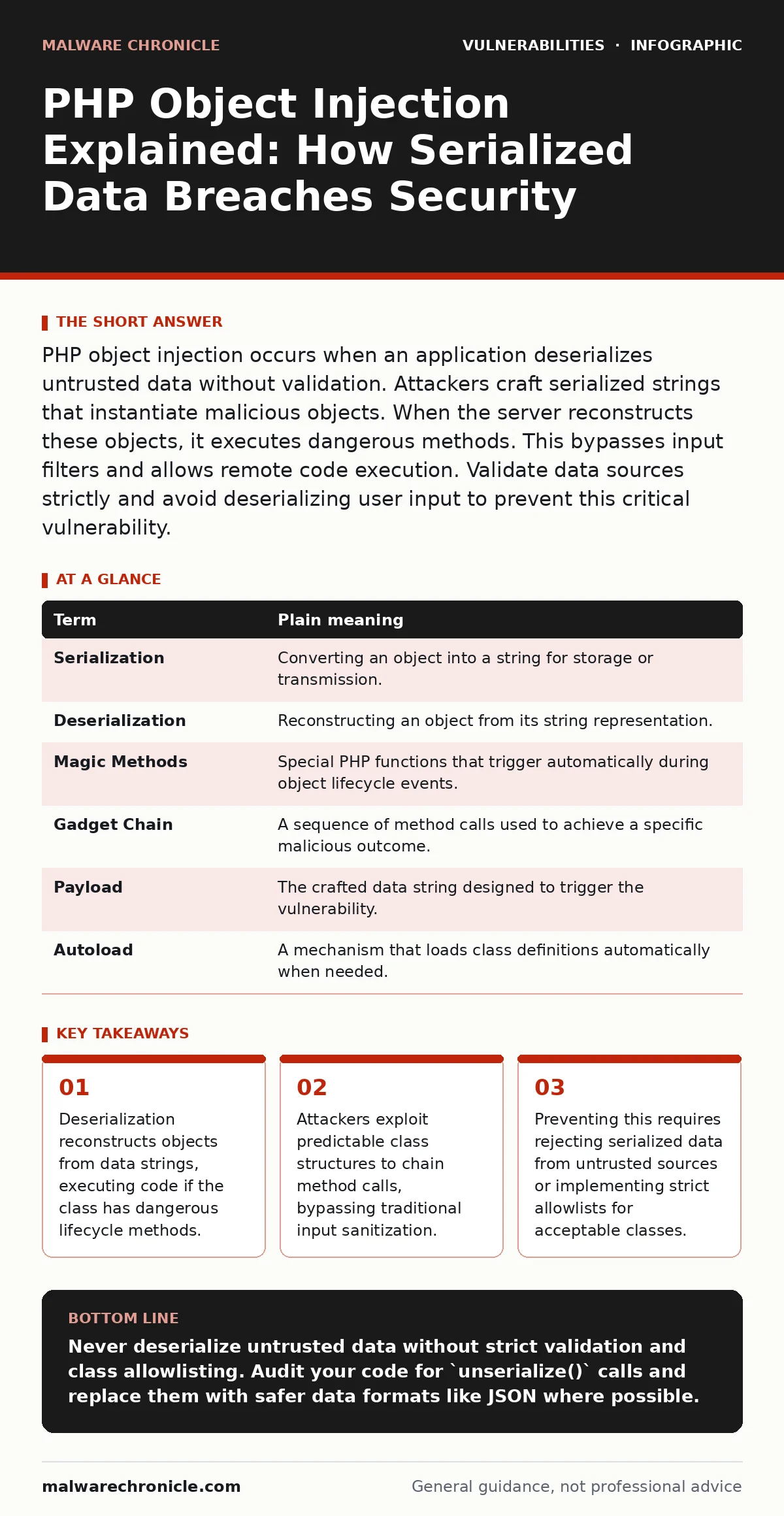
PHP object injection occurs when an application deserializes untrusted data without validation. Attackers craft serialized strings that instantiate malicious objects. When the server reconstructs these objects, it executes dangerous methods. This bypasses input filters and allows remote code execution. Validate data sources strictly and avoid deserializing user input to prevent this critical vulnerability.
The Blueprint Analogy
Imagine you order custom furniture. The manufacturer sends a blueprint describing every screw, plank, and hinge. Your workshop follows this blueprint to assemble the chair. If the blueprint is accurate, you get a sturdy seat. If the blueprint contains hidden instructions to drill holes through the floorboards, your workshop blindly follows them. You did not ask for floor damage. The blueprint simply contained instructions your workshop was programmed to execute. PHP object injection works exactly like this flawed blueprint system.
What Is Serialization?
Serialization converts a complex object into a flat string of characters. This process allows the application to save the object to a database or send it over a network. Think of it as packing a house into a single suitcase. The suitcase contains all the furniture, but flattened and compressed. When the application needs the object again, it unpacks the suitcase. This unpacking process is called deserialization. The application reads the string and rebuilds the object in memory.
| Term | Plain meaning |
|---|---|
| Serialization | Converting an object into a string for storage or transmission. |
| Deserialization | Reconstructing an object from its string representation. |
| Magic Methods | Special PHP functions that trigger automatically during object lifecycle events. |
| Gadget Chain | A sequence of method calls used to achieve a specific malicious outcome. |
| Payload | The crafted data string designed to trigger the vulnerability. |
| Autoload | A mechanism that loads class definitions automatically when needed. |
How The Attack Works
The attacker does not need to write new code on your server. They only need to find existing classes that perform dangerous actions. Suppose the application has a logging class that writes to a file. The attacker crafts a serialized string that creates an instance of this logging class. They set the filename property to a PHP script. When the server deserializes the string, it instantiates the logging object. The object’s destructor method runs automatically. It writes the malicious script to the web directory. The attacker now has a backdoor.
Why Input Filters Fail
Traditional security measures focus on sanitizing input. You might strip HTML tags or escape special characters. These filters assume the data is passive. They do not expect the data to contain executable instructions. The serialized string looks like random noise to a standard filter. It contains no obvious SQL keywords or script tags. The filter passes the string through. The deserialization engine then interprets the noise as valid object instructions. This is why static application security testing (SAST) tools sometimes miss these flaws. They analyze code structure, not runtime data flow.
The Hidden Cost of Convenience
Developers use serialization for caching and session management. It is fast and easy. You store a complex object, retrieve it, and continue working. The convenience hides a significant risk. You are trusting the data source implicitly. If an attacker can influence the serialized data, they control the reconstruction process. This is similar to allowing anyone to modify the furniture blueprint before it reaches your workshop. The cost is not just a broken chair. It is a compromised server.
Simple Safety Habits
You can reduce this risk with disciplined coding practices. First, never deserialize data from untrusted sources. If you must deserialize, use a strict allowlist of permitted classes. This ensures only known-safe objects are reconstructed. Second, implement data validation before deserialization. Check the structure and content of the string. Reject anything that does not match the expected format. Third, consider using safer data formats like JSON for simple data. JSON does not execute code during parsing. It only stores key-value pairs.
- Audit your codebase for
unserialize()calls. Identify where user input reaches these functions. - Implement allowlists for classes that can be deserialized. Reject any class not on the list.
- Replace serialization with JSON or other safe formats where possible. Avoid object reconstruction for simple data.
What This Means For You
As an ordinary user, you cannot fix server-side code. You can, however, recognize signs of a compromised site. Look for unexpected redirects or strange files in your downloads. If you manage your own server, ensure automatic software updates are enabled. Many vendors patch serialization flaws quickly. Delaying updates leaves you exposed to known gadget chains. Regular security misconfigurations checks also help. Ensure your server does not expose debug information. This information helps attackers understand your class structures.
Beyond The Basics
PHP object injection is just one type of vulnerability. Understanding it helps you spot related issues. For instance, cross-site WebSocket hijacking also exploits trust boundaries. Both require careful validation of data sources. Similarly, authorization bypass vulnerabilities often stem from trusting client-side data. These issues share a common root: assuming data is safe because it came from a known source. Always verify the integrity and origin of data before processing it.
Final Thoughts
Serialization is a powerful tool. It allows complex objects to travel across networks. But it carries inherent risks. You must treat serialized data as executable code. Validate it, restrict it, and prefer safer alternatives when possible. By understanding how object injection works, you can build more resilient applications. You protect not just your data, but your entire infrastructure. Stay alert to new gadget chains and update your defenses accordingly.
Key takeaways
- Deserialization reconstructs objects from data strings, executing code if the class has dangerous lifecycle methods.
- Attackers exploit predictable class structures to chain method calls, bypassing traditional input sanitization.
- Preventing this requires rejecting serialized data from untrusted sources or implementing strict allowlists for acceptable classes.
Never deserialize untrusted data without strict validation and class allowlisting. Audit your code for `unserialize()` calls and replace them with safer data formats like JSON where possible.
Frequently asked questions
Can I fix PHP object injection by just filtering input?
No, standard input filters do not understand serialized structures. You must validate the data format and restrict which classes can be instantiated during deserialization.
Is JSON safe from object injection?
Yes, JSON parsing does not execute code or instantiate objects. It only creates associative arrays or simple data structures, making it inherently safer for data exchange.
How do I find vulnerable code in my project?
Search your codebase for calls to `unserialize()` or similar functions. Check if the argument to these functions comes from user input, cookies, or external APIs.
What is a gadget chain in this context?
A gadget chain is a sequence of existing class methods that an attacker chains together. Each method call triggers the next, eventually leading to a malicious action like file writing.
How this guide was produced: written by the Malware Chronicle editorial team with AI assistance, checked against the public references listed below, and reviewed when the facts change. See our editorial policy or report an error.