
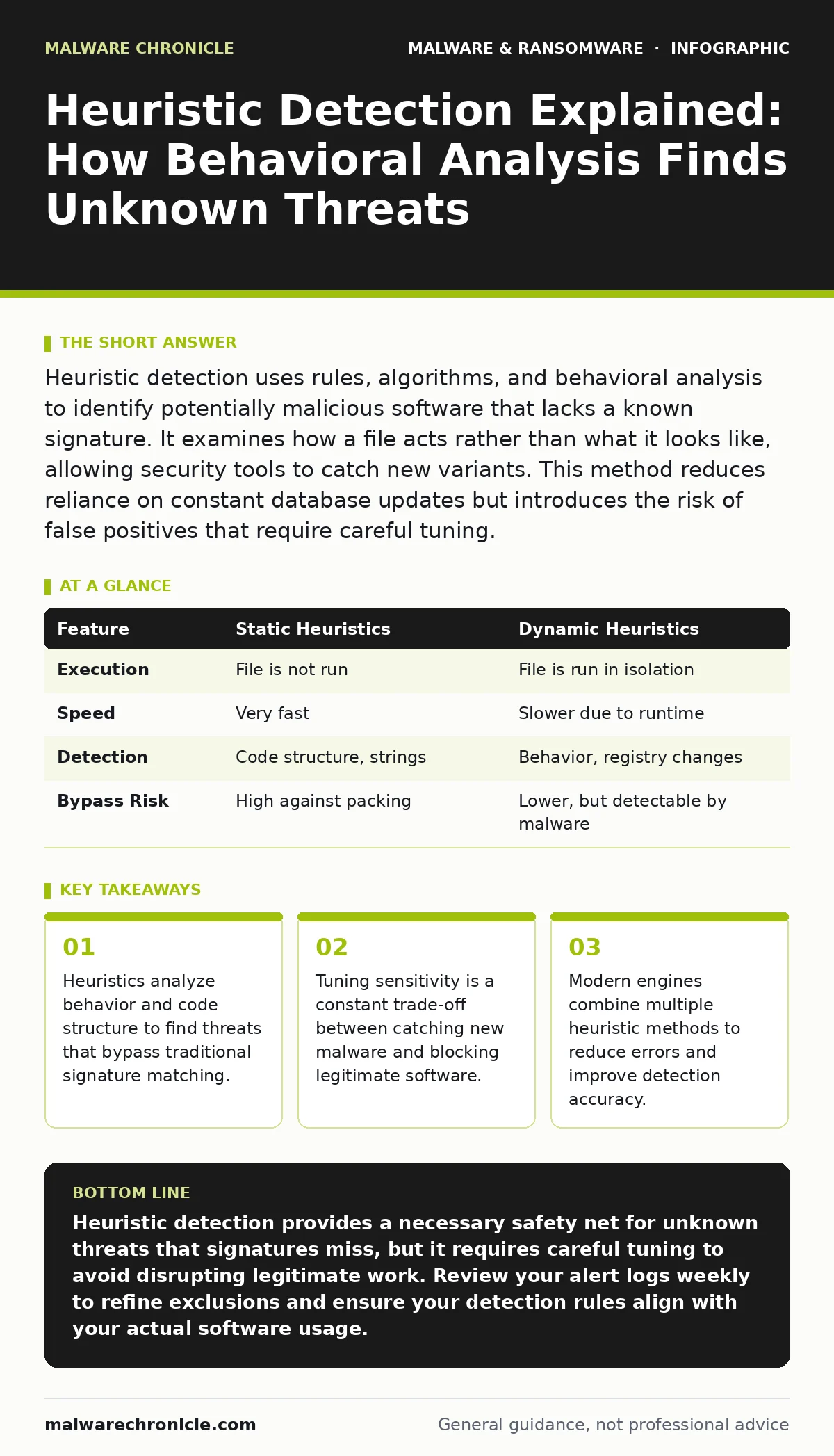
Heuristic detection uses rules, algorithms, and behavioral analysis to identify potentially malicious software that lacks a known signature. It examines how a file acts rather than what it looks like, allowing security tools to catch new variants. This method reduces reliance on constant database updates but introduces the risk of false positives that require careful tuning.
What is heuristic detection?
Heuristic detection is a method of identifying malware by analyzing characteristics and behaviors rather than matching files against a list of known hashes. Traditional antivirus software relies on malware signatures, which are unique digital fingerprints of specific virus instances. Heuristics look at the code structure, instructions, and actions a file attempts to perform. This allows the system to flag suspicious activity even if the specific file has never been seen before.
How does it differ from signature-based detection?
Signature-based detection requires a known sample of the malware to create a unique identifier. If a hacker changes even a single byte of the malicious code, the signature no longer matches, and the file slips through. Heuristic detection does not require a prior sample. It evaluates the file against a set of rules or models that define what malicious code typically looks like or does. This makes heuristics effective against polymorphic malware, which constantly alters its appearance to evade signature scans.
Why do false positives occur?
False positives happen when the heuristic engine misidentifies a legitimate program as malicious. Because heuristics rely on patterns rather than exact matches, benign software that shares traits with malware can trigger an alert. For example, a legitimate utility that modifies system files might look similar to a computer worm that spreads by altering hosts. You must balance sensitivity. High sensitivity catches more threats but blocks more legitimate tools. Low sensitivity lets threats through but keeps your workflow smooth.
What are the main types of heuristic analysis?
Engines generally use static, dynamic, or hybrid analysis. Static analysis examines the file’s code without running it, looking for suspicious instructions or strings. Dynamic analysis runs the file in a controlled environment, such as a sandbox, to observe its behavior in real time. Hybrid approaches combine both methods. Static analysis is fast but can miss packed or obfuscated code. Dynamic analysis is thorough but slower and resource-intensive.
How do machine learning models change heuristics?
Modern heuristic engines often use machine learning to improve accuracy. Instead of relying on hard-coded rules written by human analysts, the model trains on vast datasets of benign and malicious files. It learns complex, non-linear patterns that are difficult for humans to define explicitly. This allows the system to generalize better, identifying new threats with fewer false positives over time. However, these models require significant computational resources and large, clean datasets to train effectively.
See also: Logic Bombs: How to Find and Neutralize Hidden Code Triggers · Detect Wiper Malware Early: Signals, Logs, and Hidden Blind Spots
Can attackers bypass heuristic detection?
Attackers use techniques like obfuscation, packing, and encryption to hide the true nature of their code. Obfuscation makes the code difficult for static analysis to read by inserting junk instructions or renaming variables. Packing compresses or encrypts the payload, so the malicious code only exists in memory after execution. If the heuristic engine only performs static analysis, it may see only the benign packer and miss the threat. Dynamic analysis helps here, but advanced malware can detect sandboxes and remain dormant.
| Feature | Static Heuristics | Dynamic Heuristics |
|---|---|---|
| Execution | File is not run | File is run in isolation |
| Speed | Very fast | Slower due to runtime |
| Detection | Code structure, strings | Behavior, registry changes |
| Bypass Risk | High against packing | Lower, but detectable by malware |
What is the cost of running heuristic scans?
Heuristic analysis consumes more CPU and memory than simple signature checks. Scanning every file on a network with deep dynamic analysis can slow down systems significantly. You must decide which files warrant deep inspection. Typically, only files from untrusted sources or those exhibiting specific triggers undergo full heuristic analysis. The rest may receive a lighter static scan. This tiered approach manages performance while maintaining security.
How do you tune heuristic sensitivity?
Tuning involves adjusting the thresholds for what constitutes suspicious behavior. You start with a conservative setting and monitor alerts. If you see too many false positives, you raise the threshold or create exclusions for trusted applications. If you miss threats, you lower the threshold. This process is iterative. You can also use software restriction policies to limit which applications can run, reducing the surface area that heuristics need to scan.
How do heuristics handle fileless malware?
Fileless malware operates directly in memory, leaving no executable file on the disk for traditional scanners to find. Heuristic detection here shifts to monitoring process behavior and memory activity. Tools analyze system calls, registry modifications, and network connections. If a legitimate process like PowerShell begins making unexpected network requests to command and control servers, heuristics flag the behavior. This requires memory forensics capabilities to inspect the running state of processes.
What is the future of heuristic detection?
Heuristics are moving toward proactive, predictive models. Rather than just reacting to observed behaviors, these systems attempt to predict intent based on partial data. They integrate with broader security information and event management systems to correlate file behavior with network traffic and user activity. This holistic view improves context. A file might look benign in isolation, but its behavior combined with unusual login times triggers a higher alert level.
How does this relate to remote access tools?
Legitimate remote access tool abuse is a common vector for attackers. Once inside, they may use legitimate administrative tools to move laterally. Heuristics can detect when these tools are used in unusual ways, such as running from unexpected directories or connecting to multiple internal hosts rapidly. This behavioral anomaly signals potential compromise. Combining heuristic file analysis with endpoint detection and response provides deeper visibility into these attacks.
Key takeaways
- Heuristics analyze behavior and code structure to find threats that bypass traditional signature matching.
- Tuning sensitivity is a constant trade-off between catching new malware and blocking legitimate software.
- Modern engines combine multiple heuristic methods to reduce errors and improve detection accuracy.
Heuristic detection provides a necessary safety net for unknown threats that signatures miss, but it requires careful tuning to avoid disrupting legitimate work. Review your alert logs weekly to refine exclusions and ensure your detection rules align with your actual software usage.
Frequently asked questions
Do I still need antivirus if I use heuristics?
Yes, heuristics are a component of modern antivirus solutions. Signature-based detection remains fast and accurate for known threats, while heuristics handle unknowns. Both work together for layered defense.
Can heuristics detect ransomware before encryption starts?
Often, yes. Heuristics look for preparatory behaviors like mass file enumeration, shadow copy deletion, or rapid registry changes. These actions typically precede the actual encryption phase, allowing for early intervention.
Is dynamic analysis safe for my production environment?
Dynamic analysis usually occurs in a sandbox, isolated from your main system. This prevents any detected malware from affecting your live data. Ensure your sandbox is properly segmented to contain any potential escapes.
How often should I update heuristic rules?
Heuristic rules and models should update regularly, often daily or weekly. New attack techniques emerge constantly, and your detection capabilities must evolve to recognize new behavioral patterns and obfuscation methods.
How this guide was produced: written by the Malware Chronicle editorial team with AI assistance, checked against the public references listed below, and reviewed when the facts change. See our editorial policy or report an error.