
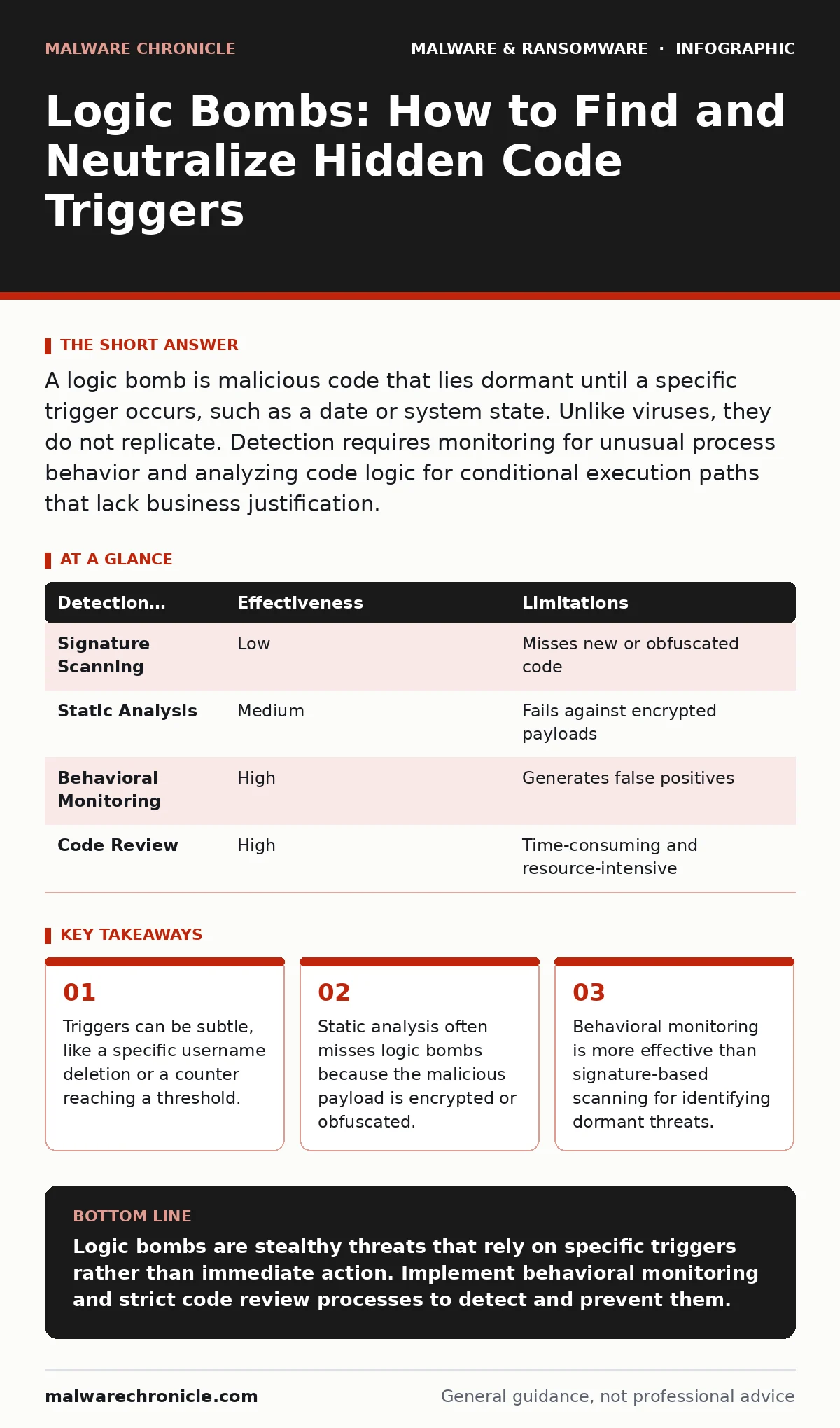
A logic bomb is malicious code that lies dormant until a specific trigger occurs, such as a date or system state. Unlike viruses, they do not replicate. Detection requires monitoring for unusual process behavior and analyzing code logic for conditional execution paths that lack business justification.
What exactly is a logic bomb?
A logic bomb is a piece of code intentionally inserted into a software system that will set off a malicious function when specified conditions are met. Unlike a virus or a worm, it does not replicate itself to spread to other systems. It remains dormant, often hidden within legitimate applications or scripts, waiting for a specific event to activate its payload.
How does a logic bomb differ from other malware?
The primary difference lies in the trigger mechanism and the lack of self-replication. While ransomware encrypts files immediately upon execution, a logic bomb waits. It might wait for a specific date, a particular user login, or the absence of a certain file. This delay allows the attacker to blend in, making the initial infection appear as routine software deployment or a minor configuration change.
What are the most common triggers for activation?
Triggers vary widely but often exploit routine administrative actions or system states. Common triggers include a specific date or time, the deletion of a particular user account, the presence or absence of a specific file, or a certain number of system reboots. Some advanced bombs trigger only when the system is disconnected from the network, ensuring the payload executes without immediate detection by remote monitoring tools.
How do attackers hide logic bombs in code?
Attackers use obfuscation and encryption to conceal the malicious logic within benign code. They might split the trigger and the payload into separate modules that only interact when the condition is met. Another technique involves using legitimate system libraries or APIs to mask the malicious calls, making the code look like standard operations to casual review. This is why static analysis, which examines code without running it, often fails to detect these threats.
Can logic bombs target specific users or departments?
Yes, attackers often tailor logic bombs to target specific roles or departments for maximum impact. For example, a bomb might trigger only when a finance executive logs in, exfiltrating sensitive data at that precise moment. This targeting requires the attacker to have detailed knowledge of the organization’s structure and access controls. It highlights the risk of remote access tool abuse, where attackers gain persistent access to map out high-value targets before deploying the bomb.
See also: Detect Wiper Malware Early: Signals, Logs, and Hidden Blind Spots · Cryptojacking Response: Immediate Steps to Contain and Recover
How do you detect a logic bomb in production?
Detection relies heavily on behavioral analysis rather than signature matching. You must monitor for unusual process behavior, such as a standard application accessing sensitive files it never touches, or a script executing at odd intervals. Memory forensics can reveal anomalies in running processes that do not match known good states. Look for processes that spawn child processes with elevated privileges unexpectedly or network connections to unknown endpoints during off-hours.
| Detection Method | Effectiveness | Limitations |
|---|---|---|
| Signature Scanning | Low | Misses new or obfuscated code |
| Static Analysis | Medium | Fails against encrypted payloads |
| Behavioral Monitoring | High | Generates false positives |
| Code Review | High | Time-consuming and resource-intensive |
What is the impact of a triggered logic bomb?
The impact depends on the payload but can range from data deletion to system paralysis. A logic bomb might wipe critical databases, corrupt system files, or exfiltrate sensitive information to an external server. In some cases, it might simply log keystrokes or screen captures, turning the system into a spy device. The delayed nature of the attack means that by the time the damage is apparent, the attacker may have already covered their tracks.
How do you neutralize a suspected logic bomb?
Isolate the affected system immediately to prevent the payload from executing or spreading. Do not shut it down, as this may trigger the bomb or destroy volatile evidence in memory. Instead, disconnect it from the network and power sources that could cause a reboot. Analyze the system using heuristic detection tools that look for suspicious patterns rather than known signatures. If the trigger is identified, you can disable the condition, such as changing the system clock or removing the triggering file, but this requires careful handling to avoid accidental activation.
Can antivirus software stop logic bombs?
Traditional antivirus software is often ineffective against logic bombs because it relies on known signatures. If the bomb is new or heavily obfuscated, the antivirus will not recognize it. You need endpoint detection and response solutions that monitor behavior in real-time. These tools can identify when a process behaves anomalously, such as a text editor trying to access a database, even if the process itself is legitimate.
How do you prevent logic bombs in your codebase?
Prevention starts with strict code review processes and the use of secure development practices. Implement software restriction policies to ensure only authorized code runs in production environments. Use automated tools to scan for obfuscated code or unusual conditional statements. Additionally, limit administrative privileges so that even if a bomb is triggered, its damage is contained. Regularly audit third-party libraries and components, as they can be vectors for crypto-stealing malware or logic bombs if not properly vetted.
What role does insider threat play in logic bombs?
Insiders are a significant vector for logic bombs because they have legitimate access to code and systems. A disgruntled employee might insert a trigger that activates upon their termination or after a specific project milestone. Because they understand the system’s normal operations, they can hide the bomb in places that are rarely reviewed. This makes behavioral monitoring and strict access controls critical for mitigating insider risks.
How do logic bombs interact with command and control servers?
Some logic bombs communicate with command and control servers before executing their payload. This allows the attacker to verify that the target is still active and to issue further instructions. The bomb might check for a specific file on a remote server as its trigger. If the server is taken down, the bomb may remain dormant indefinitely, or it might have a fallback trigger. This interaction provides a potential point of detection if network traffic is monitored for unusual outbound connections.
What are the legal implications of deploying a logic bomb?
Deploying a logic bomb is a serious criminal offense in most jurisdictions, often classified as computer fraud or sabotage. Even if the bomb is never triggered, the intent to cause harm is sufficient for prosecution. Organizations found harboring logic bombs may face liability for failing to protect data and systems. Legal teams should be involved immediately in any investigation to preserve evidence and assess potential regulatory violations.
Key takeaways
- Triggers can be subtle, like a specific username deletion or a counter reaching a threshold.
- Static analysis often misses logic bombs because the malicious payload is encrypted or obfuscated.
- Behavioral monitoring is more effective than signature-based scanning for identifying dormant threats.
Logic bombs are stealthy threats that rely on specific triggers rather than immediate action. Implement behavioral monitoring and strict code review processes to detect and prevent them.
Frequently asked questions
Can a logic bomb be triggered by a specific network event?
Yes, triggers can include network disconnection, connection to a specific IP, or the receipt of a particular packet.
How long can a logic bomb remain dormant?
It can remain dormant for years, depending on the complexity of the trigger and the stability of the system.
Are logic bombs common in mobile applications?
They are less common but possible, often triggered by specific device states or user actions.
Can a logic bomb be removed without deleting the application?
It is difficult; usually, the safest approach is to replace the affected component or application entirely.
How this guide was produced: written by the Malware Chronicle editorial team with AI assistance, checked against the public references listed below, and reviewed when the facts change. See our editorial policy or report an error.