
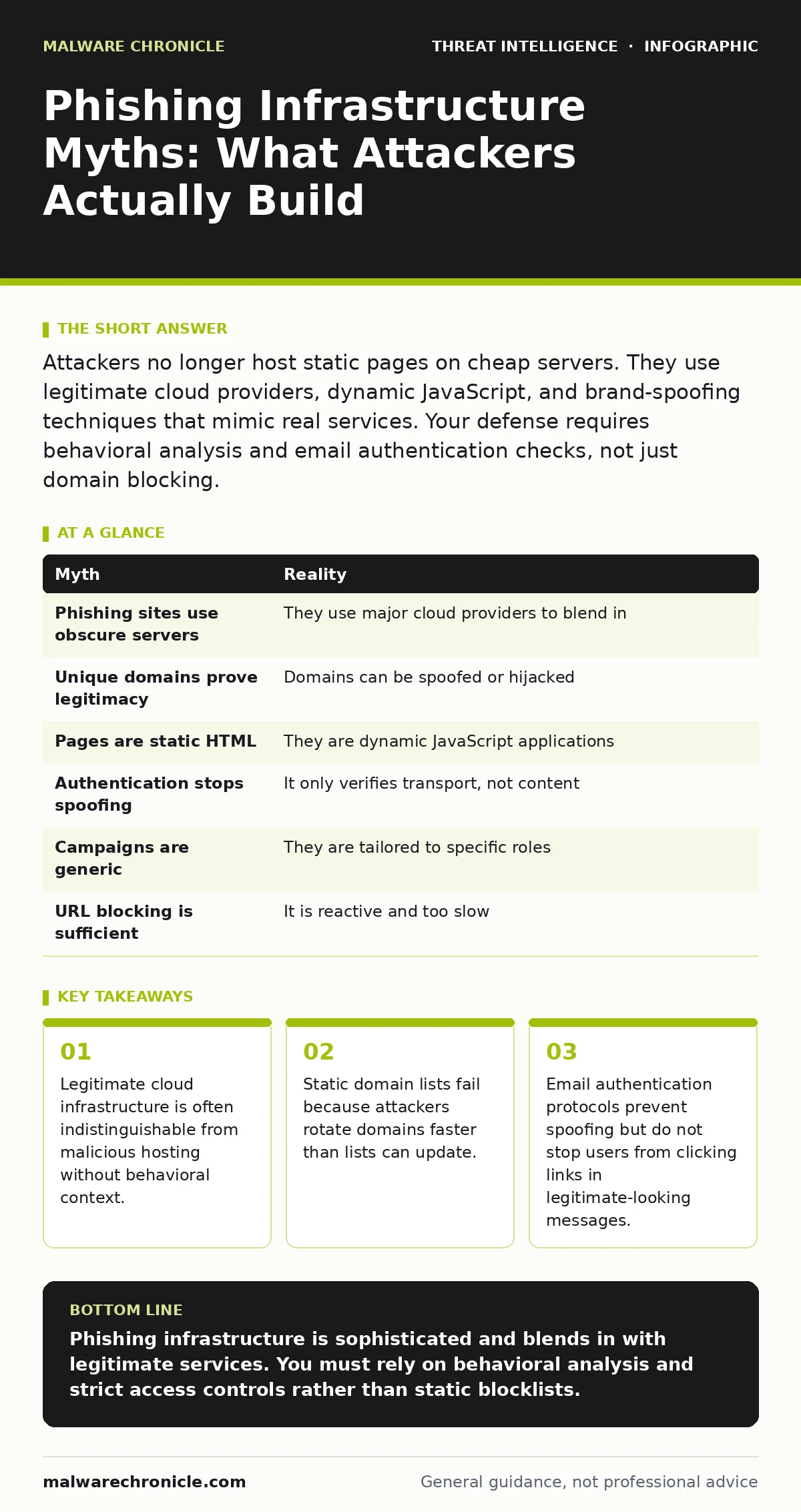
Attackers no longer host static pages on cheap servers. They use legitimate cloud providers, dynamic JavaScript, and brand-spoofing techniques that mimic real services. Your defense requires behavioral analysis and email authentication checks, not just domain blocking.
Myth: Phishing sites are hosted on obscure, low-reputation servers
Reality: Most modern phishing infrastructure runs on the same cloud platforms used by legitimate businesses. Attackers rent virtual machines or use serverless functions from major providers because these services offer high availability, global content delivery networks, and built-in HTTPS certificates. This means the hosting provider itself is not an indicator of malicious intent.
You might assume that a server with a poor reputation score is a phishing site. This is no longer reliable. Attackers rotate through thousands of clean instances, discarding them once they are flagged. The infrastructure is ephemeral and expensive to track.
Myth: A unique domain name proves a site is legitimate
Reality: Domain names can be purchased by anyone, including those impersonating your organization. Attackers register domains that look similar to yours, using subtle character swaps or different top-level domains. They may even acquire expired domains that previously hosted legitimate content to inherit trust signals.
You cannot trust a domain simply because it looks correct or has a history of valid usage. The domain registration data is often hidden behind privacy protectors. The visual similarity is the attack vector, not the domain's technical pedigree.
This relates to the challenges discussed in indicators of attack. Static indicators like domain names have a short half-life. Relying on them alone creates a gap where new threats operate freely before they are listed.
Myth: Phishing pages are static HTML files with fake forms
Reality: Modern phishing pages are complex web applications that load dynamically via JavaScript. They can fetch content from legitimate sources, mimic the exact layout of real services, and change their appearance based on the victim's location or device. Some even connect to real APIs to validate credentials in real-time.
You may think that inspecting the source code will reveal a simple form. The code is often obfuscated or loaded from multiple external sources. The page structure is generated on the fly, making it difficult to distinguish from the real service without executing the code in a safe environment.
This complexity is why YARA rules, which analyze static file signatures, are less effective against web-based threats. The malicious behavior is in the runtime execution, not the initial file structure.
Myth: Email authentication protocols stop all spoofing
Reality: Protocols like SPF, DKIM, and DMARC verify that an email originated from an authorized server. They do not verify the content of the message or the intent of the sender. An attacker can send a message from a legitimate domain if they have compromised that domain's email account or if the authentication records are misconfigured.
You might believe that a passing DMARC check means the email is safe. It only means the email was not forged at the transport level. The content can still be malicious, and the sender can be a legitimate employee whose account was taken over.
This distinction is critical when analyzing false positives in threat detection. A message that passes authentication but contains suspicious links should be treated as a potential compromise, not a benign error.
Myth: Phishing campaigns target everyone equally
Reality: Attackers often tailor their infrastructure to specific industries or roles. They may create landing pages that mimic internal tools, HR portals, or vendor login pages. The infrastructure is designed to blend in with the expected digital environment of the target.
You might assume that generic phishing attempts are the norm. While spray-and-pray attacks exist, the most dangerous campaigns use reconnaissance to build realistic scenarios. The infrastructure supports this by hosting multiple variants of the same page for different targets.
This targeting strategy reduces the noise in your security telemetry. When you see a login attempt from a known vendor domain, it is hard to distinguish from legitimate traffic. The context of the user's role becomes the primary indicator.
See also: Configuration Drift Mechanics: How Security Posture Decays Over Time
Myth: Blocking known malicious URLs is sufficient
Reality: URL blocklists are reactive and always lag behind new campaigns. Attackers use URL shorteners, redirect chains, and legitimate proxy services to hide the final destination. By the time a URL is added to a blocklist, the campaign may have already succeeded.
You might think that updating your firewall rules daily protects you. This approach fails against zero-day phishing sites. The lifespan of a phishing page can be minutes. Static blocking cannot keep pace with this velocity.
This is where behavioral analysis becomes necessary. Instead of blocking known bad URLs, you must detect suspicious patterns in how users interact with links. This aligns with the goals of Sigma rules, which define detection logic based on behavior rather than static indicators.
| Myth | Reality |
|---|---|
| Phishing sites use obscure servers | They use major cloud providers to blend in |
| Unique domains prove legitimacy | Domains can be spoofed or hijacked |
| Pages are static HTML | They are dynamic JavaScript applications |
| Authentication stops spoofing | It only verifies transport, not content |
| Campaigns are generic | They are tailored to specific roles |
| URL blocking is sufficient | It is reactive and too slow |
Myth: Users are the only weak link
Reality: While user education is helpful, it is not a control. Attackers design interfaces that bypass cognitive checks by mimicking familiar patterns. Even experienced users can be tricked by sophisticated infrastructure that passes all visual and technical checks.
You might believe that training users to spot typos is enough. Attackers have moved beyond simple typos. They use legitimate branding, correct grammar, and realistic scenarios. The infrastructure is designed to exploit trust, not just errors.
This shifts the responsibility to technical controls. You must implement multi-factor authentication and conditional access policies. These measures limit the damage even if a user clicks a malicious link.
Key takeaways
- Legitimate cloud infrastructure is often indistinguishable from malicious hosting without behavioral context.
- Static domain lists fail because attackers rotate domains faster than lists can update.
- Email authentication protocols prevent spoofing but do not stop users from clicking links in legitimate-looking messages.
Phishing infrastructure is sophisticated and blends in with legitimate services. You must rely on behavioral analysis and strict access controls rather than static blocklists.
Frequently asked questions
How do I detect phishing sites that use legitimate cloud providers?
Look for anomalies in traffic patterns, such as unusual geographic origins or rapid spikes in login attempts from new IP ranges.
Does DMARC protect against account takeover?
No, DMARC verifies the sender's domain authorization but does not prevent attackers from using compromised legitimate accounts.
Why are URL blocklists ineffective?
They are reactive and cannot keep pace with the rapid rotation of phishing domains and the use of redirect chains.
What is the role of multi-factor authentication in phishing defense?
It adds a second layer of verification that is difficult for attackers to bypass, even if they capture credentials.
How this guide was produced: written by the Malware Chronicle editorial team with AI assistance, checked against the public references listed below, and reviewed when the facts change. See our editorial policy or report an error.